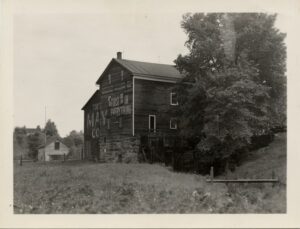
Fowlers Mill (originally Fowler’s Mills) developed around a group of mills built in the 1830s on the Chagrin River. Opportunities from these mills led to Fowlers Mill becoming the commercial center of Munson Township. From the 1830s into the twentieth century, the community expanded with construction of churches, a post office, township hall, stores, hotel, blacksmith shop, schools, and houses built in such styles as Federal, Greek Revival, Italianate, and Queen Anne. This type of community center was common in rural, nineteenth century America, but rarely survives with so much original fabric intact. On Mayfield Road, the Disciple Church was built in 1842. East of the church, the brick central school built in 1913 replaced earlier one-room schoolhouses. The gristmill is the only mill standing in Geauga County. The cemetery contains burials dating from the 1830s. The Fowler’s Mills Historic District was placed on the National Register of Historic Places in 2002.
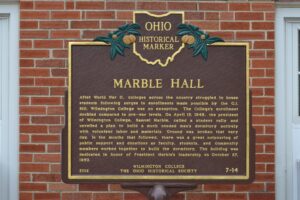
After World War II, colleges across the country struggled to house students following surges in enrollments made possible by the G.I. Bill. Wilmington College was no exception. The College’s enrollment doubled compared to pre-war levels. On April 13, 1948, the president of Wilmington College, Samuel Marble, called a student rally and unveiled a plan to build a much needed men’s dormitory entirely with volunteer labor and materials. Ground was broken that very day. In the months that followed, there was a great outpouring of public support and donations as faculty, students, and community members worked together to build the dormitory. The building was dedicated in honor of President Marble’s leadership on October 27, 1950.
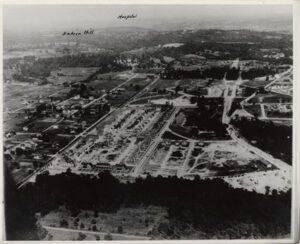
Ground was broken for Mariemont by Mary M. Emery, the village’s founder, on April 23, 1923. This planned community was designed by eminent town planner John Nolen and twenty-five of America’s leading architects. As part of the “garden city movement,” Mariemont was influenced by English models. Mariemont was incorporated July 12, 1941, and was listed on the National Register of Historic Places on July 24, 1979.
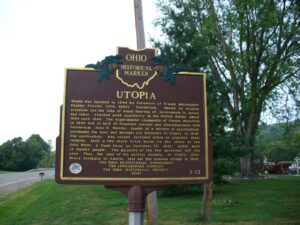
Utopia was founded in 1844 by followers of French philosopher Charles Fourier (1772-1837). Fourierism, based on utopian socialism and the idea of equal sharing of investments in money and labor, reached peak popularity in the United States about 1824 until 1846. The experimental community of Utopia dissolved in 1846 due to lack of financial success and disenchantment with Fourierism. John O. Wattles, leader of a society of spiritualists, purchased the land and brought his followers to Utopia in 1847. The spiritualists, who sought secluded areas to practice their religion, built a two-story brick house on the shore of the Ohio River. A flash flood on December 13, 1847, killed most of Wattles’ people. The majority of the few survivors left the area. Thus, the idea of the perfect society, or utopia, died. Henry Jernegan of Amelia, laid out the present village in 1847.
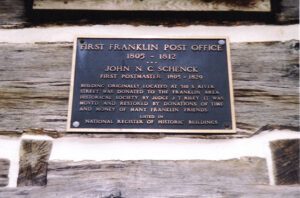
The oldest known structure standing in Franklin, the Old Log Post Office is a reminder of the links the community’s earliest members maintained to the rest of the young state of Ohio and to the United States during the early nineteenth century. John Noble Cumming Schenck, older brother of one of the founders of Franklin, William C. Schenck, established a store here in 1802. In 1805 President Thomas Jefferson appointed John Schenck postmaster of Franklin, a position he held until 1829. Schenck’s store is considered Franklin’s first post office and was one of the first four in Warren County. This building first stood at 310 South River Street and over the years was completely covered by additions and clapboards. They were removed in October 1974 and the house was moved to this location on December 6 of that year. In 1976 the structure was listed on the National Register of Historic Places.
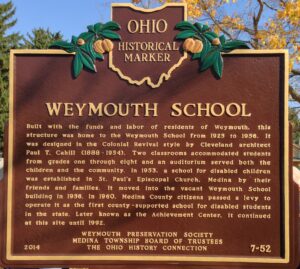
Built with the funds and labor of residents of Weymouth, this structure was home to the Weymouth School from 1925 to 1956. It was designed in the Colonial Revival style by Cleveland architect Paul T. Cahill (1888-1954). Two classrooms accommodated students from grades one through eight and an auditorium served both the children and the community. In 1953, a school for disabled children was established in St. Paul’s Episcopal Church, Medina by their friends and families. It moved into the vacant Weymouth School building in 1956. In 1960, Medina County citizens passed a levy to operate it as the first county-supported school for disabled students in the state. Later known as the Achievement Center, it continued at this site until 1992.
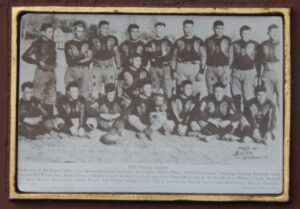
The Oorang Indian football team was founded by LaRue native Walter Lingo (1890-1966), owner of the Oorang Airedale Dog Kennels. The team, comprised of Native American Indians, played in the National Football League (NFL) in 1922-23. The star player and coach was Jim Thorpe (1887-1953), a Sac and Fox Indian. Thorpe gained international fame as a two-time gold medal winner (decathlon and pentathlon) in the 1912 Olympics and was acclaimed as the “World’s Greatest Athlete.” The team gave LaRue the distinction of being the smallest community ever to have an NFL franchise.
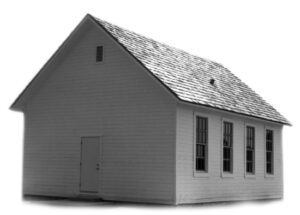
Descendants of slaves, who may have reached Ohio through the Underground Railroad, and other African Americans, formed the community of Flatwoods in the southwest part of Bokescreek Township. This one-room schoolhouse was built circa 1868 for African American children of Flatwoods and remained open until 1923. Remnants of past lessons remain inscribed on the chalkboard. The schoolhouse was threatened with demolition in 1999 and later moved to Veteran’s Park. The Logan County Historical Society owns and maintains the site as a living history museum.