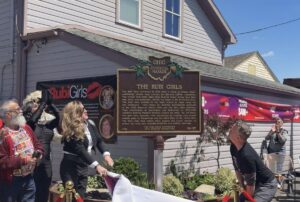
The Rubi Girls originated in 1984 when a group of friends began performing comedy drag routines for Dayton’s LGBTQ+ community. The troupe took their name from Rubicon Street where they first met, lived, and performed. During the height of the HIV/AIDS crisis, The Rubi Girls decided to use their talents to raise funds for the community. They began by donating performance proceeds to the Ohio AIDS Coalition and volunteering as performers and facilitators at the Ohio AIDS Coalition Healing Weekend Retreats. By the 1990s, The Rubi Girls expanded their fundraising efforts to include such annual benefit galas as Kweenz with Kause, Masquerage, and The Show Must Go On. For almost four decades, the Rubi Girls have shared their comedy while raising millions of dollars for local and regional HIV/AIDS and LGBTQ+ charities.
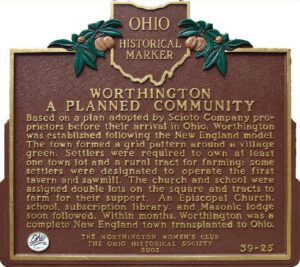
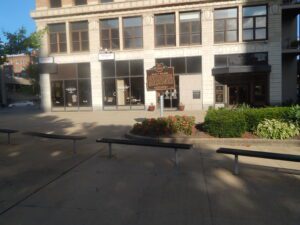
The Scioto Company, led by James Kilbourn (Kilbourne) of Granby and Berlin, Connecticut, founded Worthington in 1803, the year that Ohio became a state. The Scioto Company was organized as a land company in 1802 with 38 original proprietors from Connecticut and Massachusetts. They purchased 16,000 acres of land along the Olentangy River for $1.25 per acre. The name Worthington was adopted in honor of Thomas Worthington, Territorial Land Commissioner, United States Senator, and future Ohio governor. He advised Kilbourn on the location for the settlement and his name provided recognition for the community.
The figure atop the Soldiers’ Monument has looked over Youngstown’s Central Square since 1870. Ohio Governor David Tod began campaigning for a monument for Youngstown’s fallen soldiers even before the Civil War ended. The community raised $15,000, and the cornerstone was laid in 1868. The memorial was completed and dedicated on July 4, 1870, with Governor Rutherford B. Hayes and Congressman James A. Garfield, both future U.S. presidents, attending the ceremony. Four cannons procured by Garfield formerly surrounded the monument. In 1951 the figure on the pedestal was accidentally damaged. A new statue of Carrara marble was commissioned, sculpted in Italy, and installed in 1955. The Bertolini Bros., a local marble firm, donated the new figure, which as patterned after the original, as their gift to the city.
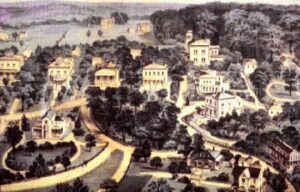
Established in 1851 after the addition of the Cincinnati, Hamilton, and Dayton Railway, Glendale incorporated in 1855 as Ohio’s first planned community and one of the nation’s first planned villages. The original planning included forested greenbelts and parks, curvilinear streets meandering around established trees, large lots, and superior building standards. Glendale is designated as a National Historic Landmark community from the Department of Interior and a Certified Local Government through the Ohio Historic Preservation Office, all owed to Glendale’s persistent adherence to the plan and faithful preservation of original infrastructure. Much of today’s preserved infrastructure includes the original 59 pivotal buildings, curvilinear streets, tree canopy, stone gutters, gas streetlights, and railroad depot.
Fout Hall was one of three original buildings on the Bonebrake Theological Seminary campus. Constructed 1920-1923, it was named for Dr. J. E. Fout, who managed campus construction. Bonebrake Seminary was founded in 1871 by Dayton’s United Brethren in Christ Church and became co-educational in 1873. Generous cash and land gifts (1909-1911) enabled the construction of a new campus. Fout Hall, the administration building, and a powerhouse were designed by Dayton architect Frederick J. Hughes in the Jacobethan Revival style. The three-story buff-brick dormitory was the largest of the buildings and cost $250,000. As well as dining hall, laundry, and storage facilities, it featured 12 single rooms, 54 two-room suites, and 6 three-room suites. Fout Hall was an integral part of the National Register listing of the Dayton View Triangle Historic District in 2022.
Approximately 700′ south of Albany Street on S Edwin C Moses Blvd
Dayton
, OH
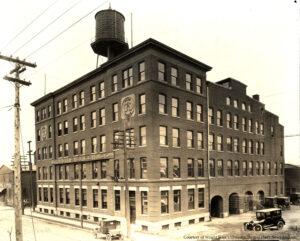
Green & Green Company invented the Cheez-It in the 1920s. John Green and his son Weston founded their company in 1897 to produce a hard cracker recipe created by Dr. William Wolf of Dayton. Originally based in Chicago, the Greens moved production to their hometown two years later, opening a small factory above downtown Dayton’s Victory Theater. In 1907, Green & Green built a new bakery on the corner of Cincinnati and Concord streets in the Edgemont neighborhood. As their “Wolf” or “Dayton” cracker grew in popularity, Green & Green added the flakier line of “Edgemont” Crackers, which included the Cheez-It. In 1921, Weston Green applied for a trademark patent on the name “Cheez-It,” and the popular snack was born. (Continued on other side)
The ARK in Berea is the first structure in Cuyahoga County to incorporate sustainable building concepts from the Earth Summit in Rio de Janeiro in 1992. Hand built in 1994 as a work of art by environmental artists David and Renate Jakupca, it is a study for future buildings for the Headquarters of the International Center for Environmental Arts (ICEA) and Eco Village. A hybrid structure utilizing cob, straw bales, aluminum cans, used tires, and recycled construction materials, the ARK (Architektur Recycled Kulturstall) helps to address the environmental problems of large urban areas and the trend of rebuilding rather than remodeling existing structures. The ARK is used as a museum, community center, and art studio of David Jakupca.
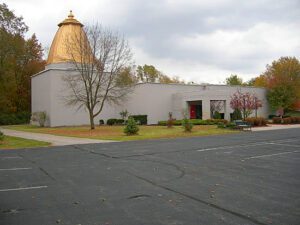
The Hindu Temple of Toledo was established in 1981 for the growing Hindu and Jain communities in northwest Ohio. Religious functions were initially held in a house located on a 15-acre property purchased in 1983. The Temple, designed in a Hindu-American style, was dedicated in August 1989. In 2000, the Temple underwent an expansion of 6000 square feet to the Heritage Hall area. Deities, Ganesh, Krishna, Radha, Vishnu, Laxmi, Rama, Sita, and Mahavir, are housed in the Temple. The holy structure is a living legacy of peaceful co-existence among religions and cultures.