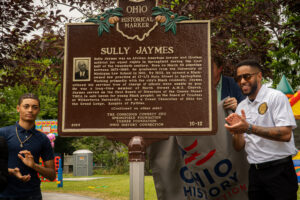
Sully Jaymes was an African American lawyer and tireless activist for equal rights in Springfield during the first half of the twentieth century. Born on March 30 sometime between 1875-1880, he graduated from the University of Michigan Law School in 1901. By 1903, he opened a Black-owned law practice at 17-1/2 Main Street in Springfield. Working primarily with the city’s Black residents, Jaymes offered his services free of charge if clients were unable to pay. He was a long-time member of North Street A.M.E. Church. Jaymes served on the first Board of Directors of the Center Street YMCA (a safe-haven for young Black people), on the Board of Trustees at Wilberforce University, and as a Grand Chancellor of Ohio for the Grand Lodge, Knights of Pythias. (Continued on other side)
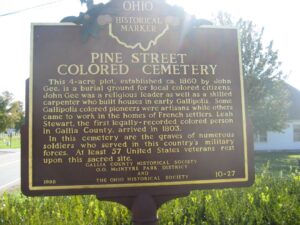
This 4-acre plot, established ca. 1860 by John Gee, is a burial ground for local colored citizens. John Gee was a religious leader as well as a skilled carpenter who built houses in early Gallipolis. Some Gallipolis colored pioneers were artisans while others came to work in the homes of French settlers. Leah Stewart, the first legally-recorded colored person in Gallia County, arrived in 1803. In this cemetery are the graves of numerous soldiers who served in this country’s military forces. At least 57 United States veterans rest upon this sacred site.
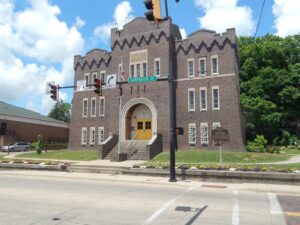
In the first years of the twentieth century, Athens’ citizens formed a new National Guard company. The guardsmen initially held drill at the Campbell Block on Court Street, but soon the Athens Commercial Club began advocating for an armory from the Ohio National Guard. In 1912, the Armory Board approved the request. Plans were drawn up for the armory and the Guard purchased land from the Athens Brick Company at the foot of Shale Hill. Construction began in the spring of 1915 and the Armory opened in December. In March of 1917, the city held a dedication ceremony and parade. Before World War I, the Athens Armory housed Company L and the Machine Gun Company, both part of the 7th Infantry Regiment, Ohio National Guard. (Continued on other side)
corner of South Michigan Avenue and East Indiana Street
Edgerton
, OH
Edgerton was settled beside the St. Joseph River when the Lake Shore & Michigan Southern railroad was completed in 1854. The village was incorporated on December 4, 1865, and named for Alfred P. Edgerton, who donated the land for the park. He was an agent for Hicks & Company, a land speculation business. The firm of Von Behren & Shaffer built the town hall and opera house in 1884 for $7,998. The building and park became a hub of local activity. The park’s bandstand showcased the Edgerton Village Band and citizens gathered for picnics and festivities. (Continued on other side)
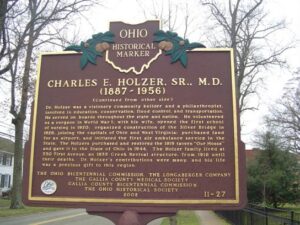
Dr. Charles Elmer Holzer came to Gallipolis in 1909, as a resident surgeon at the Ohio Hospital for Epileptics. Recognizing the need for a community hospital, he returned in May 1910, after completing his training. With a local loan, he opened a seven-bed hospital. In 1913, he furthered his training in surgery, closing the hospital temporarily to study in Europe. He returned to Gallipolis in 1914, married nurse Alma Vomholt and resumed his practice. In 1916, he began construction on the First Avenue Holzer Hospital, the first general hospital in southeast Ohio. In 1949, the Holzers gave the growing hospital to the citizens of the five county area, to be administered by the Holzer Hospital Foundation. After outgrowing its downtown location, Holzer Medical Center opened on Jackson Pike in 1972 with 269 beds. (continued on other side)
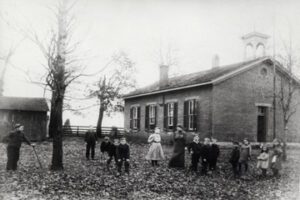
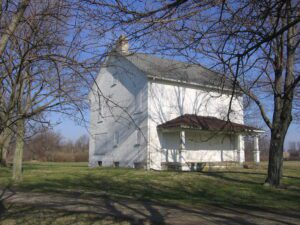
In 1854, Samuel and Rebecca McClellan Collins deeded 1.28 acres to Beavercreek Township, Greene County, for the purpose of building a schoolhouse. The first two schoolhouses were constructed of stone with fireplaces for heat. Collins neighborhood children in first through eighth grade were educated in the present red brick building until 1944, when decreased enrollment forced Xenia Township to close the school. Virgil and Helen Bryson Brantley, great-granddaughter of Samuel and Rebecca Collins, purchased the school property in 1982 and began the restoration of the vandalized and deteriorated schoolhouse. The pony/coal shed and privies were rebuilt on their foundations. (Continued on other side)
Edmund Munger was born in 1763 in Norfolk, Connecticut, and later moved to Vermont. In 1799, his wife Eunice Kellogg and five children traveled by wagon and flat-bottomed boat to claim land in Washington Township. A blacksmith by trade and a farmer, Munger was deeply interested in community affairs. In 1804, he was elected a Montgomery County Commissioner and four years later to Ohio’s Seventh General Assembly. From 1809 to 1826, he served as Clerk of Washington Township. His militia men elected him a Brigadier General in 1809 to take command of the Second Brigade, First Division of the Ohio Militia. During the War of 1812, Governor Return J. Meigs instructed Munger to defend the frontier within his command. His quick action protected settlers and kept vital supply routes open. General Munger died at his farm here in 1850 and is buried next to his wife in the Old Centerville Cemetery.
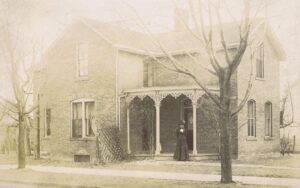
Generations of the Barker family lived in the house that stood at 89 Wood Street from 1875 to 1973. George W. Barker (1836-1913) was born enslaved in Virginia, emancipated age 13, and settled in Mansfield by 1870. He worked as a well-known chef in downtown hotels. In December 1873, Barker married Dayton-native Harriet J. Hurley (1840-1925). The next April, he purchased a corner plot in Snyder’s Subdivision for $450. Completed by 1875, his original brick house sheltered Barker, his wife, and his mother-in-law, Eliza Hurley (1815-1885). The Barker’s children — Sumner (1875-1890) and Sarah Daisy (1877-1973) — were born there. The Barker family were one of Mansfield’s historic Black families and members of the First Congregational Church. Their house once included a decorative wooden porch, numerous outbuildings, and served as an important community gathering place.