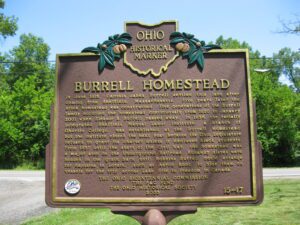
In June 1815, Captain Jabez Burrell settled this land after coming from Sheffield, Massachusetts. Five years later the brick homestead was constructed. Five generations of the Burrell family occupied the homestead continuously from 1820 to January 2001 when Eleanor B. Burrell passed away. In 1836, the racially integrated Sheffield Manual Labor Institute, a branch of Oberlin College, was established at the Burrell Homestead, but the Institute closed the next year because the Ohio Legislature refused to grant its charter unless it excluded black students. From 1837 until the start of the Civil War, the homestead was a major stop on the Underground Railroad. Runaway slaves were hidden in the grain barn until Robbins Burrell could arrange for captains in Lorain, such as Aaron Root, to hide them on vessels for the trip across Lake Erie to freedom in Canada.
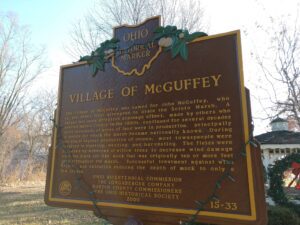
The Village of McGuffey was named for John McGuffey, who in the 1860s first attempted to drain the Scioto Marsh. A larger and more effective drainage effort, made by others who entered Hardin County in the 1880s, continued for several decades until thousands of acres of land were in production, principally of onions for which the marsh became nationally known. During the era of highest production of onions, most townspeople were involved in planting, weeding, and harvesting. The fields were bordered by windrows of willow trees to decrease wind damage over the black silt-like muck that was originally ten or more feet deep throughout the marsh. Successful treatment against wind erosion and oxidation reduced the depth of muck to only a few inches.
Ebenezer Sheldon (1754-1825) was born in Suffield, Connecticut. On April 19, 1775, he answered the “Lexington Alarm,” fought in the Revolution, and, in 1789, was appointed a captain in Connecticut’s militia. Following the Revolution, Sheldon, like many others, suffered financial hardships and sought a new beginning in the Western Reserve. In 1799, he established a homestead in Aurora and returned to Connecticut the following year to bring his wife Lovee and their six children to the area. A family legend relates that when Lovee saw the family’s home she “shed a few tears over the cheerless prospects” of her new life in the wilderness.
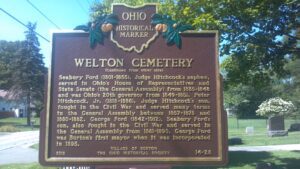
Welton Cemetery was known as Roselawn Cemetery until the early 1900s. Early settlers to the Burton area donated the land. Welton Cemetery is the burial place for veterans of the nation’s wars and for several state officials. Judge Peter Hitchcock (1781-1853) served in the War of 1812. From 1810-1852, he was elected to both houses of Ohio’s General Assembly and one term in the U.S. House of Representatives and served on the state’s Supreme Court. He was Chief Justice from 1831-1833 and 1849-1851. In 1850, he was a member of Ohio’s constitutional convention. (Continued on other side)
Following the Civil War, many of Ohio’s disabled and wounded veterans found inadequate provisions for their long-term needs. In response, the Grand Army of the Republic’s Department of Ohio lobbied for a state-operated veterans’ home. In 1886 Governor Joseph B. Foraker signed a bill establishing the Ohio Soldiers’ and Sailors’ Home for honorably discharged veterans. A board of trustees led by Sandusky publisher I.F. Mack selected the site, and the Sandusky community donated the tract of land, utilities, and a connection to the Baltimore and Ohio Railroad. The facility opened in November 1888. (continued on other side)
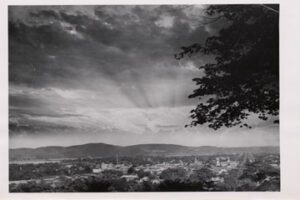
The hills before you were inspiration for the design of The Great Seal of the State of Ohio. The seal, first depicted in 1803, was often reconfigured until the present image was sanctioned by the Ohio General Assembly in 1967 and modified in 1996. In 1803 the law prescribed the sheaf of wheat to represent Ohio’s agricultural roots and the bundle of seventeen arrows to symbolize Ohio’s place as the seventeenth state in the Union. In the background is a range of hills, including Mount Logan, as viewed from Thomas Worthington’s estate, Adena, now a state memorial. (continued from other side)
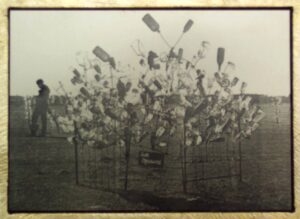
A direct descendent of original settlers in Jackson Township, Winter Zellar (Zero) Swartsel was born in 1876. Throughout his life he was a natural born showman, teacher, eccentric, anarchist, and “possibly the grandfather of American Pop Culture.” At a young age and tired of the routines of Farmersville, he declared that, “He would live by his wits while his brothers lived by the sweat of their brows.” He and a friend bicycled first to New York City and then turned around to head west and eventually the world. Later his home would overflow with items collected while traveling the world. Outside was a similar story. While chiding the American people for their wastefulness and abusing their environment, his 22 acres of farmland became his artist’s canvas filled with the thousands of items he collected from the “wasteful.” [continued on other side]
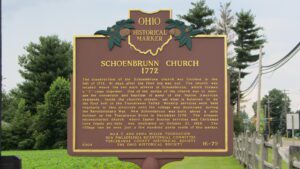
In December 1772, Brother David Zeisberger and his followers began the construction of Schoenbrunn schoolhouse. The school was built in the Tuscarawas Valley on land given to Zeisberger in the spring of 1771 by the Delaware Native Americans as a Moravian mission to the Delaware. With the land, Zeisberger laid out the town of Schoenbrunn or “Beautiful Spring.” The school served Delaware Indian children, who were taught from special textbooks prepared in the Delaware and German languages by Zeisberger. John Heckewelder, who taught at the school, is recognized as the first schoolteacher in Tuscarawas County. The present reconstructed schoolhouse was dedicated on July 29, 1928 on the 155th anniversary of the completion of the school’s construction. The village can be seen just a few hundred yards south of this marker.