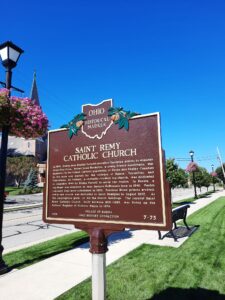
In 1839, Bishop John Baptist Purcell recruited European priests to minister to his Ohio flock. Father Louis Navarron, a young French missionary, was appointed to the French Catholic population of Darke and Shelby Counties in the area now marked by the villages of Russia, Versailles, and Frenchtown. St. Valbert, a centrally-located log church, was dedicated in December 1840 by Bishop Purcell to serve the region. In Russia, a log chapel was dedicated on Jean Jacques DeBrosse’s farm in 1846. Parish boundary lines were established in 1850, Precious Blood priests arrived, and a new church was dedicated to Saint Remigius in August 1852. As the congregation grew, so did the church buildings. The current Saint Remy Catholic Church, built between 1891-1892, was listed on the National Register of Historic Places in 1979.
Richard E. Schreder grew up in Toledo, Ohio and graduated from the University of Toledo with a degree in Mechanical Engineering. He was a decorated navy pilot and iconic aviation figure who helped shape the American soaring movement, international glider design, and competitive soaring and piloting flight strategies. He also made high performance gliders available to a wide audience through the affordable kit production of his distinctive HP (High Performance) glider designs. These designs and Schreder’s numerous contributions to aviation and the sport of soaring are recognized as “groundbreaking and pioneering” by the Smithsonian Museum and are part of the Smithsonian National Air & Space Museum’s permanent collection. (continued on other side)
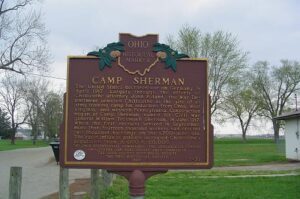
The United States declared war on Germany in April 1917. Largely through the efforts of Chillicothe attorney John Poland, the War Department selected Chillicothe as the site of an army training camp for inductees from Ohio, West Virginia, and western Pennsylvania. Construction began at Camp Sherman, named for Civil War general William Tecumseh Sherman, in June 1917. When the first recruits arrived in September, more than fourteen thousand workers had erected two thousand buildings on the 1,700-acre site. The rapid influx of soldiers increased Chillicothe’s population from 16,000 to 60,000.
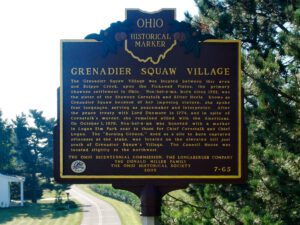
The Grenadier Squaw Village was located between this area and Scippo Creek, upon the Pickaway Plains, the primary Shawnee settlement in Ohio. Non-hel-e-ma, born circa 1722, was the sister of the Shawnee Cornstalk and Silver Heels. Known as Grenadier Squaw because of her imposing stature, she spoke four languages, serving as peacemaker and interpreter. After the peace treaty with Lord Dunmore in 1774, and in spite of Cornstalk’s murder, she remained allied with the Americans. On October 1, 1978, Non-hel-e-ma was honored with a marker in Logan Elm Park near to those for Chief Cornstalk and Chief Logan. The “Burning Ground,” used as a site to burn captured prisoners at the stake, was located on the elevated hill just south of Grenadier Squaw’s Village. The Council House was located slightly to the northwest.
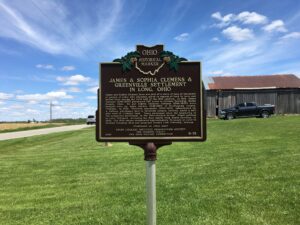
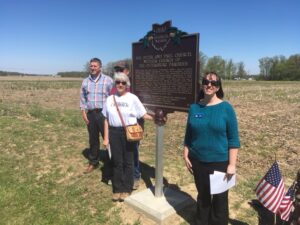
James and Sophia Clemens’ lives are part of a story of tens of thousands of people of color who migrated north in search of land to farm and better lives during the first half of the 19th century. In 1818, James Clemens (1781-1870) purchased 387 acres in German Township, Darke County, Ohio. He and Sophia (Sellers) Clemens (1786-1875) were brought here by Adam Sellers (1742-1821) of Rockingham County, Virginia. In 1822, Thornton Alexander (1783-1851), emancipated by A. Sellers, purchased land in Randolph County, Indiana, about a half mile west of Clemens’ land. These purchases were the beginning of the Greenville Settlement on the Ohio-Indiana border. Other settlers of color followed, including the Bass family from North Carolina, in 1828. The 1830 census enumerated approximately 78 people of color in German Township Ohio and adjacent Green’s Fork Township, Indiana. (Continued on other side)
Saints Peter and Paul Church, Petersburg (1835), was the mother church for St. Joseph, Wapakoneta; St. John the Evangelist, Fryburg; St. Lawrence, Rhine; and Our Lady of the Immaculate Conception, Botkins. All were founded by German-Catholic immigrants to west-central Ohio. After the removal of the Wapakoneta Shawnee in 1832, the land became available for purchase. The 1830s and ’40s saw a wave of devout German settlers who wished to practice their faith in their new home, a desire served by missionary priests such as Father Wilhelm Horstman. Father Horstman first visited the settlement at Petersburg on May 8, 1835, presiding at Mass, baptizing, and blessing a marriage. In April 1836, immigrants John and Anna Mary Ruppert sold 40 acres of land in Pusheta Township to the trustees of the Catholic Church and a log church was built at the Petersburg site. (Continued on other side
Archibald Worthington (1818-1895) was a freed slave from Virginia, a Civil War veteran, and prominent landowner in Highland Township. Census records indicate he was manumitted prior to 1850, and by 1860 owned land in northwest Ohio. Worthington also farmed, boarded freed slaves, and owned apple orchards and livestock. April 1866 township records show that he supported the local school for Black families. He and his wife Elizabeth raised three children: Henry, Mathilda, and James. Henry enlisted in the Massachusetts 54th Volunteer infantry, one of the first Black regiments formed in the Civil War. He died January 8, 1865, in a prison camp and is buried in North Carolina’s Salisbury National Cemetery. Mathilda and James both met partners and married, had children, and left the area. Archibald Worthington died in 1895 and is buried in Wilmington’s Sugar Grove Cemetery.
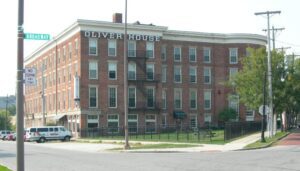
Overlooking the “Middlegrounds,” an early site of railroad, immigration, and commercial activity, the Oliver House opened in 1859 as Toledo’s premier hotel. It was designed by nationally prominent architect Isaiah Rogers, in the Greek Revival style, and built by the family of William Oliver for whom the hotel was named; owner of this land, Oliver was one of Toledo’s earliest real estate investors. (Continued on other side)