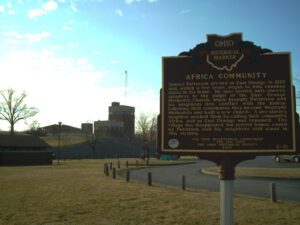
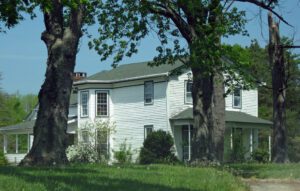
Samuel Patterson arrived in East Orange in 1824 and, within a few years, began to hide runaway slaves in his home. He also invited anti-slavery speakers to the pulpit of the East Orange Methodist Church, which brought Patterson and his neighbors into conflict with the bishop. Following their consciences, they became Wesleyan Methodists and built a new church. A pro-slavery neighbor mocked them by calling their community Africa, and so East Orange was renamed. The village has disappeared, but several homes owned by Patterson and his neighbors still stand in this vicinity.
Betsey Mix Cowles dedicated her life to fighting slavery and improving the status of women. Her desire for a formal education led her to Oberlin College, where she completed two years of study in 1840. An advocate of immediate abolition, Cowles lectured on the moral depravity of slavery, opened her home, at this site, to fugitive slaves. Opposed to expansion of slavery into the West, Cowles protested the Mexican War. Cowles served as president of Ohio’s first women’s rights convention (in Salem) in 1850, and the following year wrote a treatise on equal pay for working urban women. She served as the first dean of women at Grand River Institute, and later became one of the first women public school superintendents in Ohio.
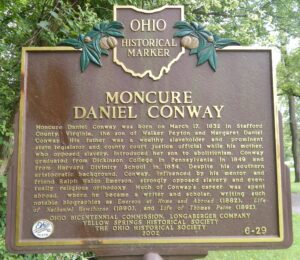
Moncure Daniel Conway was born on March 17, 1832 in Stafford County, Virginia, the son of Walker Peyton and Margaret Daniel Conway. His father was a wealthy slaveholder and prominent state legislator and county court justice official while his mother, who opposed slavery, introduced her son to abolitionism. Conway graduated from Dickinson College in Pennsylvania in 1849 and from Harvard Divinity School in 1854. Despite his southern aristocratic background, Conway, influenced by his mentor and friend Ralph Waldo Emerson, strongly opposed slavery and eventually religious orthodoxy. Much of Conway’s career was spent abroad, where he became a writer and scholar, writing such notable biographies as Emerson at Home and Abroad (1882), Life of Nathaniel Hawthorne (1890), and Life of Thomas Paine (1892).
Congregations of the Religious Society of Friends (Quakers), called “meetings”, worshiped in plain meeting houses. On this site stood the last Richland Friends Meeting House, built in 1872. Ninety-four Friends established the meeting in 1826 and it endured for 147 years. The cemetery is where many generations of members of this meeting are buried. The faith, based on pacifism and simplicity, blossomed in the region during the first half of the 19th century. (Continued on other side)
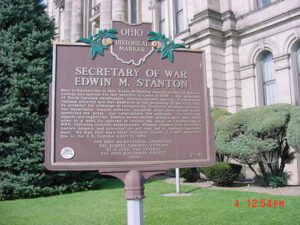
Born in Steubenville in 1814, Edwin McMasters Stanton studied at Kenyon College and opened his law practice in Cadiz in 1836. The grandson of North Carolina slaveholders, Stanton opposed slavery. A successful railroad attorney and War Democrat at the beginning of the Civil War, he accepted the challenge of reorganizing President Abraham Lincoln’s War Department. Stanton enforced unpopular draft laws, fought draft, restricted the press, and nationalized the railroads. An effective planner and logistician, Stanton moved 20,000 soldiers more than 1,200 miles in a week by railroad to relieve the siege of Chattanooga in 1863. Following Lincoln’s assassination, Stanton clashed with President Andrew Johnson and provoked the act that led to Johnson’s impeachment. He died four days after President Ulysses S. Grant appointed him to the U.S. Supreme Court in 1869.
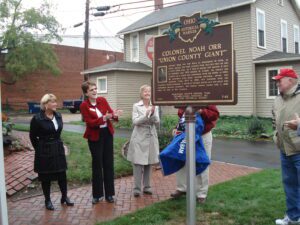
Cyprian Lee (1792-1854) settled in the Union County wilderness in 1820 and purchased the 118 West Sixth Street lot in 1828 for $6. County treasurer, coroner, shoemaker, and anti-slavery activist, Lee lived here in a log cabin until 1832 when this Greek Revival two-story brick house was completed. Other notable citizens to have resided in this oldest brick house in Marysville were showman Noah Orr (1836-1882), also known as the “Union County Giant,” and Josiah Jacob Morelock (1833-1899), a member of the Marysville City Council and the first Fire Department in Marysville. The Morelock family tannery business and stables were located behind this house.
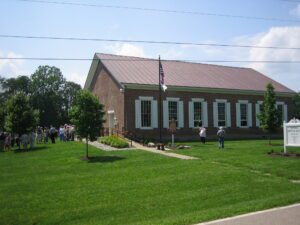
The Hopewell Associate Reformed Church and Cemetery, now known as Historic Hopewell, was founded in 1808 in a log building that was replaced in 1826 with the present building. It was built by the area’s first settlers, mainly Scotch-Irish who left Kentucky and South Carolina because of their opposition to slavery. The church encouraged worship by African Americans and played an important role in the Underground Railroad. It became the parent church for four “Daughter” Presbyterian congregations: Fairhaven in 1835, Oxford in 1837, College Corner in 1849, and Morning Sun in 1876. Reverend Alexander Porter, the first pastor, was committed to education and constructed a school near the Hopewell Spring that still produces clear water. “Old Hopewell” was completely refurbished in 1880, but by 1915 the membership declined and regular services discontinued. Today Hopewell holds Sunday services in the summer and is maintained by a generous and devoted group of volunteers.
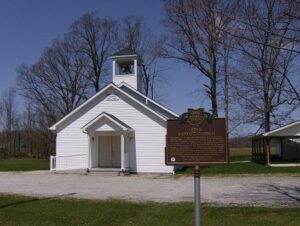
Thirteen African American families migrated to Pebble Township in Pike County in the early 1820s from Virginia. Some of the families were former slaves while others were freeborn people of color. Their farm knowledge and skill helped to make them prosperous, angering some of their white neighbors who began a campaign of harassment. Ten of the original African American settlers eventually moved away, but despite the difficulties with the white population, other African Americans continued to arrive to the settlement. They founded a church, later known as the Eden Baptist Church, built a meeting hall, and organized a school. Several of the families were also involved in the activity of the Underground Railroad. The PP Settlement thrived until the 1950s when, for economic reasons, residents moved to other communities.