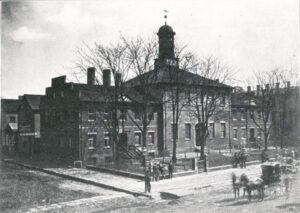
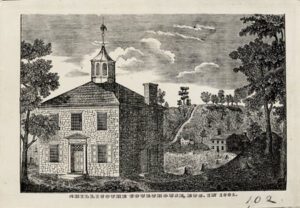
In 1809 the citizens of Zanesville erected a building on this site which served as the capitol of Ohio from October 1, 1810, until May 1, 1812. The 9th and 10th sessions of the Ohio General Assembly met here before returning to Chillicothe in May 1812. The building was then used as the Muskingum County Courthouse until the present courthouse was built in 1874. The 1809 date stone from the old building was incorporated into the new building and may be seen over the front steps.
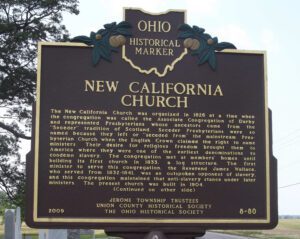
The New California Church was organized in 1826 at a time when the congregation was called the Associate Congregation of Darby and represented Presbyterians whose ancestors came from the “Seceder” tradition of Scotland. Seceder Presbyterians were so named because they left or “seceded from” the mainstream Presbyterian Church when the English Crown claimed the right to name ministers. Their desire for religious freedom brought them to America where they were one of the earliest denominations to condemn slavery. The congregation met at members’ homes until building its first church in 1833, a log structure. The first minister to serve this congregation, the Reverend James Wallace, who served from 1832-1841, was an outspoken opponent of slavery, and this congregation maintained that anti-slavery stance under later ministers. The present church was built in 1904. (continued on other side)
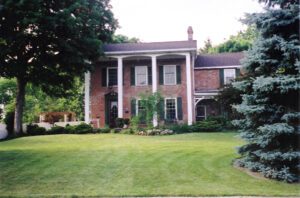
Jonathan Wright (1782-1855) and his wife Mary Bateman Wright (1787-1866) moved with their five children from Menallen, Adams County, Pennsylvania, in 1814 and built this Federal style house. Using skills acquired from his father, Joel Wright, a surveyor who platted the city of Columbus, Jonathan platted the village of “Springborough,” named for the many springs in the vicinity. The Wright family established and operated a woolen factory, two flour mills, a general store, and a 320-acre farm in the Springboro area. The Wrights were active members of the Society of Friends (Quakers) and strongly opposed slavery. The house was a station on the Underground Railroad, offering assistance to runaway slaves during their flight to freedom. Many members of the Wright family, including Jonathan, Mary, and four of their children, are buried in the Friends Cemetery on nearby Factory Road.
The first Northwest Territory assembly formally met in Cincinnati in September 1799 to initiate self-government. The legislators were deeply divided politically. The Republicans (antifederalists or “Jeffersonians”), led by Thomas Worthington and Edward Tiffin of Chillicothe, opposed the appointed government headed by the Federalist governor, Arthur St. Clair. They saw it as arbitrary and autocratic and recognized that change could occur only with statehood. To deter the movement, the St. Clair faction in 1801 divided the territory and removed the capital from Chillicothe to Cincinnati. Their actions triggered a violent confrontation led by the antifederalist Michael Baldwin who incited the local rabble-rousers, known as “the Bloodhounds,” to riot in the streets of Chillicothe. Both political unrest and advancing settlement accelerated the Chillicothe faction’s campaign for Ohio statehood.
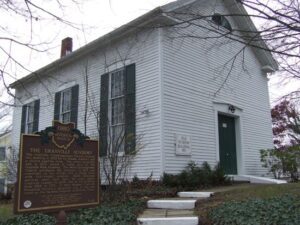
The Granville Congregational Church erected this building in 1833 for its Female Academy and a church meeting room. The school prospered and, in 1837, moved to make way for the Granville Male Academy. The Welsh Congregational Church purchased the structure in 1863 and converted its two stories into a single room with full-height windows. Welsh language services were held here for sixty years. Granville Grange #2230 met in the building from 1923 to 1973. It then became Granville Historical Society’s property and, in 1981, was listed on the National Register of Historic Places.
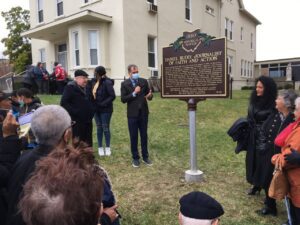
Daniel Arthur Rudd was born into slavery on August 7, 1854, in Bardstown, Kentucky. He became a newspaperman, lecturer, publicist, and tireless advocate for the Roman Catholic Church. After the Civil War Rudd moved to Springfield. Baptized and raised in Catholicism, he joined St. Raphael Parish, where the philosophy of racial equality offered by the church solidified his vision of justice. By 1885 he had established his own weekly newspaper, The Ohio State Tribune. He rebranded it The American Catholic Tribune (ACT) after moving to Cincinnati. Rudd claimed ACT was the only Catholic newspaper owned by an African American. At the height of its popularity in 1892, the publication had a circulation of 10,000. In 1893 Rudd was asked to chair the Afro-American Press Association, representing more than 200 black-owned newspapers.
3201-3537 Burlington-Macedonia Road, Lawrence County Road 120
South Point
, OH
Macedonia Cemetery (circa 1840) belongs to Macedonia Church, Ohio’s first Black Church. Those buried include settlers of the Macedonia Free Black Settlement, built by free people who assisted freedom seekers along the Underground Railroad. Also interred are soldiers of the Civil War’s United States Colored Troops (USCT), most of whom served in the 5th Regiment, Ohio’s first Black Regiment (1863). The Polley family also rest here. Emancipated slaves, the family continued their freedom struggle when their children were kidnapped from Ohio and unlawfully sold into slavery. Macedonia’s extant burial grounds include this sacred site and another 1/2 mile north.
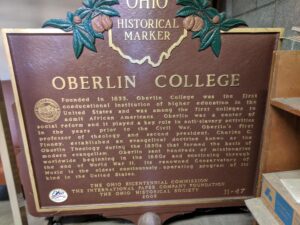
Founded in 1833, Oberlin College was the first coeducational institution of higher education in the United States and was among the first colleges to admit African Americans. Oberlin was a center of social reform and it played a key role in anti-slavery activities in the years prior to the Civil War. Oberlin’s first professor of theology and second president, Charles G. Finney, established an evangelical doctrine known as the Oberlin Theology during the 1850s that formed the basis of modern evangelism. Oberlin sent hundreds of missionaries worldwide beginning in the 1880s and continuing through the end of World War II. Its renowned Conservatory of Music is the oldest continuously operating program of its kind in the United States.