

, OH
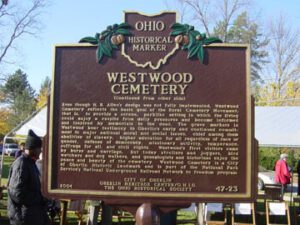
Shortly after Oberlin Colony was established in 1833, a two-acre burying ground was set aside south of Plum Creek in the area bounded by Main, Morgan, and Professor streets. By 1861, however, with the town and Oberlin College growing and the Civil War escalating, the need for a larger cemetery became clear. After an extensive search, 27.5 acres of land belonging to Henry Safford were acquired one mile west of the center of Oberlin. H.B. Allen was hired to create a design in the style of the Rural Cemetery Movement, and in July 1864 Westwood Cemetery was formally dedicated. Burials in Westwood had actually begun in August 1863, and over the next few years hundreds of remains were reinterred from Oberlin’s “Old Cemetery” and from burying grounds in surrounding communities. In the mid-1860s the cemetery was enlarged to its present 47 acres, and in 2004 burials and memorials were estimated to number almost ten thousand. (Continued on other side)
, OH
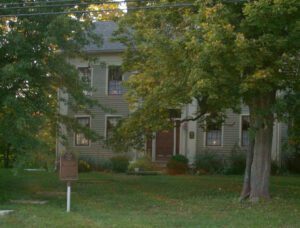
Built in 1819, this classic Greek Revival style colonial is attributed to the works of master builder and architect Jonathon Goldsmith. Goldsmith is known for his simple, yet elegant craftsmanship and architectural designs, especially the unique front doorways that are signatures of his creations. The house reveals original detailed woodwork and a functional floor plan. It was constructed for Uri Seeley, one of the earliest settlers of Lake County. Seeley and his family were dedicated to the anti-slavery movement and used this residence as a stop for travelers on the Underground Railroad. The property was listed on the National Register of Historic Places in 1973.
, OH
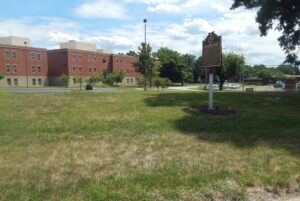
After the outbreak of the Civil War in the spring of 1861, the U.S. War Department commissioned Ohio Senator B.F. Wade of Jefferson and local Congressman John Hutchins of Warren to supervise the Union Army’s recruiting service in Northeastern Ohio. Recruitment rolls were to be filled in summer so training could be conducted during the fall. The Oak Grove Fairgrounds in Warren, home of the Trumbull County Agricultural Society, was one of the sites selected for the training. This camp was named Camp Hutchins in Congressman Hutchins’ honor. John Hutchins, an attorney by profession, had served as Trumbull County Clerk of Courts and had been assocaited with future Ohio governors David Tod (1862-1864) and Jacob Cox (1866-1868), in their law firms. An ardent anti-slavery man and Underground Railroad agent, Hutchins served in the U.S. Congress from 1859 to 1863.
, OH
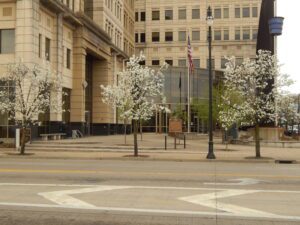
Abraham Lincoln spoke from the rear of a Cincinnati, Hamilton & Dayton Railroad passenger train on Saturday, September 17, 1859, to about 1000 people at South Fourth and Ludlow streets (about 785 feet south of here). Lincoln, elected president of the United States a year later, made five Ohio speeches, considered an extension of his 1858 debates with Stephen A. Douglas while they competed for a U.S. Senate seat from Illinois. After Douglas defeated Lincoln, he toured Ohio supporting 1859 Democratic candidates. The Republican response was to ask Lincoln to do the same for his party. He spoke twice in Columbus on September 16, and in Dayton, Hamilton, and Cincinnati the next day. Later, Republicans swept the 1859 elections, selecting William Dennison Jr., an 1835 Miami University graduate, as governor and winning majorities in the legislature. When Lincoln became president, he appointed Dennison postmaster general in 1864. [Continued on other side]
, OH
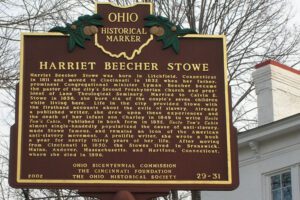
Harriet Beecher Stowe was born in Litchfield Connecticut in 1811 and moved to Cincinnati in 1832 when her father, prominent Congregational minister Lyman Beecher became the pastor of the city’s Second Presbyterian Church and president of Lane Theological Seminary. Married to Calvin E. Stowe in 1836, she bore six of the couple’s seven children while living here. Life in the city provided Stowe with the firsthand accounts about the evils of slavery. Already a published writer, she drew upon these experiences and the death of her infant son Charley in 1849 to write Uncle Tom’s Cabin. Published in book form in 1852, Uncle Tom’s Cabin almost single-handedly popularized the cause of anti-slavery, made Stowe famous, and remains an icon of the American anti-slavery movement. A prolific writer, she wrote a book a year for nearly thirty years of her life. After moving from Cincinnati in 1850, the Stowes lived in Brunswick, Maine, Andover, Massachusetts, and Hartford, Connecticut, where she died in 1896.
, OH
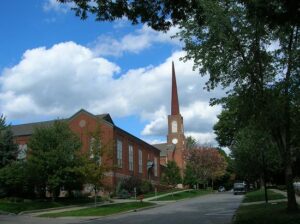
On this site, the first meetinghouse owned by the Hudson Congregational Church was dedicated March 1, 1820, twenty-one years after David Hudson first came to the Hudson area. Its members met here until they completed their sanctuary on Aurora Street in 1865. In August 1835, church members unanimously adopted a resolution declaring that slavery is”a direct violation of the law of Almighty God.” At a November 1837 prayer meeting, church member and anti-slavery leader John Brown made his first public vow to destroy slavery.
, OH
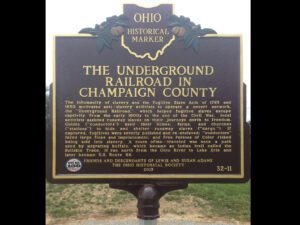
The inhumanity of slavery and the Fugitive Slave Acts of 1793 and 1850 motivated anti-slavery activists to operate a covert network, the “Underground Railroad,” which helped fugitive slaves escape captivity. From the early 1800s to the end of the Civil War, local activists assisted runaway slaves on their journeys north to freedom. Guides (“conductors”) used their homes, farms, and churches (“stations”) to hide and shelter runaway slaves (“cargo.”) If captured, fugitives were severely punished and re-enslaved; “conductors” faced large fines and imprisonment, and Free Persons of Color risked being sold into slavery. A route often-traveled was once a path used by migrating buffalo, which became an Indian trail called the Bullskin Trace. It ran north from the Ohio River to Lake Erie and later became U.S. Route 68.
, OH
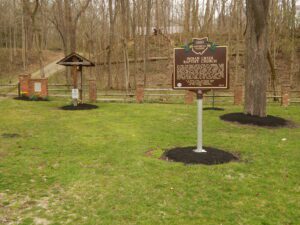
The Indian Creek Regular Baptist Church was established in 1810 as an arm of the Little Cedar Creek Church of Brookville, Indiana. The congregation purchased three acres of land for a burial ground and church and built a log structure here in 1811. Members voted in 1812 that they would receive no person who believed in the principles of slavery. By 1829, membership had reached 150 and the present brick meeting house was built. In the 1840s, membership declined due to conflict over mission activity The congregation dissolved in 1879 and the land was deeded to the Indian Creek Cemetery Association in 1880. The county park system received the property in 1960 through and with the cooperation of the Butler County Historical Society and the Cemetery Association.