

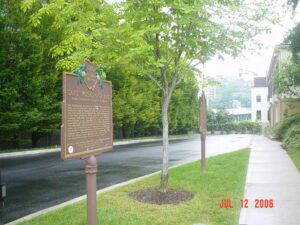
, OH
The first African American artist to achieve international acclaim, painter Robert S. Duncanson (1821-1872) was born in New York and settled in Cincinnati in 1840. He pursued his artistic career during a time of tremendous racial prejudice and was acknowledged as the “best landscape painter in the West.” Arts patron Nicholas Longworth commissioned murals from Duncanson around 1850 for his home Belmont, now the Taft Museum of Art; these paintings are regarded as one of the finest pre-Civil War domestic decoration schemes in the United States. Sponsored by anti-slavery groups, he traveled widely during the 1860s in Europe. Duncanson rose above oppression to create expressions of African American cultural identity, leading the way for other people of color to pursue careers in the arts.
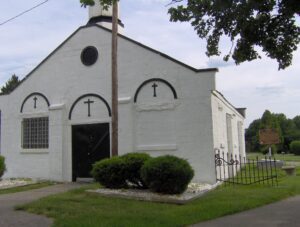
, OH
Born in Richmond, Virginia, Powhatan Beaty moved to Cincinnati in 1849, where he spent the majority of his life. Beaty enlisted as a private in the Union Army in June 1863, and two days later was promoted to first sergeant, Company G, 5th United States Colored Troops (USCT). All the officers of Company G were killed or wounded during an attack on Confederate forces at New Market Heights, Virginia, in September 1864. Beaty took command of his company, and for his valor received the Congressional Medal of Honor. Beaty was one of two African-Americans buried in Ohio to receive the Medal of Honor for service in the Civil War. He died on December 6, 1916, leaving two sons, attorney and state representative A. Lee Beaty and John W. Beaty. He is buried in Union Baptist Cemetery along with nearly 150 USCT veterans.
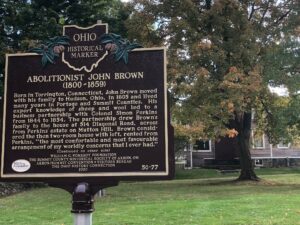
, OH
Born in Torrington, Connecticut, John Brown moved with his family to Hudson, Ohio, in 1805 and lived many years in Portage and Summit Counties. His expert knowledge of sheep and wool led to a business partnership with Colonel Simon Perkins from 1844 to 1854. The partnership drew Brown’s family to the house at 514 Diagonal Road, across from Perkins’ estate on Mutton Hill. Brown considered the then two-room house with loft, rented from Perkins, “the most comfortable and most favourable arrangement of my worldly concerns that I ever had.” (Continued on other side)
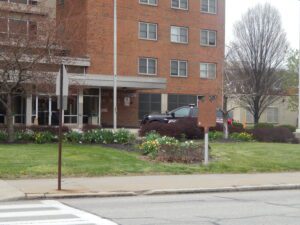
, OH
John Malvin (1795-1880) was an operative on the Underground Railroad and an ardent member of anti-slavery and abolitionist causes. Born in Dumfries, Virginia of a free mother and enslaved father, Malvin was apprenticed at an early age to learn carpentry and taught himself to read and write. In 1827, he moved to Cincinnati where he became an ordained preacher and an activist in the cause of freedom. In 1831, with his wife Harriet, he moved to Cleveland where he became a charter member of the First Baptist Church, a sawmill operator, and captain and owner of the canal boat Auburn. (continued on other side)
, OH
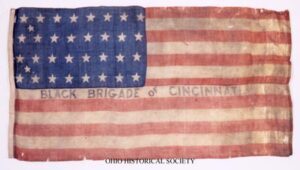
Following the success of Confederate forces in eastern Kentucky and General John Hunt Morgan’s raids there in 1862, Cincinnatians believed that Southern invasion was imminent. Anxious officials ordered Cincinnati citizens to form home guards, but black men willing to volunteer were rebuffed when they attempted to join a defense force. Instead, police serving as provost guards rounded up many and marched them by bayonet to build fortifications in Kentucky. Reacting to the shameful treatment of the blacks eager to support the Union, the commander of the Department of Ohio dispatched Major General Lewis Wallace to command the civilians and to liberate black men forced into service. (continued on other side)
, OH
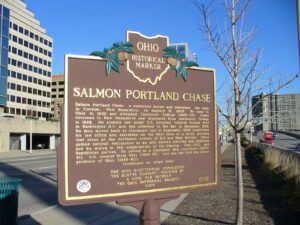
Salmon Portland Chase, a renowned lawyer and statesman, was born in Cornish, New Hampshire, on January 13, 1808. He came to Ohio in 1820 and attended Cincinnati College (1822-23). Chase returned to New Hampshire and graduated from Dartmouth College in 1826. He studied law under U.S. Attorney General William Wirt in Washington D.C. and was admitted to the bar in December 1829. He then moved back to Cincinnati and in September 1830 established his law office and residence on the first floor of a brick building that stood at the northeast corner of 3rd and Main Streets. Chase gained national recognition as an anti-slavery attorney and politician and by aiding in the organization of the Liberty, Free-Soil, and Republican parties. He served as a Cincinnati city councilman (1840-41), U.S. senator from Ohio (1849-55), and was the first Republican governor of Ohio (1856-60). (continued on other side)
, OH
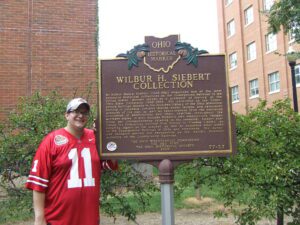
Dr. Wilbur Henry Siebert (1866-1961) organized one of the most extensive historical collections on the Underground Railroad in the United States. Siebert served as a professor of history at the Ohio State University, 1893-1935. His collection on the Underground Railroad, housed in the Archives/Library of the Ohio Historical Society in Columbus, contains diaries, books, letters, and newspaper accounts of the day, as well as reminiscences from the dwindling population of abolitionists and their families throughout the northern states. It also includes Siebert’s own manuscripts, images, notes, and correspondence relating to his research. Siebert published The Underground Railroad from Slavery to Freedom (1898), an enduring classic on the subject, as well as numerous other books on the Underground Railroad in Ohio and elsewhere. His extensive research earned him recognition as the world’s foremost authority on the Underground Railroad.
, OH
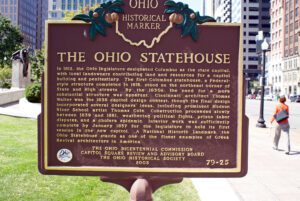
In 1812, the Ohio legislature designated Columbus as the state capital, with local landowners contributing land and resources for a capitol building and penitentiary. The first Columbus statehouse, a Federal-style structure completed in 1816, stood on the northeast corner of State and High streets. By the 1830s, the need for a more substantial structure was apparent. Cincinnati architect Thomas Walter won the 1838 capitol design contest, though the final design incorporated several designers’ ideas, including prominent Hudson River School artist Thomas Cole. Construction proceeded slowly between 1839 and 1861, weathering political fights, prison labor disputes, and a cholera epidemic. Interior work was sufficiently complete by January 1857 for the legislature to hold its first session in the new capitol. A National Historic Landmark, the Ohio Statehouse stands as one of the finest examples of Greek Revival architecture in America.