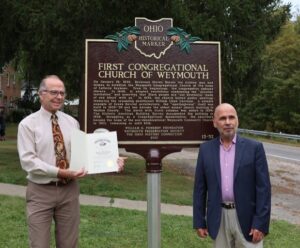
On January 19, 1835, Reverend Steven Barnes led sixteen men and women to establish the Weymouth Congregational Church at the home of Lathrop Seymour. From its beginnings, the congregation opposed slavery. In 1848, it adopted resolutions condemning the “peculiar institution” and asserting that Black people are “our brother[s] ‘made one blood’ with us.” In 1853, the church hosted public meetings featuring the crusading abolitionist William Lloyd Garrison. A notable example of Greek Revival architecture, the “meetinghouse” itself was built in 1835-’36 and has become the oldest extant church building in Medina County. The porch with Doric columns was added in 1854. The Historical American Building Survey documented the building in 1936. Struggling as a Congregational denomination, the sactuary became the home of the non-denominational Weymouth Community Church in 1920, remaining so until 2018.
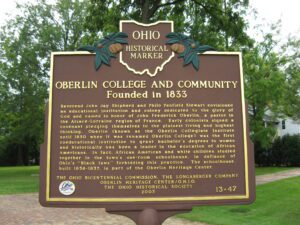
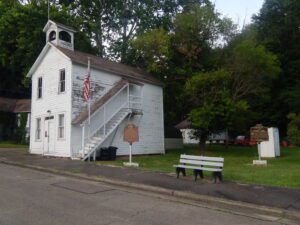
Reverend John Jay Shipherd and Philo Penfield Stewart envisioned an educational institution and colony dedicated to the glory of God and named in honor of John Frederick Oberlin, a pastor in the Alsace-Lorraine region of France. Early colonists signed a covenant pledging themselves to the plainest living and highest thinking. Oberlin (known as the Oberlin Collegiate Institute until 1850 when it was renamed Oberlin College) was the first coeducational institution to grant bachelor’s degrees to women and historically has been a leader in the education of African Americans. In fact, African American and white children studied together in the town’s one-room schoolhouse, in defiance of Ohio’s “Black laws” forbidding this practice. The schoolhouse, built 1836-1837, is part of the Oberlin Heritage Center.
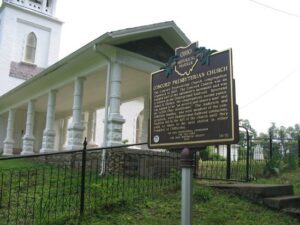
The Concord Presbyterian Church congregation organized in 1805. The Concord Church was an integral part of the antislavery movement and was a station on the Underground Railroad. Reverend James H. Dickey, the congregation’s second pastor, was known to be “an avowed anti-slavery man” and an “active Ohio abolitionist.” The Anderson and Galbraith families, who were members of the congregation, were Underground Railroad conductors. Fugitives hid in the loft of the church until they could be taken to the next station in either Frankfort or Chillicothe.
“I say white brother, because I believe that to be the proper phrase, inasmuch as I believe in the principle of the fatherhood of God and the brotherhood of all mankind no matter what the color of his skin may be.” Richard L. Davis championed the cause of racial equality throughout the eastern coalfields, calling for an end to the color line and for all miners to unite against wage slavery. He was born in Roanoke County, Virginia in 1862 and arrived in racially integrated Rendville in 1882, where he became an organizer for the Knights of Labor. In 1886, a year after the Great Hocking Valley Strike, Davis wrote his first letters to the editor of the National Labor Tribune, establishing himself as voice for miners in the labor movement. (Continued on other side)
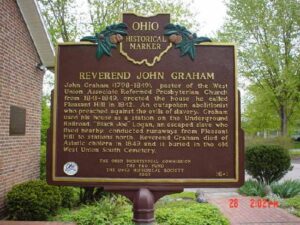
John Graham (1798-1849), pastor of the West Union Associate Reformed Presbyterian Church from 1841-1849, erected the house he called Pleasant Hill in 1842. An outspoken abolitionist who preached against the evils of slavery, Graham used his house as a station on the Underground Railroad. “Black Joe” Logan, an escaped slave who lived nearby, conducted runaways from Pleasant Hill to stations north. Reverend Graham died of Asiatic cholera in 1849 and is buried in the old West Union South Cemetery.
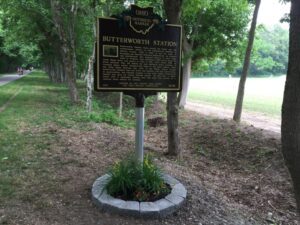
Butterworth Station (seen across the field) was the southernmost station on the Underground Railroad in Warren County. Built in 1820, it was the home of Benjamin and Rachael Moorman Butterworth. As Quakers and abolitionists who opposed slavery in their home state of Virginia, they purchased 1,500 acres along the Little Miami River and moved to Ohio in 1812. Until nearly 1850, at great personal risk, the family fed and sheltered large numbers of runaway slaves before transporting them to the next station. When the Little Miami Railroad was built in the 1840s, Henry Thomas Butterworth donated land and water and assisted with the construction. In appreciation, the railroad created a stop here called Butterworth Station and gave his family lifetime passes. On this site, a water tower with a passenger waiting area was built that served as a railroad water station for decades.
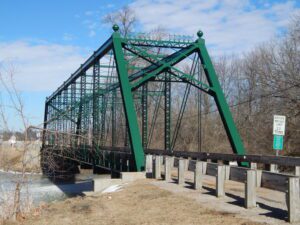
The Bridgeport Iron Bridge, often called the Streng Road Iron Bridge, was built in 1914. It replaced a wooden covered bridge built in 1869 by Reuben L. Partridge (1823-1900) and Isaac J. Grummons (1828-1921), which was damaged by the flood of 1913. The 200′ steel superstructure uses a pin-connected Pratt Through truss design and was constructed by the Central Concrete & Construction Company, Canton, Ohio, at a cost of $8,987. The original substructure abutments were constructed by John A. Maugans (1861-1933) for $3,248, but have since been replaced. In 1992 and 1993, the bridge was renovated under the leadership of County Engineer Steve A. Stolte and Assistant Engineer Jeff Stauch.
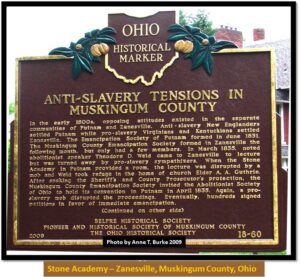
In the early 1800s, opposing attitudes existed in the separate communities of Putnam and Zanesville. Anti-slavery New Englanders settled Putnam while pro-slavery Virginians and Kentuckians settled Zanesville. The Emancipation Society of Putnam formed in June 1831. The Muskingum County Emancipation Society formed in Zanesville the following month, but only had a few members. In March 1835, noted abolitionist speaker Theodore D. Weld came to Zanesville to lecture but was turned away by pro-slavery sympathizers. When the Stone Academy in Putnam provided a room, the lecture was disrupted by a mob and Weld took refuge in the home of church Elder A.A. Guthrie. After seeking the Sheriff’s and County Prosecutor’s protection, the Muskingum County Emancipation Society invited the Abolitionist Society of Ohio to hold its convention in Putnam in April 1835. Again, a pro-slavery mob disrupted the proceedings. Eventually, hundreds signed petitions in favor of immediate emancipation. [continued on other side]