

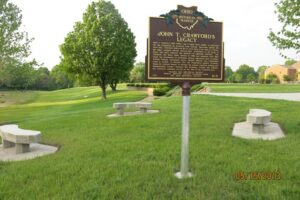
, OH
John T. Crawford (1813-1880), was a white Union soldier. In gratitude for the kindnesses he received from African-Americans during the Civil War, Crawford willed his 18 1/2-acre farm to be used as a “home, for aged, indigent worthy colored men, preference to be given to those who have suffered the miseries of American Slavery.” The Crawford Old Men’s Home opened in 1888 and operated until 1964 under the trusteeship of prominent African-Americans such as lawyer William Parham, newspaper editor Wendell Dabney, and Ambassador Jesse D. Locker. It merged with the Progressive Benefit Society’s Home for Colored Women to become the Lincoln Crawford Nursing and Rehabilitation Center. Pleasant Hill Academy, College Hill Library, and Crawford Commons are all on the site of the Crawford farm.
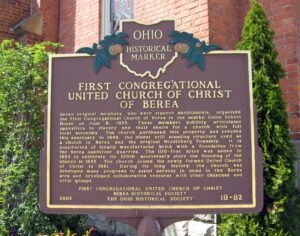
, OH
Seven original members, who were staunch abolitionists, organized the First Congregational Church of Berea in the nearby Union School House on June 9, 1855. These members publicly articulated opposition to slavery and their desire for a church with full local autonomy. The church purchased this property and erected this sanctuary in 1869, the oldest still standing structure used as a church in Berea and the original Middleburg Township. It is constructed of locally manufactured brick with a foundation from the Berea sandstone quarries. The 100-foot spire was added in 1954 to celebrate its 100th anniversary since the founding of the church in 1855. The church joined the newly formed United Church of Christ in 1961. During its long history, the church has developed many programs to assist persons in need in the Berea area and developed collaborative ventures with other churches and civic groups.
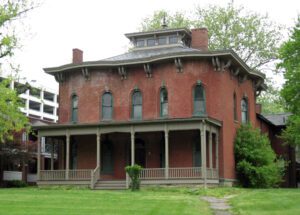
, OH
The Cozad-Bates House is one of the oldest remaining structures in Cleveland’s University Circle. The original section, built circa 1853, is the only pre-Civil War residential structure left in the neighborhood. Built by Samuel and Jane Cozad’s son, Andrew Cozad, the first section used locally made brick to form a simple two-story, one-room-deep, vernacular English-I house. The family owned a large portion of the land which is now occupied by University Circle. Justus Cozad, Andrew’s son, returning from the west where he worked as a railroad superintendent and civil engineer, built the later section on Mayfield Road for his larger family in 1872. It is a rare surviving example of Italianate-influenced residential architecture, including a hipped roof, curved bay windows, paired eave brackets, and prominent belvedere. The house was listed on the National Register of Historic Places in 1974 and designated as a Cleveland Landmark in 2006.
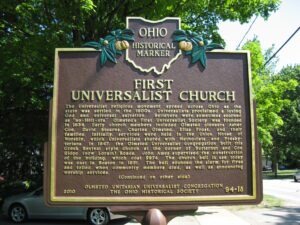
, OH
The Universalist religious movement spread across Ohio as the state was settled in the 1800s. Universalists proclaimed a loving God and universal salvation. Believers were sometimes scorned as “no-Hell-ers.” Olmsted’s First Universalist Society was founded in 1834. Early church members included Olmsted pioneers Asher Coe, David Stearns, Charles Olmsted, Elias Frost, and their families. Initially, services were held in the Union House of Worship, which Universalists shared with Methodists and Presbyterians. In 1847, the Olmsted Universalist congregation built this Greek Revival style church at the corner of Butternut and Coe Ridge (now Lorain) Roads. John Ames supervised the construction of the building, which cost $974. The church bell in use today was cast in Boston in 1851. The bell sounded the alarm for fires and tolled when community members died, as well as announcing worship services.
, OH
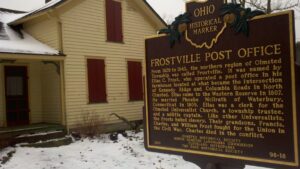
The North Olmsted Historical Society was founded in 1953 and became incorporated as a non-profit association in 1961. A year later, Frostville Museum opened in the Prechtel House. The society took on the challenge of preserving the history of the entire original township and became the Olmsted Historical Society in 1969. The Frostville Museum has grown from one house to a small village. Volunteers are dedicated to preserving the past and the present for the future. In August 2010, First Lady Michelle Obama designated the society as a Preserve America Steward. Frostville is an affiliate of the Cleveland Metroparks.
, OH
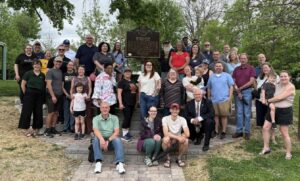
Miranda Boulden Parker lived at 2644 Marsh Avenue from 1907 to 1915. She moved into the four-family rental home with her daughters Bianca and Portia, who both worked as teachers. Miranda Parker was the widow of John P. Parker, Ripley’s Underground Railroad hero, born into slavery who famously helped more than 400 fugitives escape to freedom. In March 1914, after several vacant apartments in their Marsh Avenue home were repeatedly vandalized, daughter Bianca assumed the role as building caretaker. When she appealed to the police for help against vandals breaking windowpanes, shutters, and transoms, the police made no effort to arrest the offenders. Instead, the Health Department issued a 24-hour eviction notice. Bianca Parker sued Norwood’s Health Officer and Chief of Police unsuccessfully. The Parker family left Norwood for the more welcoming and integrated Madisonville neighborhood.
Miranda Boulden Parker lived in a home on this site from 1907(1) to 1915(2). She was the widow of Underground Railroad hero John P. Parker, who had been born into slavery. They lived in Ripley, Ohio, where John P. Parker helped more than 400 fugitives escape to freedom.(3) After his death in 1900, Miranda and their daughters Bianca and Portia, both teachers, came to Norwood. Here they rented an apartment in a four-family dwelling where Bianca became the caretaker.(4) From 1913-‘14, vandals broke over 63 windowpanes, shutters, and transoms. Bianca appealed to the police for help. Instead, the police notified the Health Department, who gave the Parkers a 24-hour eviction notice. The Parkers moved out of Norwood after unsuccessfully suing the city. (123 words)
City of Norwood, Ohio
Norwood Historical Society
The Ohio History Connection
This park was established by the City of Norwood in 1923(5) for the purpose of preventing Black Americans from owning homes here.(6) From 1907(7) to 1922(8), a four-family house on this site was rented by Black families.(9) George and Sarah Hirst lived in one of those units. On July 5, 1922, the Hirsts purchased a vacant lot next door(10) to the four-family dwelling and hired a Black contractor to build them a home.(11) White neighbors, fearing that a “Negro colony” might be developing, petitioned(12) Norwood City Council to take action.(13)(14) The Council used the right of eminent domain to seize the vacant lot from George and Sarah Hirst.(15) The Council also seized several other adjacent lots and demolished the four-family dwelling, creating Marsh Park.(16) (125 words)
City of Norwood, Ohio
Norwood Historical Society
The Ohio History Connection
, OH
Pleasant Litchford was born into slavery in Virginia in 1789. He purchased his freedom and moved his family to Ohio by 1831. A master blacksmith, Litchford bought a small farm four miles north of Columbus in 1833. By the time of his death in 1879, he was the fourth largest landowner in Perry Township. Described as “a man of iron constitution,” Litchford served as a lay-preacher, founding member, and deacon at Second Baptist Church. The church and James Poindexter, its pastor in 1847, provided an important voice during the anti-slavery movement. In 1869, Litchford sold, for $1, a parcel of land to establish a school for African American children. He was married three times and was survived by seven living children, twenty-five grandchildren, and three great-grandchildren. Pleasant Litchford was buried in the Litchford Family Cemetery.
, OH
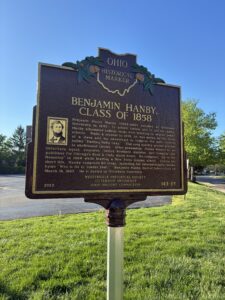
Benjamin Russel Hanby (1833-1867) enrolled at Otterbein University in 1849. To afford tuition and to aid his family, Hanby alternated college terms with teaching in nearby public schools. While a student in 1856, he was moved by the story of a slave and his sweetheart to compose the anti-slavery ballad “Darling Nelly Gray.” The song quickly proved popular in abolitionist circles. After graduation, Hanby worked as an Otterbein agent, educator, United Brethren minister, and compiler and publisher for Chicago’s Root & Cady music house. He composed “Up on the Housetop” in 1864 while leading a New Paris singing school. During his short life, Hanby composed 80 songs, including the internationally-known hymn “Who is He in Yonder Stall.” Benjamin Hanby died of tuberculosis on March 16, 1867. He is buried in Otterbein Cemetery.