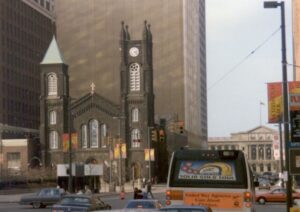
Religious worship began on this site in 1820 as a Plan of the Union Sunday School with ministers recruited by the Connecticut Home Missionary Society. Its first stone church, officially known as the First Presbyterian Church of Cleveland, was built and dedicated on February 26, 1834, but as the congregation grew, a second stone church was constructed and finished on August 12, 1855. Built of Berea Sandstone, it stands now as the oldest building on Public Square. Ravaged by fires in 1857 and 1884, the church was rebuilt according to the original plans, and the 1884 interior restored by East Coast architect, Charles W. Schweinfurth. From 1965 to 1983, the chapel served as the worship center for the Cleveland Chinese Christian Church.
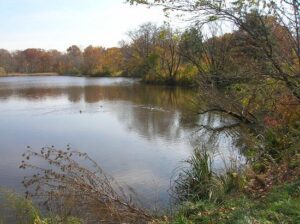
In 1822, Ralph Russell, a Connecticut pioneer who had settled in Warrensville Township ten years earlier, founded the North Union Shaker Community. The Shakers created Horseshoe Lake in 1852 when they built a dam across Doan Brook and harnessed its waterpower to operate a woolen mill near Lee Road and South Park Boulevard. The community disbanded in 1889; its 1,366 acres were eventually sold to a real estate syndicate from Buffalo, New York, the Shaker Heights Land Company. In 1896, this group deeded the Shaker Lakes Parklands to the City of Cleveland to preserve the green space in perpetuity. Ten years later, the Van Sweringen Company began to develop Shaker Heights Village as a Garden City suburb where William J. Van Aken served as mayor from 1915 until 1950. In the 1960s local residents successfully fought the proposed Clark Freeway, saving Horseshoe Lake and the Parklands from destruction.
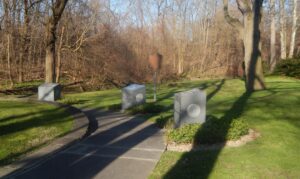
In 1962, Asian Indian students of Case Western Reserve University started India Association of Cleveland (IAC). In 1967, IAC started a newspaper “LOTUS,” regarded as the first such Asian Indian community newspapers in the United States. In 1978, IAC started a community center to be owned and managed by a new organization: India Community Center (ICC), the first such facility established by Asian Indians in Ohio. In 1980, IAC and ICC merged and formed the Federation of India Community Associations (FICA). Other associations representing the various states and interests in India became Federation members.
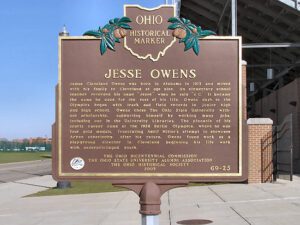
James Cleveland Owens was born in Alabama in 1913 and moved with his family to Cleveland at age nine. An elementary school teacher recorded his name “Jesse” when he said “J.C.” It became the name he used for the rest of his life. Owens’ dash to the Olympics began with track and field records in junior high and high school. Owens chose The Ohio State University without scholarship, supporting himself by working many jobs, including one in the University Libraries. The pinnacle of his sports career came at the 1936 Berlin Olympics, where he won four gold medals, frustrating Adolf Hitler’s attempt to showcase Aryan superiority. After his return, Owens found work as a playground director in Cleveland beginning his life work with underprivileged youth.
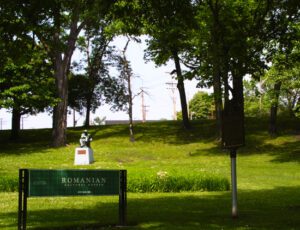
The Union and League of Romanian Societies, Incorporated was formed in 1928 from a unification of two separate fraternal organizations, the Union and the League. The Union, founded on July 4, 1906, was originally organized for the purpose of promoting the general welfare of its members through life insurance policies obtained through individual societies located in the United States and Canada. The societies of the Union and League offer social interaction within their local lodges and through the strength of the larger parent organization. The purpose of the current Union and League is to maintain and encourage Romanian cultural heritage by promoting interest in Romanian ethnic values through cultural activities and to sustain loyalty to the United States and Canada among its respective members.
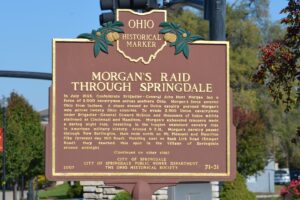
In July 1863, Confederate Brigadier-General John Hunt Morgan led a force of 2,000 cavalrymen across southern Ohio. Morgan’s force entered Ohio from Indiana. A chase ensued as Union cavalry pursued Morgan’s men across twenty Ohio counties. To evade 2,500 Union cavalrymen under Brigadier-General Edward Hobson and thousands of Union militia stationed at Cincinnati and Hamilton, Morgan’s exhausted troopers made a daring night ride, resulting in the longest sustained cavalry ride in American military history. Around 9 P.M., Morgan’s cavalry passed through New Burlington, then rode north on Mt. Pleasant and Hamilton Pike (present day Mill Road). Heading east on Bank Lick Road (Kemper Road), they reached this spot in the Village of Springdale around midnight. (Continued on other side)
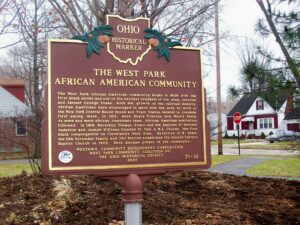
The West Park African American community began in 1809 with the first black settler and one of the earliest residents of the area, inventor and farmer George Peake. With the growth of the railroad industry, African Americans were encouraged to move into the area to work at the New York Central Round House and Train Station located in Linndale. First among these, in 1912, were Beary Frierson and Henry Sharp. As more and more African Americans came, African American institutions followed. In 1919, Reverend Thomas Evans and the families of Herndon Anderson and Joseph Williams founded St. Paul A.M.E. Church, the first black congregation on Cleveland’s West Side. Reverend D.R. Shaw, the Ebb Strowder family and Iler Burrow established the Second Calvary Baptist Church in 1923. Both became pillars of the community.
The Ohio General Assembly established the Ohio Agricultural Experiment Station in 1882. From its inception until 1892, the Station occupied 17 acres on the Columbus campus of The Ohio State University before relocating to 470 acres in Wayne County. In 1965, the Station changed its name to the Ohio Agricultural Research and Development Center (OARDC) to more accurately reflect its mission and programs. In 1982, the Center formally merged with The Ohio State University. Today, the Center encompasses nearly 2,100 acres in Wayne County with 10 branches located across the state for a total of approximately 7,100 acres dedicated to agricultural research.