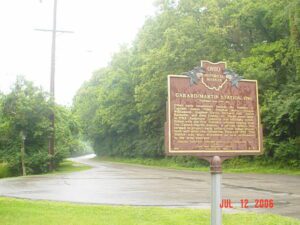
Site of the first fortified settlement in Anderson Township and one of the first in the Virginia Military District. John Garard and Joseph Martin were the founders of this Station, who, with Elias Garard, Joseph Frazee, and others, came by two flatboats with families and livestock from Garards Fort, Pennsylvania, via the Ohio and Little Miami rivers. They landed here on December 23, 1790, and proceeded to erect the fortification.(Continued on other side)
In 1796, surveyors for the Connecticut Land Company designated an area five miles square surrounding this place as Range 7, Township 7 of the Connecticut Western Reserve. A landowner’s expedition on June 15, 1798, arrived at the northwest corner of the township. One of its members, Thomas Umberfield (Umberville) brought his family to the center of the township (now Burton Village) on June 21, 1798. Here they built the first home, a simple log cabin located southwest of the spring at the end of Spring Street. The owner of the largest parcel of land in the township, Titus Street, was given the honor of naming the township. He named it after his son, Burton.
Granville T. Woods was a pivotal African American inventor during the late 19th and early 20th centuries. Woods’ invention of the telegraph device that enabled railway companies to know the location of each of their trains. This new technology greatly enhanced train scheduling and reduced the frequency of fatal collisions throughout the railway industry. From 1878 through 1880 Woods was a railroad locomotive engineer employeed by the Springfield, Jackson and Pomeroy Railroad Company and later by the Dayton and Southeastern Railroad. With frequent stops in Washington Courthouse and extensive leisure time, Woods learned telegraphy from a local telegraph operator. (Continued on other side)
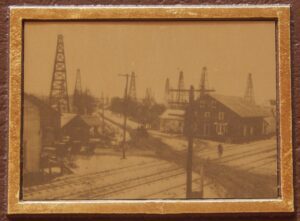
The Bremen Oil Boom commenced in 1907-’08 and the town became a center in the region’s petroleum industry. The area was a forest of oil derricks. From this point south, it was said that one could go down Broad Street from derrick to derrick and not touch the ground. A reconstructed derrick, erected to commemorate Bremen’s sesquicentennial in 1984, may be seen in Howell Park directly east of this marker.
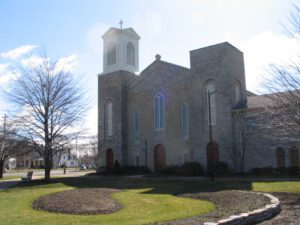
This building was begun in 1835 and was completed in 1844. It is the oldest church building in continual use in Sandusky and incorporates a portion of the original structure. This marker commemorated the one hundred fiftieth anniversary of the laying of the cornerstone and the church’s sesquicentennial observance in 1985.
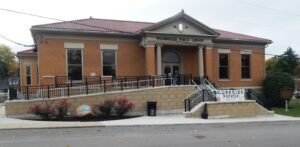
The Wilmington Public Library of Clinton County, one of 111 Carnegie libraries in Ohio, opened its doors to readers on June 30, 1904. A $12,500 gift from steel magnate and philanthropist Andrew Carnegie financed construction of the original 3,360-square-foot building. The community provided the building site, formerly known as Martin Field, and pledged tax funds for the library’s ongoing operation and maintenance. Expansions and modernizations have incorporated the original building and preserved its historic architectural style. “A Library outranks any other thing a community can do to benefit its people.” – Andrew Carnegie
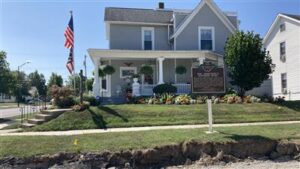
Stephen and Viola Armstrong moved their family, including 13-year-old Neil and his younger siblings, June and Dean, to the house at 601 West Benton Street in 1944. Here, Neil explored his fascination with flying by reading aviation magazines and building model airplanes. Neil completed flying lessons at nearby Port Koneta airport and earned his pilot’s license on his sixteenth birthday, even before receiving a driver’s license. Neil graduated from Blume High School in 1947 and studied aeronautical engineering at Purdue University on a Navy scholarship. The Korean conflict interrupted his studies, but he left the Navy as a decorated combat pilot, flying 78 missions. After graduating from Purdue in 1955, Neil worked at what would become the NASA Glenn Research Center in Cleveland. Soon after he became a test pilot at Edwards Air Force Base in California. (Continued on other side)
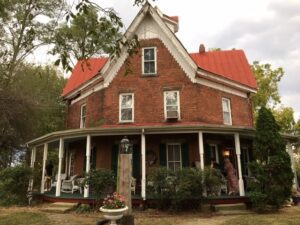
Zimmerman-Bury Octagon House. The Zimmerman-Bury Octagon House was built by Ezekiel B. Zimmerman (1843-1935) and Francis B. Hess Zimmerman (1848-1920) in 1883. Ezekiel graduated from Smithville Academy and was an avid reader. One of Ezekiel’s sons, Ernest Zimmerman (1888-1973), remembered that his father had encountered Orson Fowler’s manifesto A Home for All, or the Gravel Wall and Octagon Mode of Building (1853) and surmised that his father patterned the house after Section V of the book. The approximate 99,000 bricks comprising the house were made on the property, creating exterior walls and a center stairway which are three bricks or about 12 inches thick. Ernest noted the house’s “Russian Tin” roof, referring to its metal standing seam construction. The roof and architectural ornament make the house stand out compared to other octagon structures in Ohio. (Continued on other side)