

, OH
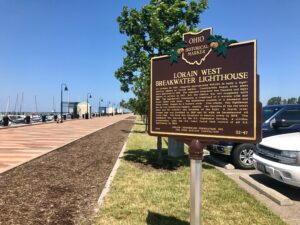
On October 22, 1913, Congress appropriated $35,000 to build a light-and-fog station at Lorain harbor. Construction began after plans were approved in 1916. The concrete structure was finished and light placed in service in 1917, but the station was not completed until 1919. The lighthouse’s foundation is comprised of a wooden crib and boxes filled with stone. The lighthouse consists of a basement and three floors, topped by a lantern room. Like others, this lighthouse had its own identifying signals, namely, the duration of the fog horn’s blast and the rotation and duration of the light. A fourth order Fresnel lens was installed in 1919 and lit with an incandescent oil vapor lamp. The lamp was converted to electric power in 1932. The lighthouse was manned by the U.S. Lighthouse Service, a civilian organization, until the U.S. Coast Guard took control of all U.S. lighthouses in 1939.
, OH
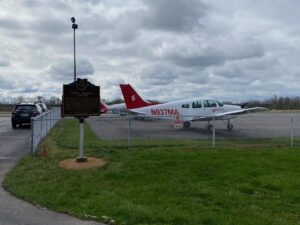
Lewis Albert Jackson (December 29, 1912-January 8, 1994) was an African American aviator remembered for training Tuskegee Airmen during World War II. As a teenager in Indiana, he began flight lessons and soloed in 1932, flying his own Waco 10. Jackson spent 1932-1937 barnstorming to save money for college while earning his Transport Pilot’s License. He re-rated to a Commercial License with Instructor Rating in 1939, and then completed advanced acrobatic training at Coffey School of Aeronautics. In late 1940, he was appointed Director of Training in the Army Air Force 66th Flight Training Detachment at Tuskegee Institute. After the war he moved to Ohio and served as an FAA Flight Examiner from 1947 to 1960. The Lewis A. Jackson Greene County Regional Airport was posthumously renamed to honor this true aviation pioneer.
, OH
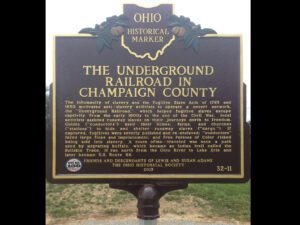
The inhumanity of slavery and the Fugitive Slave Acts of 1793 and 1850 motivated anti-slavery activists to operate a covert network, the “Underground Railroad,” which helped fugitive slaves escape captivity. From the early 1800s to the end of the Civil War, local activists assisted runaway slaves on their journeys north to freedom. Guides (“conductors”) used their homes, farms, and churches (“stations”) to hide and shelter runaway slaves (“cargo.”) If captured, fugitives were severely punished and re-enslaved; “conductors” faced large fines and imprisonment, and Free Persons of Color risked being sold into slavery. A route often-traveled was once a path used by migrating buffalo, which became an Indian trail called the Bullskin Trace. It ran north from the Ohio River to Lake Erie and later became U.S. Route 68.
, OH
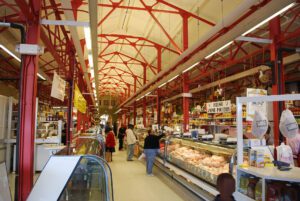
Ohio’s oldest surviving municipal market house, Findlay Market was designed under the direction of City Civil Engineer Alfred West Gilbert (1816-1900). It was listed on the National Register of Historic Places in 1972. The structure was among the first market houses in the United States to use iron frame construction technology. Originally an open pavilion, much of the market was erected in 1852, but disputes with contractors delayed its opening until 1855. The center masonry tower was built in 1902. Soon after, public health concerns prompted enclosure of the market stalls and the addition of plumbing and refrigeration. Until then, vendors found cool storage in deep cellars beneath nearby breweries. The tower bell was brought from Cincinnati’s Pearl Street Market in 1934. Findlay Market was renovated in 1973-74 and again in 2002-03.
, OH
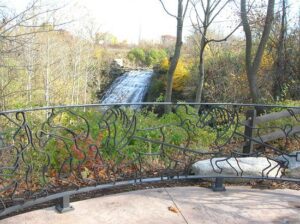
Formed by erosion of Cleveland shale and cascading 48 feet, making it the tallest waterfall in the county, the Cataract Falls of Mill Creek powered the gristmill and sawmill built by William Wheeler Williams and Major Wyatt in 1799. The mills, commissioned by the Connecticut Land Company to encourage settlement of the Western Reserve, attracted people to Newburgh. Cleveland finally outgrew bustling Newburgh by 1830 and eventually annexed most of it. The founding of the Cleveland Rolling Mill in Newburgh, beginning with the firm of Chisholm, Jones, & Company in 1857, precipitated the growth of the steel industry in Cleveland. By 1868, under the management of Henry Chisholm, it became one of the first in the nation to produce steel using the Bessemer process. The Rolling Mill, later the American Steel and Wire Company (a subsidiary of U.S. Steel), purchased the millworks at the falls in 1872.
, OH
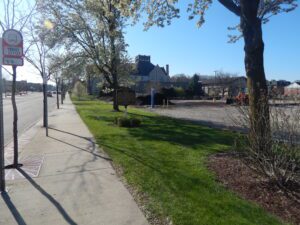
On May 1, 1950, the Akron Community Service Center and Urban League building opened to the public. The Center was a gathering place for African Americans of the community, where they addressed workplace, education, and other issues dividing the city. Directors included the late George W. Thompson, Raymond Brown, and Vernon L. Odom. The Center provided space for meetings, classes and receptions and had a swimming pool and gymnasium. The Center also hosted talent shows, which included the musicians who became Ruby and the Romantics. The group scored a #1 hit in 1963 with “Our Day Will Come.”
, OH
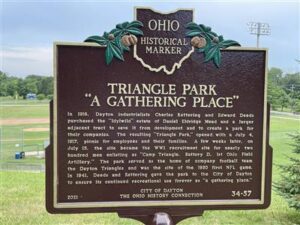
In 1916, Dayton industrialists Charles Kettering and Edward Deeds purchased the “Idylwild” estate of Daniel Eldridge Mead and a larger adjacent tract to save it from development and to create a park for their companies. The resulting “Triangle Park,” opened with a July 4, 1917, picnic for employees and their families. A few weeks later, on July 15, the site became the WWI recruitment site for nearly two hundred men enlisting as “Camp Triangle, Battery D, 1st Ohio Field Artillery.” The park served as the home of company football team the Dayton Triangles and was the site of the 1920 first NFL game. In 1941, Deeds and Kettering gave the park to the City of Dayton to ensure its continued recreational use forever as “a gathering place.”
, OH
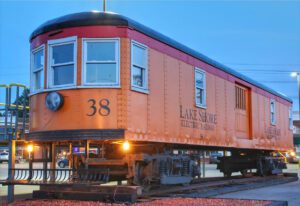
From the 1890s to the 1930s, interurban railways were an important form of travel in the Midwest. Beach Park Station had an interurban carhouse, where repairs were performed and passengers boarded. The Lorain & Cleveland Railway (L&C) built the 65½ by 200 foot brick station in 1897. By 1901, the L&C became part of the Lake Shore Electric Railway (LSE) and Beach Park became stop 65 on a line that ran from Cleveland to Toledo and then to Detroit. Requiring power and water, the LSE built an electric plant and water tower at Avon Lake. This infrastructure spurred the community’s development and growth. (Continued on other side