

, OH
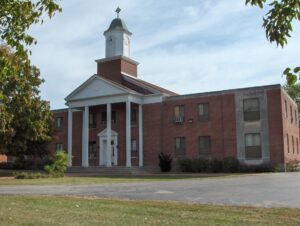
Payne Theological Seminary was originally established as Union Seminary in West Jefferson, Ohio, by the Ohio Conference of the African Methodist Church (AME) on October 18, 1844. The Cincinnati Conference of the Methodist Episcopal Church North met to establish a school for people of African descent, and in 1856, purchased Tawawa Springs, a defunct health resort, to open Wilberforce University, named for the early nineteenth century British abolitionist, William Wilberforce. In 1862 the institution closed due to low enrollment and dwindling funds. AME Bishop Daniel Alexander Payne purchased the school for $10,000, and the school was reopened in 1863 by closing the Union Seminary and merging the assets. In 1895, the department of theology separated from Wilberforce University and became Payne Theological Seminary, named in honor of Bishop Payne. Payne is the oldest, free standing African American Seminary in the United States.
, OH
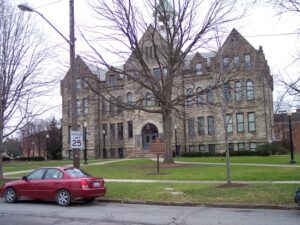
On this site the Lyceum Village and the Berea Seminary were established in 1837 by John Baldwin, James Gilruth, Henry O. Sheldon, and Josiah Holbrook. Their vision was to create the first in a connected series of Lyceum Villages. The Villages were designed especially to assist in the education of teachers, promote “scientific” exchanges over the world and thus encourage the study of the works and word of God, and cultivate the spirit of “peace on earth and good will to men.” The community, however, declined and in 1842, John Baldwin assumed the indebtedness of $15,000. James Wallace acquired the area. It was owned by the Methodist Children’s Home in the 1860s and then sold to German Wallace College in 1866, becoming the original German Wallace College campus.
, OH
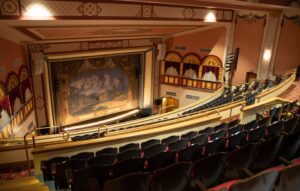
The Peoples Bank Theatre, built in 1919 and called the Hippodrome, marks an age when movies transitioned from silent films and nickelodeons into a major national industry and pastime. Designed by Columbus architect Fred Elliott for the C&M (Cambridge and Marietta) Amusement Company, the theatre featured a granite archway, 1,200 seats, a 35-by-55-foot stage, an orchestra pit, and the first air conditioning of its kind in Marietta. The Hippodrome opened May 9, 1919 with the silent film Daddy Long Legs, starring Mary Pickford. Shea Theatres of New York bought the Hippodrome and remodeled it in 1949, replacing the Hippodrome’s distinctive stone archway with a two-story southern colonial-style facade. Renamed the “Colony,” it opened June 25, 1949, showing the Esther Williams’ musical Neptune’s Daughter. (Continued on other side)
, OH
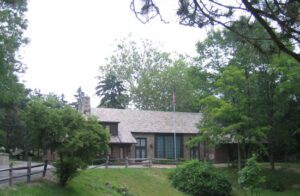
Envisioned by Fairview Village Mayor, David R. Bain, this community center was originally completed in 1937 as a project of the Works Progress Administration (WPA), a Depression-era work relief program initiated by the Federal Government in 1935. A fire destroyed the original log cabin on December 14, 1937, just four days before the planned dedication. With the support of the community, Mayor Bain turned again to the WPA for funding and labor to rebuild the structure. This cabin, constructed of bricks on the original foundation, features an 8’x12′ mural painted by artists of the WPA’s Federal Art Project and which depicts Fairview’s history through the 1930s. The new cabin was dedicated on January 15, 1940, and was named in honor of Mayor Bain in 1957, four years after his death.
, OH
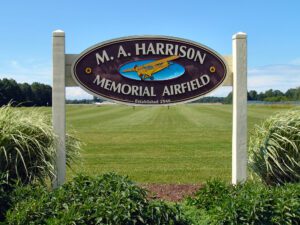
Marion A. Harrison established M.A. Harrison Memorial Airfield, formerly Harrison Airport, in 1946 on land encompassing 80 acres. This facility served to promote aviation activities in the Birmingham community with flight charters, flight instruction, and rides. Birmingham Metal Products was located here during World War II producing fighter aircraft fuel parts, and the airfield was used to train civilian pilots. Today, it remains dedicated to flight.
, OH
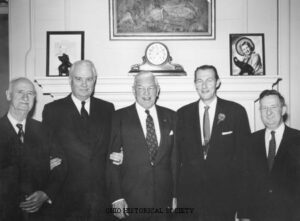
Ohio’s fifty-ninth governor, Marietta native C. William O’Neill was the only Ohioan to head all three branches of state government. An honor graduate of both Marietta High School and Marietta College, O’Neill won election to the Ohio House of Representatives in 1938, serving there until 1950 but interrupted from 1943-1946 when he was with General George Patton’s Third Army in Europe during World War II. In 1947 he became the youngest Speaker of the House in Ohio history. Elected Attorney General in 1950, he won the governorship in 1956, modernizing the highway and mental health departments during his tenure. His election to the State Supreme Court in 1960 and elevation to Chief Justice in 1970, noted by landmark judicial reforms, capped his exemplary career of public service to Ohio.
, OH
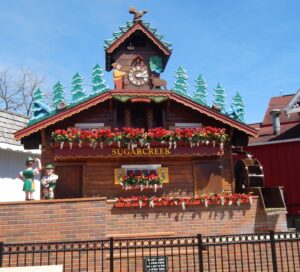
The Alpine Alpa restaurant in Wilmot, Ohio commissioned clockmaker Karl Schleutermann to build the world’s largest cuckoo clock in 1963. Twelve years and $50,000 later, the enormous outdoor clock was finished. It was featured on the cover of the “Guinness Book of World Records” in 1978. After exposure to Ohio’s weather for 30 years, Hampton Hotel’s “Save-A-Landmark” program helped to restore the cuckoo clock to operating condition in 2007. The restaurant closed two years later, and the owner of the local store Walnut Creek Cheese purchased the clock and donated it to the Village of Sugarcreek. The clock was moved to its new home in May 2012. Village leaders and community members returned the clock to working condition and placed it on display for all to enjoy.
, OH
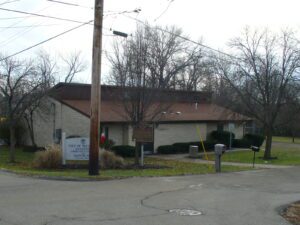
Civic organizations played pivotal roles in the development of the residential community of Hazelwood, founded as a subdivision of Blue Ash in 1888. The Hazelwood Civic Association, initially established as the Brothers Civic Society in 1941, addressed community needs by working for public improvements and promoting civic relations through social events and educational programs. Efforts by the HCA led to the construction of a new civic center and the introduction of the Boy and Girl Scouts and other programs that were previously unavailable to African-American children. Hazelwood’s deterioration and the threat of encroaching industrial development led to the formation of the Hazelwood Improvement Corporation in 1968. The HIC, acting as an agent of the city of Blue Ash, helped to upgrade housing, pave roads, build new homes to ensure a residential nature, install water and sewage systems, and erect streetlights. In 1997, the Hazelwood Community Association was organized to assist residents during Hazelwood’s transition to a racially integrated community.