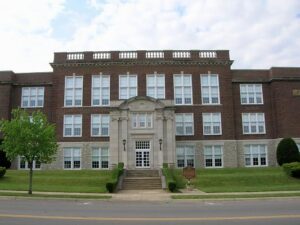
Jefferson Street, between N. 5th and N. 6th Streets
Greenfield
, OH
A focal point of community pride for generations, McClain High School was the gift of textile manufacturer Edward Lee McClain to his hometown, “as promising the greatest good to the greatest number for the longest time.” Designed by nationally prominent school architect William B. Ittner, the school was dedicated in September 1915. Lauded as one of the most complete and state-of-the-art school plants of its time, McClain High School embodied the ideals of the progressive education movement in the early 20th century. A fully equipped gymnasium, motion-picture equipment, and a pipe organ were rare luxuries for any school during this era. Additional gifts by McClain also furnished a vocational training center and an athletic field. Numerous sculptures, paintings, and other works of art displayed throughout the school continue to enhance the atmosphere of Greenfield’s acclaimed halls of learning.
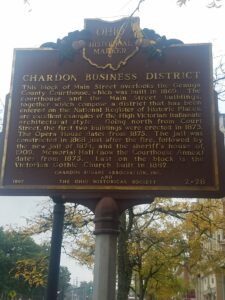
This block of Main Street overlooks the Geauga County Courthouse, which was built in 1869. The courthouse and the Main Street buildings, together which compose a district that has been entered on the National Register of Historic Places, are excellent examples of the High Victorian Italianate architectural style. Going north from Court Street, the first two buildings were erected in 1873. The Opera House dates from 1875. The jail was constructed in 1868 just after the fire, followed by the new jail of 1874, and the sheriff’s house of 1909. Memorial Hall (now the Courthouse Annex) dates from 1875. Last on the block is the Victorian Gothic Church built in 1882.
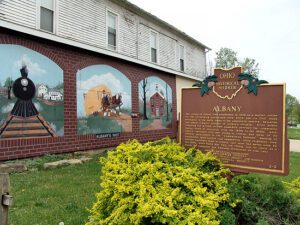
The village of Albany was established in 1838 as a market center for the surrounding agricultural area, which saw its first white settlement in the early years of the nineteenth century. Education was always a major concern of Albany’s citizens. Since public schooling was minimal, private academies provided the community various levels of education from the 1840s to the 1880s. Anti-slavery sentiment also was strong in Albany, and many of its citizens participated in the “Underground Railroad.” Because of educational opportunities and sympathetic white neighbors, free African-Americans came to Albany, but most had moved away by the 1930s. After World War Two, the village lost its status as a center for commerce and business.
On Allen Street between Lower and Upper Market Streets
Lebanon
, OH
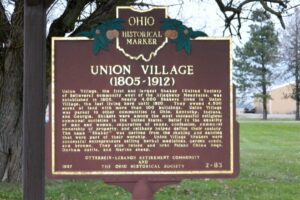
Union Village, the first and largest Shaker (United Society of Believers) community west of the Allegheny Mountains, was established in 1805. Nearly 4,000 Shakers lived in Union Village, the last living here until 1920. They owned 4,500 acres of land with more than 100 buildings. Union Village was parent to other communities in Ohio, Kentucky, Indiana, and Georgia. Shakers were among the most successful religious communal societies in the United States. Believe in equality of men and women, separation of sexes, confession, communal ownership of property, and celibacy helped define their society. The name “Shaker” was derived from the shaking and dancing that were part of their worship. Union Village Shakers were successful entrepreneurs selling herbal medicines, garden seeds, and brooms. They also raised and bred Poland China hogs, Durham cattle, and Merino sheep.
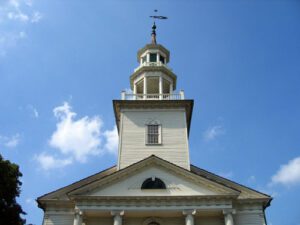
Tallmadge was established in 1807 by David Bacon as a Congregational community. In 1821 local landowners donated timber to build this church, designed and constructed by one of Ohio’s first architects, Col. Lemuel Porter. Dedicated on September 8, 1825, the structure is considered to be a perfect example of the pure Connecticut-type of Federal architecture. It is the oldest Ohio church to be continuously occupied as a place of worship.
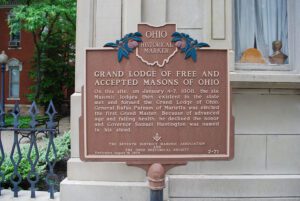
On this site, on January 4-7, 1808, the six Masonic lodges then existent in the state met and formed the Grand Lodge of Ohio. General Rufus Putnam of Marietta was elected the first Grand Master. Because of advanced age and failing health, he declined the honor and Governor Samuel Huntington was named in his stead.
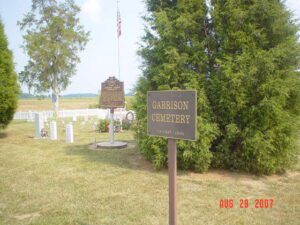
Descendants of Lemuel Garrison Sr., a Revolutionary War soldier, were among the first Europeans to own and settle land at Garrison Corner (intersection of State Route 123 and Shawnee Trace) . Garrison Cemetery burials took place from ca. 1837 to 1936. The cemetery has 327 lots. Eighty-six burials are documented including veterans John J. Garrsion, Benjamin Garritson, James Knicely, Nicodemus Rude, and William Rude. (continued on other side)
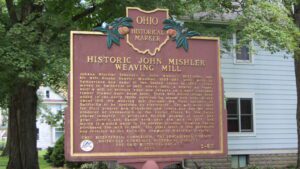
Johann Mischler (changed to John Mishler), 1852-1930, and his wife Rosina Beyeler Mischler, 1852-1927, were born in Switzerland and came to the United States in 1882. They moved to Smithville in 1887 where John, a weaver by trade, built a mill to produce rugs and carpets on a hand operated timber framed barn beam loom. Three belt driven looms were added in the early 1900s powered by steam and later diesel. About 1915, the weaving mill became the first business in Smithville to be operated by electricity. The mill wove cloth for fruit presses and dishcloths and towels and was the only producer of cheesecloth in the United States for the Swiss cheese industry. It produced 40,000 pounds of cloth per year. John’s son Daniel took over the mill in 1930 and moved it a block away to its present location. Charles Norris purchased the mill in 1983. Ten years later, it was purchased and restored by the Smithville Community Historical Society.