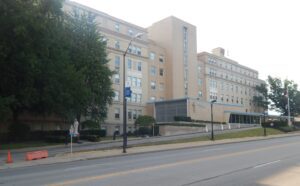
The Sisters of the Humility Mary, who came here from France in 1864, opened St. Elizabeth Hospital on this site in the former Fitch House on December 8, 1911. St. Elizabeth Hospital has cared for all, regardless of ability to pay, and devoted itself to helping poor and underserved populations. On December 8, 2011, what is now St. Elizabeth Health Center celebrated its centennial and the evolution of St. Elizabeth Hospital into Humility of Mary Health Partners. The century-old mission of the Sisters continues to guide the institution into the 21st century.
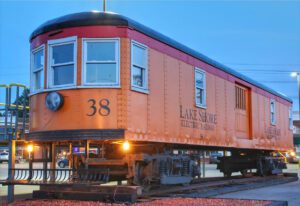
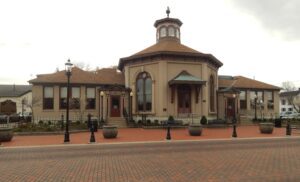
From the 1890s to the 1930s, interurban railways were an important form of travel in the Midwest. Beach Park Station had an interurban carhouse, where repairs were performed and passengers boarded. The Lorain & Cleveland Railway (L&C) built the 65½ by 200 foot brick station in 1897. By 1901, the L&C became part of the Lake Shore Electric Railway (LSE) and Beach Park became stop 65 on a line that ran from Cleveland to Toledo and then to Detroit. Requiring power and water, the LSE built an electric plant and water tower at Avon Lake. This infrastructure spurred the community’s development and growth. (Continued on other side
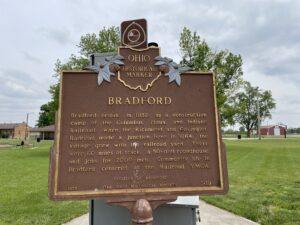
Bradford began, in 1852, as a construction camp of the Columbus, Piqua, and Indiana Railroad. When the Richmond and Covington Railroad made a junction here in 1864, the village grew with the railroad yard. There were 60 miles of track, a 50-stall roundhouse, and jobs for 2000 men. Community life in Bradford centered at the Railroad YMCA.
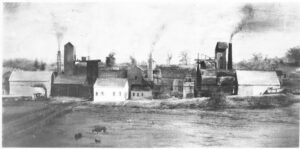
The discovery in the mid-19th century of iron-rich black band ore in this region helped revitalize Mahoning Valley’s iron industry. The land now called Mineral Ridge was primarily a farming community before the 1850s. In the 1830s, coal was discovered and mining began on a small scale. For years, it was believed that the coal seam sat on top of a layer of slate, which was considered to be of little worth. In the mid-1850s, however, John Lewis, superintendent of the Mineral Ridge Coal Mines, identified what was previously thought to be slate as valuable black band ore instead. (Continued on other side)
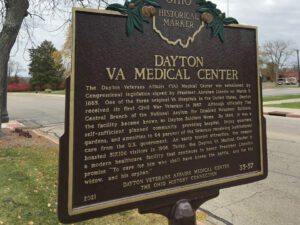
The Dayton Veterans Affairs (VA) Medical Center was established by Congressional legislation signed by President Abraham Lincoln on March 3, 1865. One of the three original VA Hospitals in the United States, Dayton received its first Civil War Veterans in 1867. Although officially The Central Branch of the National Asylum for Disabled Volunteer Soldiers, the facility became known as Dayton Soldiers Home. By 1884, it was a self-sufficient planned community, providing hospital, living quarters, gardens, and amenities to 64 percent of the Veterans receiving institutional care from the U.S. government. An early tourist attraction, the campus boasted 517,106 visitors in 1906. Today, the Dayton VA Medical Center is a modern healthcare facility that continues to honor President Lincoln’s promise “To care for him who shall have borne the battle, and for his widow, and his orphan.”
Begun as a partnership between candle maker William Procter and soap maker James Gamble in 1837, Procter & Gamble (P&G) grew from its roots to become one of the world’s largest and best-known consumer products companies. Building on Civil War candle and soap contracts, P&G grew rapidly by nationally marketing its floating Ivory Soap (1879). Innovative product research and creative marketing techniques resulted in the development of dozens of successful, universally recognized brands and expansion into beauty care, paper, and health care products. Its worldwide headquarters remains in Cincinnati.
Steel-frame skyscrapers and retail buildings replaced wood-frame residences as the downtown evolved into a commercial district. A small public library branch occupied the north side of the square from 1923 to 1954. The Keith-Albee Theater (later the Palace) in the northeast corner of the square from 1926 to 1964, featured vaudeville performances and movies. Streetcar tracks around the square were removed for scrap during World War II. With expansion of suburban shopping malls, downtown theaters and department stores gradually closed. In 1973-74 Central Square was converted to a pedestrian Federal Plaza by closing off traffic on Federal Street one block east and west of Market Street. Central Square reopened in 2004 with a new traffic pattern, planting beds, and street furniture. Marker for “Central Square (1798-1899)” across the street.
Clark Lane (1823-1907), industrialist and philanthropist, was a son of John Lane (1793-1880) and Rosanah Crum (1795-1877). John came with his family to the Ohio Country when it was still part of the Northwest Territory. As a young man, Clark worked in his family’s blacksmith shop, and eventually helped found Owens, Lane & Dyer Machine Company in 1854. It built agricultural machinery, sawmills, papermaking machines, and other products, initiating Hamilton’s prominence in metals manufacturing. Lane funded the Butler County Children’s Home, an orphanage for over a century, and constructed an octagon house as his residence on Third Street. He built this library in 1866, also as an octagon, and donated it to the people of Hamilton. A 19th century admirer wrote, “The name and generous deeds of Clark Lane will never fade from the memories of a grateful people who have been recipients of his favor.”