

, OH
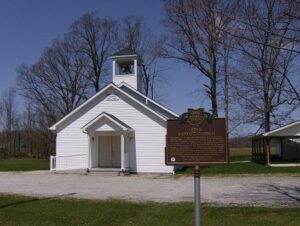
Thirteen African American families migrated to Pebble Township in Pike County in the early 1820s from Virginia. Some of the families were former slaves while others were freeborn people of color. Their farm knowledge and skill helped to make them prosperous, angering some of their white neighbors who began a campaign of harassment. Ten of the original African American settlers eventually moved away, but despite the difficulties with the white population, other African Americans continued to arrive to the settlement. They founded a church, later known as the Eden Baptist Church, built a meeting hall, and organized a school. Several of the families were also involved in the activity of the Underground Railroad. The PP Settlement thrived until the 1950s when, for economic reasons, residents moved to other communities.
, OH
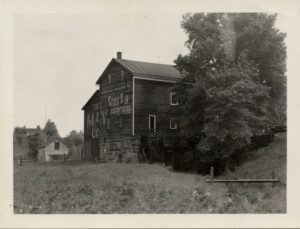
Fowlers Mill (originally Fowler’s Mills) developed around a group of mills built in the 1830s on the Chagrin River. Opportunities from these mills led to Fowlers Mill becoming the commercial center of Munson Township. From the 1830s into the twentieth century, the community expanded with construction of churches, a post office, township hall, stores, hotel, blacksmith shop, schools, and houses built in such styles as Federal, Greek Revival, Italianate, and Queen Anne. This type of community center was common in rural, nineteenth century America, but rarely survives with so much original fabric intact. On Mayfield Road, the Disciple Church was built in 1842. East of the church, the brick central school built in 1913 replaced earlier one-room schoolhouses. The gristmill is the only mill standing in Geauga County. The cemetery contains burials dating from the 1830s. The Fowler’s Mills Historic District was placed on the National Register of Historic Places in 2002.
, OH
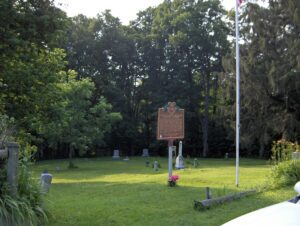
This cemetery stands as evidence of a once thriving African American farming community established in the 1820s. With the aid of community leader, Alexander “Sandy” Harper (c.1804-1889), Captina, originally called Guinea, became a stop on the Underground Railroad, a national network, shrouded in secrecy, of volunteers who directed slaves northward. Harper is buried in this cemetery, along with Benjamin Oliver McMichael (1865-1941), an educator who taught for twelve years in Captina/ Flatrock at a segregated schoolhouse. There are 113 known burials in the cemetery, including nine Civil War veterans. At this site in 1825, an African Methodist Episcopal Church was established to serve the community. Many of its members left Captina to work in cities, but the church continued services until 1962. The building then fell into disrepair and collapsed during a windstorm in 1978.
, OH
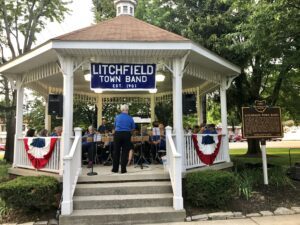
Around 1900, the newly formed Litchfield Cemetery and Park Association needed a band to lead processions to and from the town cemetery on Memorial Day. The Litchfield Town Band was born. Urial Crow served as its first director, so the group was sometimes known as “The Crow Band”. Although there were periods when the band was inactive, it has been a community institution for more than a century. The group plays a broad repertoire of standards and marches by John Philip Sousa at Memorial Day and other commemorations, ice cream socials, and various community events. Directors have included Urial Crow, Loren Hayes (c. 1915), Floyd Koons (mid-1920s), Raymond Bradley (1935-1939), Hal Leach (1939-1945), Kenneth Bradley (1946-2011) and Cynthia Bennett (since 2012).
, OH
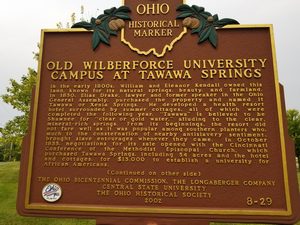
In the early 1800s, William and Eleanor Kendall owned this land, known for its natural springs, beauty, and farmland. In 1850, Elias Drake, lawyer and former speaker in the Ohio General Assembly, purchased the property and named it Tawana or Xenia Springs. He developed a health resort hotel surrounded by summer cottages, all of which were completed the following year. “Tawana” is believed to be Shawnee for “clear or gold water,” alluding to the clear, mineral-rich springs. From its beginnings, the resort did not fare well as it was popular among southern planters who, much to the consternation of nearby antislavery sentiment, brought slave entourages whenever they came. In October 1855, negotiations for its sale opened with the Cincinnati Conference of the Methodist Episcopal Church, which purchased Tawana Springs, including 54 acres and the hotel and cottages, for $13,000 to establish a university for African Americans. (Continued on other side)
, OH
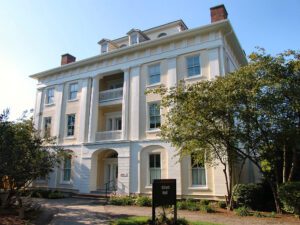
Built in 1833 as a health resort named the Mansion House Hotel, Elliott Hall is noted as Ohio’s oldest collegiate Greek Revival building. The closure of the Bank of the United States and an economic panic in 1837 created nation-wide financial difficulties, which led to the decline of the luxury resort. Under the leadership of Reverend Adam Poe, minister of William Street Methodist Church, the citizens of Delaware purchased the building for the establishment of a Methodist college for men. Ohio Wesleyan University was chartered on March 7, 1842, and the founding building was named for Dr. Charles Elliott, Ohio Conference leader who helped examine the site and establish the university. In 1877, Ohio Wesleyan University and the Ohio Wesleyan Female College merged into a co-educational institution. Elliott Hall was moved to its present location in 1892 when University Hall was built.
, OH
James and Sophia Clemens’ lives are part of a story of tens of thousands of people of color who migrated north in search of land to farm and better lives during the first half of the 19th century. In 1818, James Clemens (1781-1870) purchased 387 acres in German Township, Darke County, Ohio. He and Sophia (Sellers) Clemens (1786-1875) were brought here by Adam Sellers (1742-1821) of Rockingham County, Virginia. In 1822, Thornton Alexander (1783-1851), emancipated by A. Sellers, purchased land in Randolph County, Indiana, about a half mile west of Clemens’ land. These purchases were the beginning of the Greenville Settlement on the Ohio-Indiana border. Other settlers of color followed, including the Bass family from North Carolina, in 1828. The 1830 census enumerated approximately 78 people of color in German Township Ohio and adjacent Green’s Fork Township, Indiana. (Continued on other side)
, OH
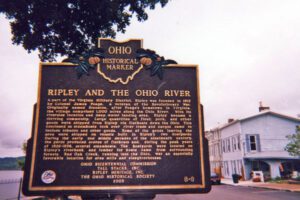
A part of the Virginia Military District, Ripley was founded in 1812 by Colonel James Poage, a veteran of the Revolutionary War. Originally named Staunton, after Poage’s hometown in Virginia, the village comprised 1,000 acres along the Ohio River. With its riverside location and deep water landing area, Ripley became a thriving community. Large quantities of flour, pork, and other goods were shipped from Ripley via flatboats down the Ohio. This continued as steamboats took over river trade and cargos came to include tobacco and other goods. Some of the goods leaving the area were shipped on vessels built in Ripley’s two boatyards. During the early and middle decades of the nineteenth century, the yards produced scores of flatboats and, during the peak years of 1826-1836, several steamboats. The boatyards were located on Ripley’s riverbank and lumber for boats came from surrounding forests. Red Oak Creek, running into the Ohio, was an especially favorable location for area mills and slaughterhouses.