

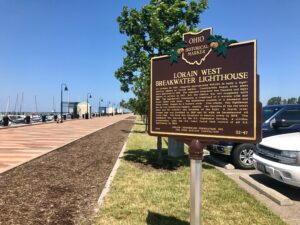
, OH
On October 22, 1913, Congress appropriated $35,000 to build a light-and-fog station at Lorain harbor. Construction began after plans were approved in 1916. The concrete structure was finished and light placed in service in 1917, but the station was not completed until 1919. The lighthouse’s foundation is comprised of a wooden crib and boxes filled with stone. The lighthouse consists of a basement and three floors, topped by a lantern room. Like others, this lighthouse had its own identifying signals, namely, the duration of the fog horn’s blast and the rotation and duration of the light. A fourth order Fresnel lens was installed in 1919 and lit with an incandescent oil vapor lamp. The lamp was converted to electric power in 1932. The lighthouse was manned by the U.S. Lighthouse Service, a civilian organization, until the U.S. Coast Guard took control of all U.S. lighthouses in 1939.
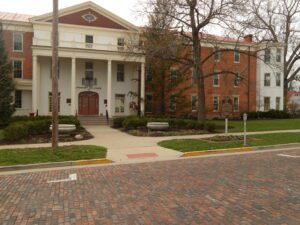
, OH
Chartered in 1849, the Institute was the first of three women’s colleges established in Oxford. The original brick building was completed in 1850, and forms the core structure. The Reverend John Witherspoon Scott, a member of Miami University’s early faculty, headed the Institute. In 1867, the Institute merged with Oxford Female College and later became the Oxford College for Women. Miami University acquired the building in 1928; in 1930 the Daughters of the American Revolution rededicated it as the “Caroline Scott Harrison Memorial.” From 1929-1998 it served as a Miami dormitory, nicknamed “Ox College.” Since 2003, the three-story building has housed the Oxford Community Arts Center. The structure is the oldest extant women’s college building in Ohio. It was placed on the National Register of Historic Places in 1976.
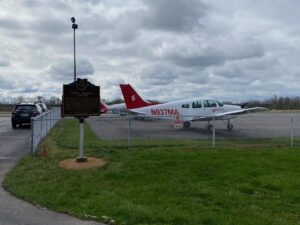
, OH
Lewis Albert Jackson (December 29, 1912-January 8, 1994) was an African American aviator remembered for training Tuskegee Airmen during World War II. As a teenager in Indiana, he began flight lessons and soloed in 1932, flying his own Waco 10. Jackson spent 1932-1937 barnstorming to save money for college while earning his Transport Pilot’s License. He re-rated to a Commercial License with Instructor Rating in 1939, and then completed advanced acrobatic training at Coffey School of Aeronautics. In late 1940, he was appointed Director of Training in the Army Air Force 66th Flight Training Detachment at Tuskegee Institute. After the war he moved to Ohio and served as an FAA Flight Examiner from 1947 to 1960. The Lewis A. Jackson Greene County Regional Airport was posthumously renamed to honor this true aviation pioneer.
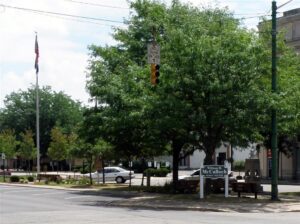
, OH
William McCulloch was born in Holmes County where he was educated in a one-room schoolhouse before moving to Wooster to attend high school and the College of Wooster. He attained prominence as Ohio’s Speaker of the House from 1939-1943 and House member from the Fourth Ohio Congressional District from 1948-1973. During his time in Washington, McCulloch was best known as a co-sponsor and staunch advocate of the Civil Rights Act of 1964. He was recognized by President Lyndon Johnson as the prime mover for passage of this landmark legislation. As a conservative Republican voice in the House, he was instrumental in championing other civil rights legislation, including fair housing and public accommodations. McCulloch was a founding partner in 1928 of the Piqua law firm that bears his name.
, OH
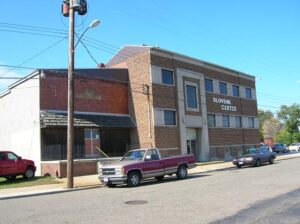
In 1918, early Slovene immigrants organized the Slovenian Independent Society Home and later constructed this hall, which became the center for Barberton Slovene cultural, social, and recreational activities. They formed dramatic and singing clubs, conducting performances in their native language. In the early twentieth century, prior to employers providing insurance or health care for their workers, the society acted to ensure sick and death benefits for its members. It also prepared members for citizenship in their newly chosen country. First generation Slovenes provided the labor that helped spur the growth of local industries while succeeding generations have continued to contribute to the community in various business, industrial, professional, and governmental capacities.
, OH
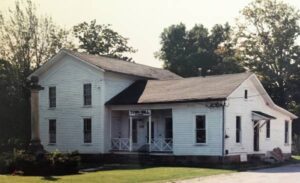
The Village of South Amherst incorporated in 1918. Mayor Fred Ruth and village’s council authorized a special election on February 22, 1919 so that the village could issue bonds to establish a town hall. The village used the funds to buy the house of Jeannette and Alexander Born. Purchased on September 3, 1919 for $3,750, the home-turned town hall served the village for 70 years. As the community grew and the building aged, the need for a new facility became clear. The old town hall was demolished and construction of a spacious $274,000 building begun in September 1988. The village’s government moved into its new 3,200 square-foot hall in February 1989.

, OH
Ohio’s oldest surviving municipal market house, Findlay Market was designed under the direction of City Civil Engineer Alfred West Gilbert (1816-1900). It was listed on the National Register of Historic Places in 1972. The structure was among the first market houses in the United States to use iron frame construction technology. Originally an open pavilion, much of the market was erected in 1852, but disputes with contractors delayed its opening until 1855. The center masonry tower was built in 1902. Soon after, public health concerns prompted enclosure of the market stalls and the addition of plumbing and refrigeration. Until then, vendors found cool storage in deep cellars beneath nearby breweries. The tower bell was brought from Cincinnati’s Pearl Street Market in 1934. Findlay Market was renovated in 1973-74 and again in 2002-03.
, OH
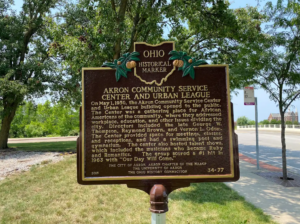
On May 1, 1950, the Akron Community Service Center and Urban League building opened to the public. The Center was a gathering place for African Americans of the community, where they addressed workplace, education, and other issues dividing the city. Directors included the late George W. Thompson, Raymond Brown, and Vernon L. Odom. The Center provided space for meetings, classes and receptions and had a swimming pool and gymnasium. The Center also hosted talent shows, which included the musicians who became Ruby and the Romantics. The group scored a #1 hit in 1963 with “Our Day Will Come.”