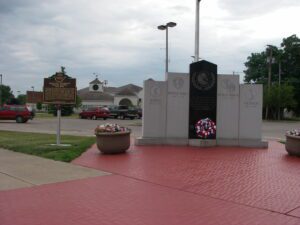
From 1942 until 1946, members of local churches and two railroad auxiliaries operated a community-based free canteen for passing troops on the platform of the Pennsylvania Railroad station. A grateful region honored approximately 1.2 million of the nation’s sons and daughters with welcoming words, sandwiches, pies, cakes, cookies, fruits, drinks, and other sundries. Staffed and funded entirely by volunteers, donations came from many communities in eight counties. Crestline’s children donated their pennies to pay for construction of a larger canteen in 1943. Volunteers met as many as 25 trains daily. They served troops on passenger trains, troop trains, and hospital trains and new recruits and returning veterans as well as troops from allied countries on their trips to and from Europe or the Pacific. Throughout World War II, many other canteens were created across the nation, including many in Ohio. The Crestline region’s reputation was enhanced immeasurably by the volunteer’s service.
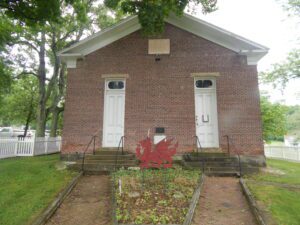
In 1972 a group of Welsh-Americans chartered the Welsh-American Heritage Museum to preserve Welsh history and culture, and to preserve the Welsh Congregational Church. The old brick church was where songs of praises rang, as the Welsh gathered and sang beloved hymns of their homeland in four-part harmony. The church is a link in a long, unbroken chain of memories and still serves the community as a center of Welsh-American activities and a keeper of the community’s heritage. The red dragon and daffodil are symbols of Wales.
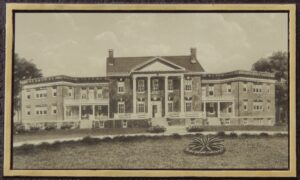
The Hillcrest Children’s Home stood near this site in Wheelersburg and opened in 1921 to the first 57 of many children who would come to live there. A 50-room building intended for 100 children, Hillcrest often housed double to triple that number. The extended community supported Hillcrest, providing entertainment, sponsoring activities, and donating presents for the children whose times there left indelible memories. The home closed in 1970 and was razed the following year.
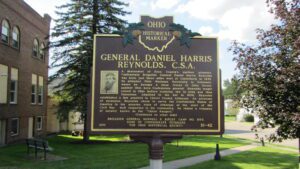
A descendent of Knox County’s earliest pioneers, Confederate Brigadier General Daniel Harris Reynolds was born just three miles west of Centerburg in 1832. He attended Ohio Wesleyan University in Delaware, where he became a close friend of Otho Strahl, another Ohio born Confederate general. Reynolds taught school in Ohio before studying law in Iowa and then Tennessee. Admitted to the bar in 1858, Reynolds established a law practice in Chicot County Arkansas. An advocate of secession, Reynolds chose to serve the Confederate States of America in his adopted state of Arkansas at the start of the Civil War. Well respected in his community, he raised a company of cavalry known as the “Chicot Rangers.” (Continued on other side)
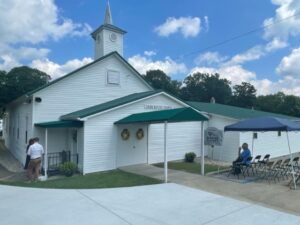
Union Baptist Church, established in 1819, is one of Ohio’s early Black churches. Its pastor and members were active on the Underground Railroad from that early date. Between the 1840s-1860s Black churches along the route to and from nearby Poke Patch assisted over 200 escaped slaves. Members met in their homes until able to obtain a log cabin (circa 1879) on a Blackfork farm. In 1919, a larger church was built on land given by The Cambria Clay Products Company. The adjacent cemetery has over fifty veterans from the Civil, Spanish American, both World, Korean, and Vietnam wars. Donald Russell Long, laid to rest in 1966, received a posthumous Congressional Medal of Honor. Union Baptist Church, the historic foundation of the Poke Patch-Blackfork community, celebrates an annual Church Anniversary to honor its legacy.
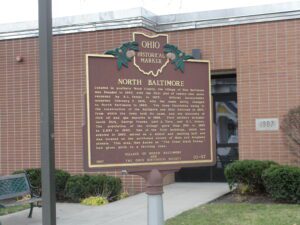
Located in southern Wood County, the village of New Baltimore was founded in 1860, with the first plat of twenty-nine acres recorded by B.L. Peters in 1873. Official incorporation occurred February 7, 1876, with the name being changed to North Baltimore in 1880. The town flourished owing to the construction of the Baltimore and Ohio Railroad in 1873, from which the town took its name, and the discovery of rich oil and gas deposits in 1886. First settlers included: Jacob Dirk, George Franks, Levi A. Tarr, and B.L. Peters. The population of the village grew from 700 in 1880 to 2,857 in 1890. One of the first buildings, which was erected in 1860, served as a school and meeting hall and was located on the northwest corner of Main and Broadway streets. This area, then known as “The Great Black Swamp,” had given birth to a thriving town.
When inventor and entrepreneur Garrett Augustus Morgan sold his Traffic Signal patent to General Electric in 1923, he used the $40,000 to purchase a 121-acre farm in Huron County in 1924. Advertising “a village of our own,” Morgan established the Wakeman Country Club — one of Ohio’s early African American recreation clubs — and offered 247 lots for $60 each in “Wakeman Heights.” Located near the intersection of State Route 60 and Chenango Road, the development provided country pleasures to Blacks excluded from the Country Club lifestyle. Club membership, included in the purchase of a lot, offered fishing, hunting, swimming, and horseback riding. A restaurant, dance hall, and amphitheater provided cultural and boxing events. The club waned during World War II and no buildings from the once-thriving Wakeman Country Club remain.
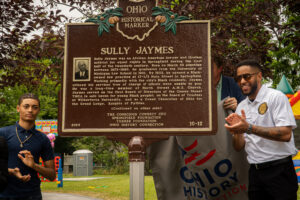
Sully Jaymes was an African American lawyer and tireless activist for equal rights in Springfield during the first half of the twentieth century. Born on March 30 sometime between 1875-1880, he graduated from the University of Michigan Law School in 1901. By 1903, he opened a Black-owned law practice at 17-1/2 Main Street in Springfield. Working primarily with the city’s Black residents, Jaymes offered his services free of charge if clients were unable to pay. He was a long-time member of North Street A.M.E. Church. Jaymes served on the first Board of Directors of the Center Street YMCA (a safe-haven for young Black people), on the Board of Trustees at Wilberforce University, and as a Grand Chancellor of Ohio for the Grand Lodge, Knights of Pythias. (Continued on other side)