

, OH
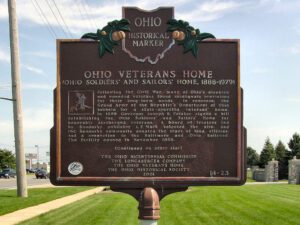
Following the Civil War, many of Ohio’s disabled and wounded veterans found inadequate provisions for their long-term needs. In response, the Grand Army of the Republic’s Department of Ohio lobbied for a state-operated veterans’ home. In 1886 Governor Joseph B. Foraker signed a bill establishing the Ohio Soldiers’ and Sailors’ Home for honorably discharged veterans. A board of trustees led by Sandusky publisher I.F. Mack selected the site, and the Sandusky community donated the tract of land, utilities, and a connection to the Baltimore and Ohio Railroad. The facility opened in November 1888. (continued on other side)
, OH
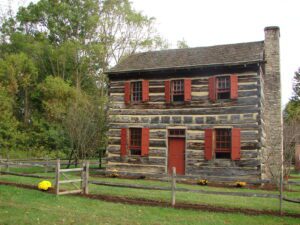
Zachariah Price DeWitt was born of a Dutch family in New Jersey in 1768. With brothers Jacob and Peter, he migrated to Kentucky where, in 1790, he married Elizabeth Teets, who was born in Pennsylvania in 1774. By 1805 all three brothers had settled in Ohio near Four Mile (Talawanda) Creek. Here Zachariah and Elizabeth raised corn, hogs, and eventually, nine children. Zachariah became a prominent community leader, operating a sawmill, building houses in Oxford, serving as Masonic Lodge secretary, and commanding a rifle company during the War of 1812. Tradition has it that Elizabeth wore a black sunbonnet to cover a scar from having been scalped as a child in Kentucky. Elizabeth died in 1843, followed by Zachariah in 1851. Both are buried in Darrtown Cemetery.
, OH
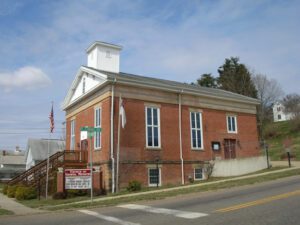
This former Universalist Church, which held a strong conviction for education and the pursuit of knowledge, was built in 1852 at a cost of $3,500. In 1865, its members decorated the first Christmas tree to be placed in a church in McConnelsville. Two years later they installed a pipe organ at a cost of $1,000, the first such organ in the community. The first Sunday School Library was also added, allowing members to borrow books and return them a week later. A number of prominent local families attended the church, including the Manly, Whitiker, Beckett, Arrick, and Murray families from the 1850s through the early twentieth century. Richard Bilbe, a former slave who had been freed, served as an early trustee of the church and attended with his family. The church was restored and reopened as a non-denominational church in 1997.
, OH
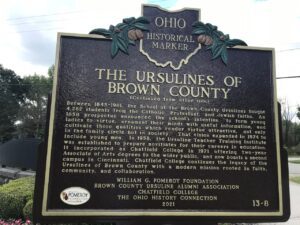
On July 21, 1845, eleven Ursuline sisters from Boulogne-sur-Mer and Beaulieu, France, arrived in St. Martin, Brown County, Ohio. A Catholic order of sisters known for providing quality education to young women, the Ursulines were invited by Cincinnati Archbishop John Baptist Purcell (1800-1883) to establish a school in the diocese and granted approximately 400 acres in St. Martin for that purpose. Led by Mother Julia Chatfield (1808-1878), the sisters quickly established their convent, a day school, and, within the year, admitted their first boarders. Originally known as The Saint Ursula Literary Institute, the school operated for the next 136 years. The Ursulines educated local students from their adopted Brown County as well as many who came from across the U.S. and farther abroad to board on campus. (Continued on other side)
, OH
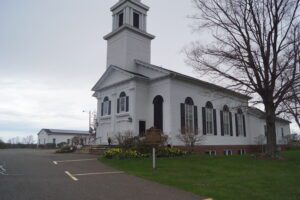
The First Congregational Church of Claridon has served the community since it was dedicated in the summer of 1832. Twenty-seven souls from the Burton Congregational Church petitioned to form their own church in Claridon in November 1827, and their request was granted the following month. In 1830, a committee made up of Cotton Kellogg, Chester Treat, and Asa Cowles contracted with John Talbot and Rufus Hurlburt to build the church. When “sledding” came during the winter of 1831, logs were hauled to Cotton Kellogg’s sawmill to be cut into lumber. (Continued on other side)
, OH
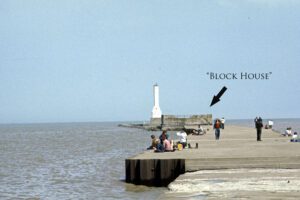
Lake Erie commerce has played a central role in the development of Huron. Important among Huron’s maritime industries were shipbuilding and commercial fishing. The city’s shipbuilding industry dates to the first decades of the nineteenth century. Shipyards were located on the Huron River’s west bank, slightly north of this marker, and also upstream at Fries Landing. Among the vessels built at Huron were the Great Western, constructed in 1838 and the first lake ship to have above-deck cabins, and the Golden Age, which, at 286 feet, was the largest craft on the Great Lakes when built in 1886. Huron shipbuilding declined as the nineteenth century drew to a close. Commercial fishing emerged thereafter, serving as Huron’s economic cornerstone for over fifty years. Huron’s fishing enterprises included the Huron, Kishman, Scott, and Zimmerman fish companies. By 1950, however, polluted lake waters ravished the once-lucrative industry. Although shipbuilding and commercial fishing are no longer a part of Huron’s daily life, they each had a profound effect upon the community’s growth for nearly two centuries.
, OH
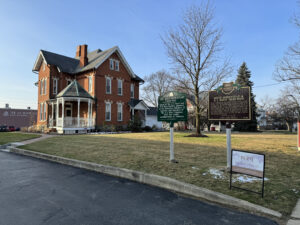
The Root Homestead was built in 1879 by Amos Ives Root, founder of the A. I. Root Company, shortly after he moved his business from the town square. The homestead housed several generations of the Root family until 1953 and was listed on the National Register of Historic Places in 1975. A pioneer of the beekeeping industry, Root helped to standardize such beekeeping equipment and tools as the Langstroth removable frame hive and the centrifugal honey extractor. As a result, beekeepers were able to harvest more honey every season without harming the bees. A prolific author and publisher, Root educated beekeepers across the globe and built a sense of community within the profession. (Continued on other side)
, OH
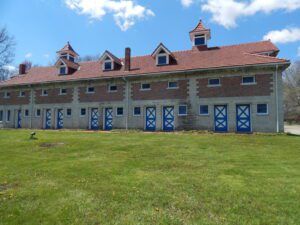
Ohio Columbus Barber, a wealthy Ohio businessman and founder of Barberton, retired in 1905 to develop his Anna Dean Farm. Built in 1910, the colt barn was a part of this 3000-acre estate. Although originally intended for bulls, the building was converted in 1912 to a stable for colts. Akron architects Harpster and Bliss designed the barn, and it was the smallest on the farm. Like many buildings erected by Barber, the colt barn features the patriotic red, white, and blue color scheme he favored. Between Barber’s death in 1920 and the founding of the Barberton Historical Society in 1974, all but nine of the estate’s thirty-five original buildings were razed. The historical society saved the colt barn in 1978, which led to the birth of the city’s historic preservation movement. The society completed restoration of the colt barn in 1998 with a grant from the Barberton Community Foundation.