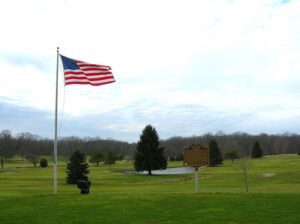
Golfer and World War II veteran William J. Powell, excluded from playing on many American golf courses because of his race, overcame the indignity of discrimination by creating his own course. Hand built in two years and opened in 1948, Clearview Golf Club is the first golf course in the United States designed, built, and owned by an African-American. The acclaimed course harmonizes with the landscape and bears many design elements of traditional British courses. A triumph of perseverance over discrimination, Clearview represents the historic postwar era when athletes first broke the “color line” in American sports.
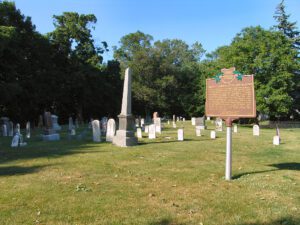
Israel Harrington (1779-1841) established a tavern at Lower Sandusky (now Fremont) shortly after the War of 1812. As a judge and land speculator, Harrington influenced the organization of much of northwestern Ohio. In 1824 he traded the tavern for land a short distance from this site, where an Indian trail crossed the Portage River. Elmore grew from this settlement. Harrington and his father (also Israel Harrington, a veteran of the American Revolution) are interred here, along with many of the pioneers who transformed this section of the Black Swamp into productive farmland.
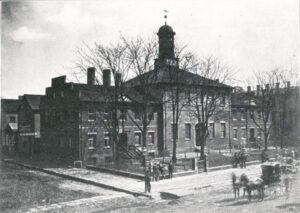
In 1809 the citizens of Zanesville erected a building on this site which served as the capitol of Ohio from October 1, 1810, until May 1, 1812. The 9th and 10th sessions of the Ohio General Assembly met here before returning to Chillicothe in May 1812. The building was then used as the Muskingum County Courthouse until the present courthouse was built in 1874. The 1809 date stone from the old building was incorporated into the new building and may be seen over the front steps.
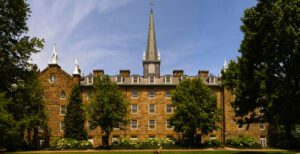
The state’s oldest private institution of higher education, Kenyon College was founded in 1824 in Worthington by Philander Chase, first Episcopal bishop of Ohio, and relocated to Gambier four years later. Both college and village are named for British benefactors, statesman Lord Kenyon and naval hero Lord Gambier. Throughout its history, Kenyon has prepared men and women for leading roles in society, including nineteenth-century graduates Edwin M. Stanton, Abraham Lincoln’s secretary of war, and Rutherford B. Hayes, Ohio governor and U.S. president. In the twentieth century, Kenyon educated such literary luminaries as poet Robert Lowell and novelist E.L. Doctorow. Kenyon has also been an innovator in education-the Advanced Placement Program began as the Kenyon Plan in the 1950s.
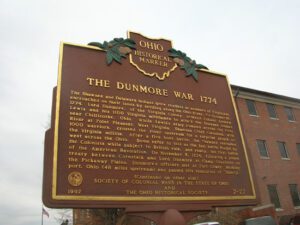
The Shawnee and Delaware Indians grew restless as numbers of Virginians encroached on their lands by settling along the Ohio River. On October 10, 1774, Lord Dunmore, of the Virginia Colony, ordered Colonel Andrew Lewis and his 1100 Virginia militiamen to attack the Shawnee Indians near Chillicothe, Ohio. While Lewis’s army camped across the Ohio River at Point Pleasant, West Virginia, Shawnee Chief Cornstalk, with 1000 warriors, crossed the river upstream for a surprise attack on the Virginia militia. After a five hour battle, the Shawnee retreated west across the Ohio. Some refer to this as the last battle fought by the Colonists while subject to British rule, and really, the first battle of the American Revolution. On November 5, 1774, following a peace treaty between Cornstalk and Lord Dunmore at Camp Charlotte on the Pickaway Plains, Dunmore’s officers met at Fort Gower, Hockingport, Ohio (48 miles upstream) and passed this resolution of “liberty”: (continued on other side)
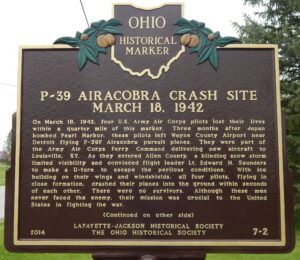
On March 18, 1942, four U.S. Army Air Corps pilots lost their lives within a quarter mile of this marker. Three months after Japan bombed Pearl Harbor, these pilots left Wayne County Airport near Detroit flying P-39F Airacobra pursuit planes. They were part of the Army Air Corps Ferry Command delivering new aircraft to Louisville, KY. As they entered Allen County, a blinding snow storm limited visibility and convinced flight leader Lt. Edward H. Saunders to make a U-turn to escape the perilous conditions. With ice building on their wings and windshields, all four pilots, flying in close formation, crashed their planes into the ground within seconds of each other. There were no survivors. Although these men never faced the enemy, their mission was crucial to the United States in fighting the war.
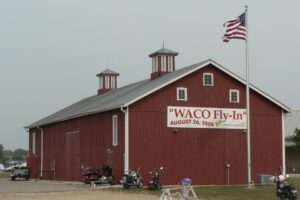
Founded in 1921 as the Weaver Aircraft Company and located in Lorain, Ohio, the Waco Aircraft Company relocated to Troy in March 1923. It was the first aircraft company to use assembly line production and shock strut landing gear. Leading all civilian aircraft production at a ratio of two to one from 1927-1929, the company had sales distributors in 24 countries worldwide. The United States government became the prime contractor of Waco Aircraft Company’s troop/cargo gliders (CG-4A) used extensively during World War II. The company also managed the U.S. Army’s glider program for 15 companies that produced gliders nationwide. The last WACO, model W “Aristrocrat,” was built in Troy in June 1947.
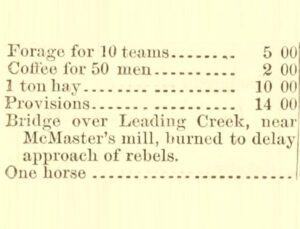
General John Hunt Morgan led a force of 2,000 Confederate cavalrymen into Meigs County on July 18, 1863, during a raid north of the Ohio River. More than 50,000 Union troops and mlitia pursued Morgan across the State of Ohio. At Langsville, in an attempt to delay the Confederate approach, local militia burned the bridge near McMaster’s grist mill. This was the first burned bridge encountered by the Confederates on their trek across Kentucky, Indiana and Ohio. A young Confederate soldier, shot and killed by a local resident, was buried near this site. After suffering losses at Buffington Island, Morgan surrendered eight days later near West Point in Columbiana County. The surrender field was the northernmost point reached by Confederate forces during the Civil War.