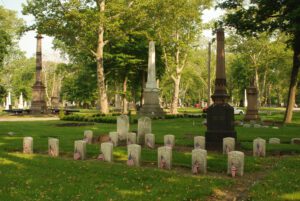
Howard Daniels, who lived from 1815-1863, was a noted architect and landscape gardener. Over the course of his life, he designed six Ohio and New York cemeteries, including Woodland that began in 1852 when he laid out 20 of its 60 acres into fashionable “rural cemetery” style. Later acreage in the cemetery adapted his curvilinear design. “As beautifully prepared for a burial place as fancy and taste could desire,” Woodland was dedicated on June 14, 1853, and became Cleveland’s primary cemetery. An ornate gatehouse, chapel, and fountains came later. Generations of Clevelanders, pioneering and prominent, as well as veterans onward from the War of 1812, are buried here. For more than a century, Woodland, in its original and newly platted sections, has embraced people from every race, the rich and poor, natives and immigrants, and the famous and obscure. It has truly become a community cemetery. [continued on other side]
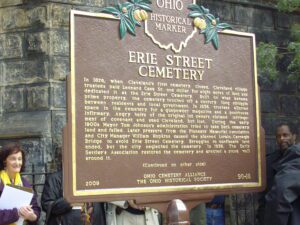
In 1826, when Cleveland’s first cemetery closed, Cleveland village trustees paid Leonard Case Sr. one dollar for eight acres of land and dedicated it as the Erie Street Cemetery. Built on what became prime property, the cemetery touched off a century long struggle between residents and local government. In 1836, trustees allotted space in the cemetery for a gunpowder magazine and a poorhouse infirmary. Angry heirs of the original lot owners claimed infringement of covenant and sued Cleveland, but lost. During the early 1900s Mayor Tom Johnson’s administration tried to take back cemetery land and failed. Later pressure from the Pioneers’ Memorial Association and City Manager William Hopkins caused the planned Lorain Carnegie Bridge to avoid Erie Street Cemetery. Struggles to confiscate land ended, but the city neglected the cemetery. In 1939, The Early Settler’s Association restored the cemetery and erected a stone wall around it. (continued on other side)
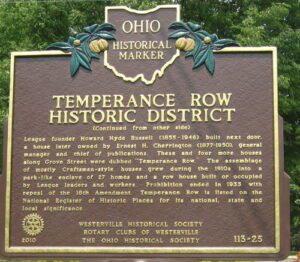
Here lived the reformers of the Anti-Saloon League of America who led the movement that turned the United States “dry” in 1920 with the 18th Amendment prohibiting the manufacture, sale or transportation of intoxicating liquor. Moving its headquarters to Westerville in 1909, the League built a publishing house that buried the liquor industry in a 10-year avalanche of books, pamphlets and periodicals that helped win Prohibition and made Westerville the “Dry Capital of the World.” Rev. Purley A. Baker (1858-1924), the League’s general superintendent, bought 11 acres and erected his rustic home at Park and Grove streets in 1910. (Continued other side)