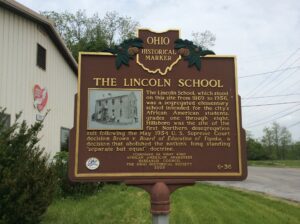
The Lincoln School, which stood on this site from 1869 to 1956, was a segregated elementary school intended for the city’s African American students, grades one through eight. Hillsboro was the site of the first Northern desegregation suit following the May 1954 U.S. Supreme Court decision Brown v. Board of Education of Topeka, a decision that abolished the nation’s long standing “separate but equal” doctrine. (Continued on other side)
The Pittsburgh No. 8 coal seam, located 100 feet below river level at Powhatan Point, extends across much of eastern Ohio, western Pennsylvania, and northern West Virginia. The Cleveland and Western Coal Company, founded by Cleveland industrialist Frank E. Taplin, opened the Powhatan No. 1 mine here in 1922 to take advantage of both river and rail transportation. It became the largest deep mine in Ohio and was the first mine in the state to be completely mechanized. Reorganized as the North American Coal Corporation in 1925, the company operated seven shaft mines in this area during the twentieth century. Four of these mines closed between 1980 and 1984 as clean air standards made locally mined high-sulfur coal difficult to market.
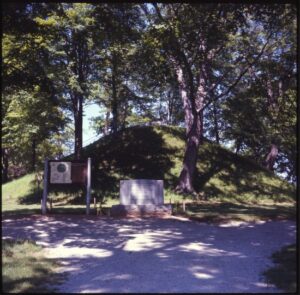
Major John James (1772-1854) established James Cemetery in 1828 on and around a Native American mound that is the only significant ancient mound remaining in the city of Jackson. The mound is about 70 feet in diameter and nearly six feet tall. In the late 1800s, this mound comprised one point of three ancient mound groups forming a triangular configuration along East Broadway Street, formerly known as James Street. One group was a few hundred feet northeast of here on the Watson farm and a second was just to the northwest on the Warnicke farm. These mounds were built by the Hopewell Culture, prominent in southern Ohio from about 100 BC to 400 AD. Major James, his wife, and several immediate family members are buried on the mound including Jackson County pioneers Andrew Long, Daniel Hoffman, and David Mitchell.
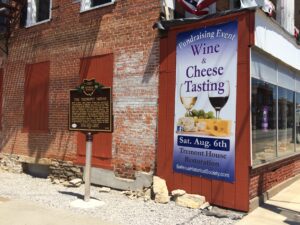
Built in 1846, the Tremont House was opened by Loel and Samuel B. Chandler to serve stagecoach traffic on the Maumee Pike (U.S. Route 20). Briefly a hotel, this Bellevue landmark has housed grocery and hardware stores, a pharmacy, and even a cigar factory. The third floor ballroom hosted community events and fraternal organizations such as the Independent Order of Odd Fellows (IOOF). The building’s west side is on the western boundary of the Firelands region of the Connecticut Western Reserve. An example of Greek Revival architecture, the Tremont House was listed on the National Register of Historic Places in 2006.
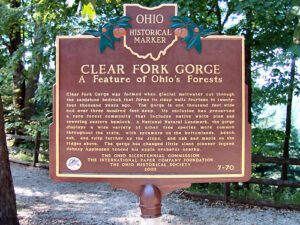
Clear Fork Gorge was formed when glacial meltwater cut through the sandstone bedrock that forms its steep walls fourteen to twenty-four thousand years ago. The gorge is one thousand feet wide and over three hundred feet deep. Its seclusion has preserved a rare forest community that includes native white pine and towering eastern hemlock. A National Natural Landmark, the gorge displays a wide variety of other tree species more common throughout the state, with sycamore on the bottomlands, beech, ash, and tulip farther up the slopes, and oak and maple on the ridges above. The gorge has changed little since pioneer legend Johnny Appleseed tended his apple orchards nearby.
Born on September 28, 1769 in New Bedford, Massachusetts, Bathsheba Rouse is recognized as the first woman to teach in the Northwest Territory. Rouse arrived in the region along with other pioneers in 1788. The following year, the Belpre community employed Rouse to teach young children in the Farmers’ Castle near the Ohio River. Instruction in reading, writing, and sewing was reserved for the girls, while boys received lessons in reading, writing, and arithmetic. Rouse taught in Belpre for several terms before marrying Richard Greene and settling at nearby Marietta. Their descendants attained civic prominence in Washington County for generations. Bathsheba Rouse Greene died on February 27, 1843 at the age of seventy-three and is buried alongside her husband in Marietta’s Mound Cemetery.
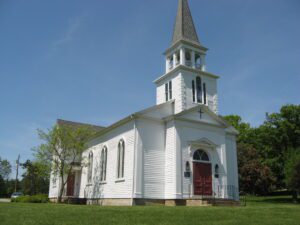
The first home of the oldest Episcopal parish in the Connecticut Western Reserve, the St. James Episcopal Church was built between 1827 and 1828. Philander Chase, first Bishop of the Diocese of Ohio, consecrated it in 1829. The belfry and steeple were added in 1881. It was moved to this site from its original Market Street location in 1972 after the parish built a new church. Renamed the St. James Meeting House, it is the anchor of a community of historic buildings that includes the Beardsley-Walter-Diehm House (circa 1828), the Oswald Detchon House (circa 1840), and the Schiller-Chuey Summer Kitchen. The oldest known structure in Boardman, the St. James Meeting House was added to the National Register of Historic Places in 1979.
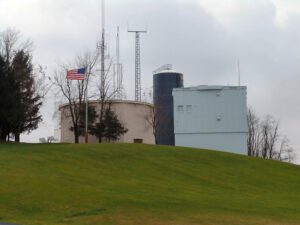
Campbell Hill is named for Charles D. Campbell of Bellefontaine, who owned this land from 1898 to 1937. A marble stone marker atop the hill, set in 1900 by the U.S. Coast and Geodetic Survey, marks it as the highest point in Ohio at an elevation of 1549.09 feet. In 1951, the federal government established the 664th Aircraft Control and Warning (AC&W) Squadron here as part of the North American Air Defense Command (NORAD). Its military and civilian operators used sophisticated radar and computer equipment to locate and identify aircraft as friendly or suspicious, and relayed information to a central site in Battle Creek, Michigan. This Cold War site operated until 1969. It was converted to civilian use as a vocational education center in 1974.