

, OH
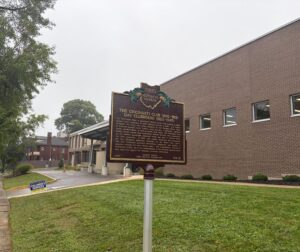
The Cincinnati Club, a prominent Jewish social club founded in 1889, opened their clubhouse at 2840 Melrose Avenue in 1894. A.E. Elzner designed the brick and stone building in the Norman-Gothic style. It featured massive round towers, wide porches, a ballroom, billiard rooms, bowling alley, as well as ornate club rooms. The Cincinnati Club hosted lavish events that celebrated Jewish identity and community. As the Jewish population migrated north and east of Walnut Hills, the club dissolved. In 1922, the vacant clubhouse was purchased by the Disabled American Veterans of the World War (DAV). The DAV Clubhouse provided recreation, resources, and shelter to disabled veterans for over twenty years. The organization, founded in Cincinnati in 1920, led to the establishment of the Veterans Administration and improved support for wounded veterans nationwide.
, OH
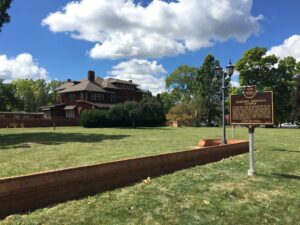
The Harding Hospital, initially called the Columbus Rural Rest Home, was founded in 1916 by George T. Harding II, MD (1878-1934) and his associates, many of whom shared his commitment to service and his Seventh-day Adventist Christian faith. The psychiatic treatment center moved to Worthington in 1920. The hospital’s goal was to provide treatment with attention to the person’s physical, mental, social and spiritual needs. The program, with its emphasis on relational issues and psychotherapy, drew patients from across Ohio and beyond. In 1936 a residency program in psychiatry for physicians was started and educational programs for other mental health professionals followed. The campus’ beauty contributed to its being a place of healing for many. Since 1999, Harding Hospital has been a part of The Ohio State University’s Wexner Medical Center.
, OH
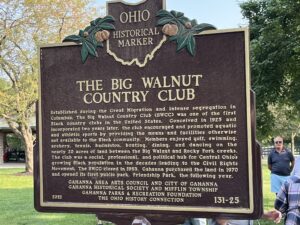
Established during the Great Migration and intense segregation in Columbus, The Big Walnut Country Club (BWCC) was one of the first Black country clubs in the United States. Conceived in 1925 and incorporated two years later, the club encouraged and promoted aquatic and athletic sports by providing the means and facilities otherwise not available to the Black community. Members enjoyed golf, swimming, archery, tennis, badminton, boating, dining, and dancing on the nearly 20 acres of land between the Big Walnut and Rocky Fork creeks. The club was a social, professional, and political hub for Central Ohio’s growing Black population in the decades leading to the Civil Rights Movement. The BWCC closed in 1963. Gahanna purchased the land in 1970 and opened its first public park, Friendship Park, the following year.
, OH
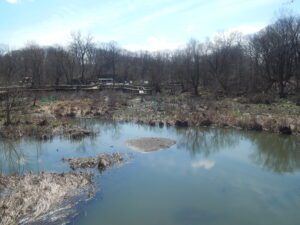
Around 1895 a park system was created connecting the corridor of Doan Brook from Shaker Lakes to Gordon Park on Lake Erie. In 1915, the Shaker Heights Land Company and Van Sweringen Company deeded property to the City of Cleveland for the park. In 1947, Cleveland leased to the cities of Shaker Heights and Cleveland Heights portions of the park within their boundaries. A proposed “Clark Freeway” (I-290) linking I-271 to downtown Cleveland through the park threatened the area in the 1960s. The proposal faced strong opposition from the Park Conservation Committee, a coalition of 30 garden clubs, the City of Shaker Heights, the Cleveland Heights PTA Council, the Shaker Historical Society, and other organizations. Governor James Rhodes withdrew the plans in 1970. The Clark Freeway was defeated and the park preserved.
, OH
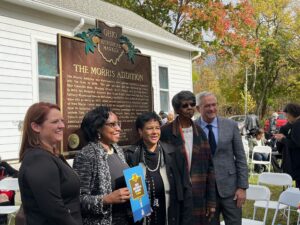
Bethel A.M.E. Church was the first African American church in Worthington. Black residents joined Worthington’s established churches as early as 1847 or worshipped together in their homes. Peter Banks with D.H. Taborn, Charles Kiner, J.T. Horton, and James Birkhead organized the A.M.E. congregation in 1896. Rapid growth moved their meetings to the Worthington Town Hall by 1897. A lot was purchased from Millie Alston on September 24, 1897, and a house relocated to serve as Bethel Chapel. Local carpenter Chester Hard constructed a new building that was dedicated as St. John A.M.E. in 1914. The church has served as the religious and social hub of Worthington’s Black community for more than a century. While St. John A.M.E. Church retains their original location, worship services moved to 7700 Crosswoods Drive in 2004.
, OH
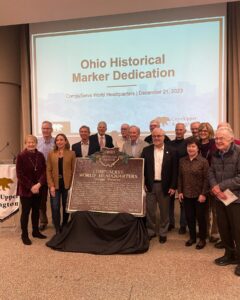
The world headquarters of CompuServe was located on the six-acre site at 5000 Arlington Centre Boulevard from 1973 to 2009. Incorporated in 1969, Compu-Serve Corporation (later CompuServe Inc.) was the first major online information services provider. Its subscribers were the first to have access to email, online newspapers and magazines, the ability to share and download files, and a variety of popular chat forums. One especially successful CompuServe innovation was the GIF graphics format. Increasing competition and a succession of corporate owners pressed CompuServe into the fate of many tech start-ups and it ran its course. It did, however, introduce millions of people to online connectivity, social networking, and laid the foundation for the widespread use of the internet.
, OH
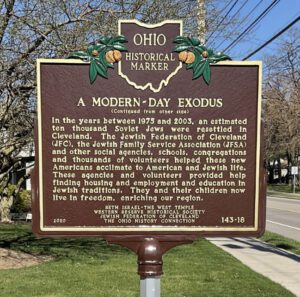
Here in 1963 congregants of Beth Israel-The West Temple, led by Louis Rosenblum, Herb Caron, and Rabbi Daniel Litt, founded the Cleveland Committee (later Council) on Soviet Anti-Semitism, the first American organization created to advocate for freedom for Soviet Jews. In 1970 this work led to the formation of the Union of Councils for Soviet Jews (UCSJ) under the leadership of Louis Rosenblum. The UCSJ, whose national office was located here 1970-1973, became the largest independent Soviet Jewry organization in the world. By the turn of the 21st century, the efforts begun here helped 1.6 million Jews leave the former Soviet Union. (Continued on other side)
, OH
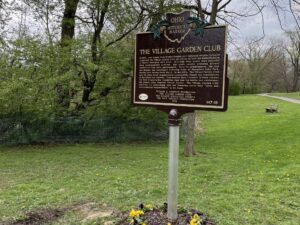
In 1930, nine women from Shaker Heights and Cleveland Heights formally organized The Village Garden Club and set as its goal the beautification of Shaker Parklands with trees. At a time when women were excluded from environmental activism, the club’s careful planning allowed members to lead civic improvements. Since its establishment, the club has planted and maintained flowering trees at Horseshoe Lake Park, pausing only during World War II. In the 1960s, The Village Garden Club and 34 other local organizations successfully fought the construction of the Clark-Lee Freeway. Club member Mary Elizabeth Croxton chaired the Park Conservation Committee that won the battle and established the Shaker Lakes Regional Nature Center. The Village Garden Club continues its stewardship over the flowering grove with “civic and environmental responsibility” as its focus.