Ella Nora Phillips Myers Stewart was one of the first practicing Black women pharmacists in the United States. After she married William Stewart in 1920, the couple settled in Youngstown, then moved to Toledo where they opened Stewart’s Pharmacy in 1922. Having broken professional barriers, Ella Stewart became a tireless civil rights champion. Advocating for Black women she was active in the Enterprise Charity Club and was a 1937 charter member of Beta Lambda and Toledo Alumnae chapters of Delta Sigma Theta Sorority. She served on the National Association of Colored Women Clubs, the Women’s Advisory Committee of U.S. Department of Labor, and Pan-Pacific Southeast Asia Women’s Association. Toledo’s Ella P. Stewart Academy for Girls was named in her honor in 1961. She was inducted into the Ohio Women’s Hall of Fame in 1978.
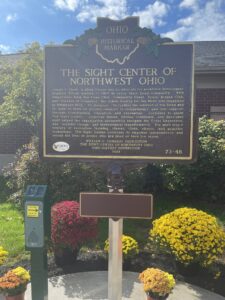
Joseph F. Clunk, a blind Ohioan and an advocate for workforce development, inspired Toledo leaders in 1923 to serve their blind community. With cooperation from the Lions Club, Community Chest, Toledo Rotary Club, and Chamber of Commerce, the Toledo Society for the Blind was organized in November 1923. Its purpose, “to further the interest of the blind and to open to them all possible avenues to independence and self-support, through investigation, education, and recreation,” continues to guide The Sight Center. Generous donors, tireless volunteers, and dedicated staff helped the organization successfully navigate the Great Depression, war, societal change, and technological transformation. For more than a century of innovative training, classes, clubs, clinics, and assistive technology, The Sight Center continues to empower independence and enrich the lives of people who are blind or have low vision.
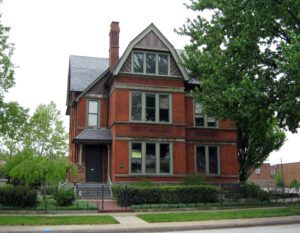
The Sarah Benedict House is a rare survivor of the once fashionable Upper Prospect neighborhood that included “Millionaires Row” on adjacent Euclid Avenue. Sarah Rathbone Benedict had this Queen Anne-inspired house built in 1883, when she was 68, and lived here until her death in 1902. She was active in the social, religious, and charitable life of Cleveland. Sarah Benedict was the widow of George A. Benedict, editor of the Cleveland Daily Herald. The house was given to the Cleveland Restoration Society by Dr. Maxine Goodman Levin in 1997 and rehabilitated for its headquarters in 1998. It is listed in the National Register of Historic Places and contributes to the locally designated Prospect Avenue Historic District.
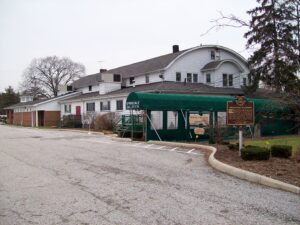
Springvale Ballroom is located on part of the one hundred and forty acre tract that English immigrant John Biddulph bought in 1840. Fred Biddulph, John Biddulph’s grandson, was born near this site in 1887. Fred and his wife, Clara, built the five thousand square foot Springvale Ballroom. On May 19, 1923, they paid fifteen dollars for the right to open the dancing pavilion. The first dance at Springvale Ballroom was held on May 23rd. A five hole golf course was added to the property in 1928. Later changes to Springvale included renovation of the ballroom, the addition of a golf office, and an upgrade to a full eighteen hole course.
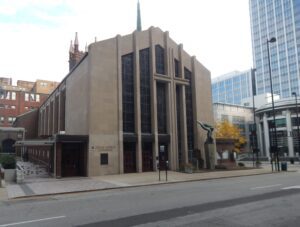
In 1817 twenty-two men, including future President William Henry Harrison, chartered Cincinnati’s first Episcopal parish, Christ Church. In 1835 members erected a Gothic Revival-style church on this site. The neighborhood evolved as the city grew with the influx of immigrants. Parish women raised funds to teach, feed, clothe, and shelter tenement families, and alleviate suffering during floods and disease outbreaks. In 1883 the women helped establish what became Cincinnati Children’s Hospital. In 1909 members opened the Late Gothic-style Parish House, a community center with kitchen, classrooms, library, auditorium, clinic, gymnasium, and bowling alley. By the parish’s centennial in 1917, music had expanded beyond worship to public concerts. In 1940 the annual Boar’s Head Festival of music and pageantry began. Since the 1960s, members have collaborated with local agencies to advocate for social and economic justice, a mission continuing into the 21st century. (Continued on other side)
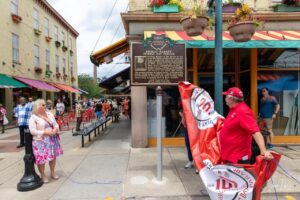
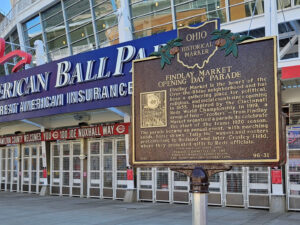
Findlay Market is the heart of the Over-the-Rhine neighborhood and has been a gathering place for political, religious, and social events since opening in 1855. Inspired by the Cincinnati Reds World Championship in 1919, a group of fans –“rooters” – from Findlay Market organized a parade to celebrate the start of the team’s 1920 season. The parade became an annual event, with marching bands, horse-drawn “Tally-Ho” wagons and rooters processioning to Redland and later Crosley Field, where they presented gifts to Reds officials. (Continued on other side)
Findlay Market is the heart of the Over-the-Rhine neighborhood and has been a gathering place for political, religious, and social events since opening in 1855. Inspired by the Cincinnati Reds World Championship in 1919, a group of fans – “Rooters” – from Findlay Market organized a parade to celebrate the state of the team’s 1920 season. The parade became an annual event, with marching bands, horse-drawn “Tally-Ho” wagons and rooters processioning to Redland and later Crosley Field, where they presented gifts to Reds officials. (Continued on other side)
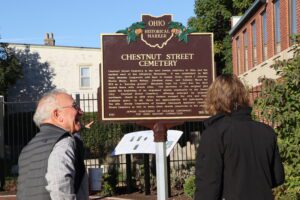
Chestnut Street Cemetery is the first Jewish cemetery in Ohio and the earliest west of the Allegheny Mountains. It was established in 1821 when Nicholas Longworth sold land to Joseph Jonas, David I. Johnson, Morris Moses, Moses Nathan, Abraham Jonas, and Solomon Moses for $75 as a “burying ground.” Benjamin Lape (or Leib) was the first buried there with Jewish rites. The purchase of the original plot marks the beginning of an organized Jewish community in the Queen City. Chestnut Street Cemetery, although enlarged by adjacent purchases, closed in 1849 when cholera ravaged the city and filled available space. In all, there are approximately 100 interments on the site. Jewish Cemeteries of Greater Cincinnati maintains Chestnut Street Cemetery as well as many other Jewish cemeteries in the region.