

, OH
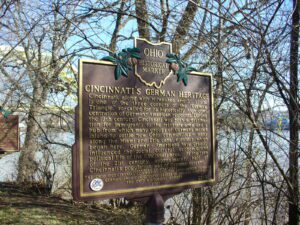
Cincinnati, along with Milwaukee and St. Louis, is one of the three corners of the “German Triangle,” so-called for its historically high concentration of German-American residents. During the 19th century, Cincinnati was both a destination for immigrants to the tri-state area and a hub from which many groups of Germans moved inland to settle new Ohio communities-many along the Miami and Erie canal corridor which began here. German-Americans have greatly influenced the social, cultural, economic and political life of the Cincinnati area. At the turn of the 21st century, approximately half of Cincinnati’s population was of German descent. (Continued on other side)
, OH
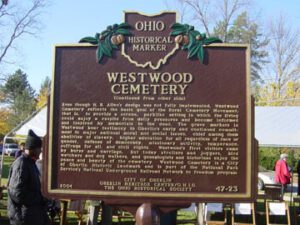
Shortly after Oberlin Colony was established in 1833, a two-acre burying ground was set aside south of Plum Creek in the area bounded by Main, Morgan, and Professor streets. By 1861, however, with the town and Oberlin College growing and the Civil War escalating, the need for a larger cemetery became clear. After an extensive search, 27.5 acres of land belonging to Henry Safford were acquired one mile west of the center of Oberlin. H.B. Allen was hired to create a design in the style of the Rural Cemetery Movement, and in July 1864 Westwood Cemetery was formally dedicated. Burials in Westwood had actually begun in August 1863, and over the next few years hundreds of remains were reinterred from Oberlin’s “Old Cemetery” and from burying grounds in surrounding communities. In the mid-1860s the cemetery was enlarged to its present 47 acres, and in 2004 burials and memorials were estimated to number almost ten thousand. (Continued on other side)
, OH
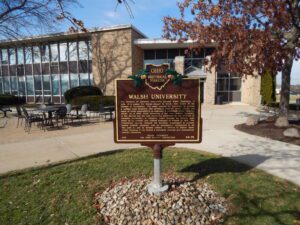
The Brothers of Christian Instruction founded Walsh University in 1958. It is named for Bishop Emmett M. Walsh, then leader of the Diocese of Youngstown. The order created the institution to provide a college-level education that developed students’ moral virtues and sense of social responsibility as embodied in traditional Judeo-Christian values. As of 2015, Walsh University is the only Catholic university in the diocese and the only university sponsored by the Brothers of Christian Instruction, a religious order founded by the Fathers Jean Marie de la Mennais and Gabriel Deshayes in France in 1819. The University’s mission reflects the Brothers’ commitment to provide quality Catholic education with an international perspective to all who seek it, and to develop leaders in service to others. Since Walsh’s founding, it has become a successful regional and international Catholic university.
, OH
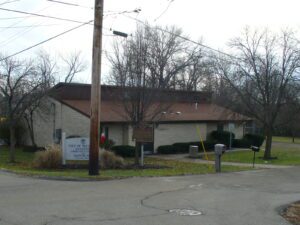
Civic organizations played pivotal roles in the development of the residential community of Hazelwood, founded as a subdivision of Blue Ash in 1888. The Hazelwood Civic Association, initially established as the Brothers Civic Society in 1941, addressed community needs by working for public improvements and promoting civic relations through social events and educational programs. Efforts by the HCA led to the construction of a new civic center and the introduction of the Boy and Girl Scouts and other programs that were previously unavailable to African-American children. Hazelwood’s deterioration and the threat of encroaching industrial development led to the formation of the Hazelwood Improvement Corporation in 1968. The HIC, acting as an agent of the city of Blue Ash, helped to upgrade housing, pave roads, build new homes to ensure a residential nature, install water and sewage systems, and erect streetlights. In 1997, the Hazelwood Community Association was organized to assist residents during Hazelwood’s transition to a racially integrated community.
, OH
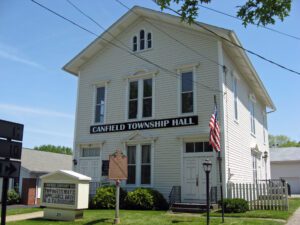
The Canfield Township Hall was erected in 1884. It served as the first public building in which the Canfield citizens could conduct town business, elections, and public meetings. An example of Renaissance Revival or “Italianate” architecture, the building is typical of late Victorian commercial buildings, but constructed of wood rather than of the customary brick. Drafted by Colonel S. Kinney, it was originally constructed for the sum of $2,389 by G.W. Strock at the corner of South Broad and East Main streets, on a lot purchased for $500. In 1936, R.J. Neff moved the hall several hundred feet south to its present location. In addition to official township meetings, the second floor has been used for a variety of activities, including social meetings, lectures, contests, dances, and roller-skating. The building served as an early home of the Canfield Historical Society and operated continuously for over one hundred and twenty-five years.
, OH
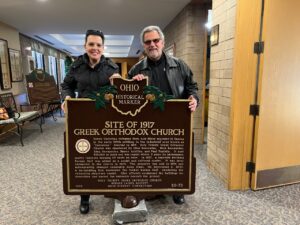
Greek Christian refugees from Asia Minor migrated to Canton in the early 1900s settling in the industrial area known as “Carnahan.” Erected in 1917, Holy Trinity Greek Orthodox Church was chartered by Elies Korosedes, Nick Kessenides, Alex Heropoulos, Harry Achilles, and Paul Paulidis. It cost $50,000 to build and was repaid within 3 years by parishioners, mostly laborers earning 30 cents an hour. In 1927, a separate building Koraes Hall was added as a social and cultural center. It was later connected to the church in 1934. The property was sold in 1976 and subsequently changed ownership many times. On September 2, 2020, a devastating fire destroyed the former Koraes Hall, rendering the remaining structure unsafe. City officials condemned the buildings for demolition and buried the remnants beneath the ground.
, OH
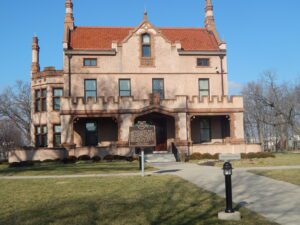
Katharine Kennedy Brown (1891-1986), born in Dayton, was a leading figure in local, state, and national Republican politics. Soon after the 19th Amendment was passed in 1920, she earned a seat on the Montgomery County Republican Executive Committee; moving up to the Ohio State Republican Central Committee in 1928 and the Republican National Committee in 1932 ─ serving on both until 1968. She founded the first Republican Women’s Club in the county. (Continued other side)
, OH
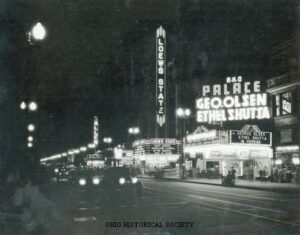
The Theater District, bound by Chester Avenue, Prospect Avenue, East 18th, East 9th and East 12th Streets, came into being at the turn of the 20th century, when Cleveland emerged as a thriving metropolis. Built between 1890-1928, the area hosted a variety of fine retail stores, theaters, prestigious clubs, restaurants, and distinct office buildings. The rise of television and flight to the suburbs sent downtown entertainment into a death spiral, until a 1970 grass roots effort saved from demolition the surviving post-World War I theaters (the State, Ohio, Hanna, Allen, and Palace), making it the “world’s largest theater restoration project.” It became a catalyst for reinvestment in downtown properties, restoring civic pride and giving testimonial to the creative vision of the city’s civic leaders and citizenry. By the year 2000, Cleveland’s Theater District boasted the nation’s 2nd largest performing arts center.