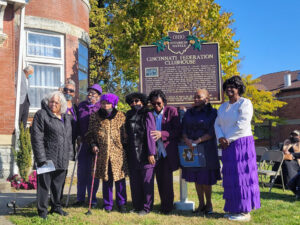
“Lifting As We Climb”: The Cincinnati Federation of Colored Women’s Clubs (CFCWC) was organized May 6, 1904, during a meeting called by Mary Fletcher Ross at the Allen Temple A.M.E. Church. Gathering together eight existing African-American women’s clubs, the CFCWC sought to unite in their work promoting “the betterment of the community.” At a time when both government and private philanthropies overlooked the needs of Black Americans, CFCWC members helped to organize the city’s first kindergartens for Black children, taught in Cincinnati African-American public schools –including the Walnut Hills Douglass and Stowe schools—and raised money for the Home of Aged Colored Women. Since 1904, the Cincinnati Federation of Colored Women’s Clubs has ensured the civic and constitutional rights of all African Americans while meeting the needs of their city.
In 1911 local doctors founded the St. Clair Hospital. The home adjacent to the hospital served as a residence home and training school for nurses. In 1940, the hospital was converted into a convalescent home. In 1948, Mr. and Mrs. William J. Garrett, an African-American couple, transformed the facility into a hotel. The Hotel St. Clair, which closed in 1976, accommodated African Americans who were not permitted to stay in white hotels. It also served as a social gathering place for members of Columbus’ black community.
James W. Rankin served four consecutive terms (1971-1978) in the Ohio House of Representatives. Born and raised in Cincinnati, he graduated from Withrow High School and The Ohio State University’s School of Social Work. While working in Cincinnati’s Seven Hills neighborhood, he ran for office to “involve the disadvantaged in the governmental processes that affected their lives.” He won his first bid and served the next seven years as a state representative for the 69th House district, later the reapportioned 25th district. Representative Rankin fought passionately for civil and human rights in education and public policy. He served on the Reference, Human Resources, and Finance committees. When Rankin died of pneumonia, aged 52, the Cincinnati Enquirer proclaimed him a “Friend of the Poor.”
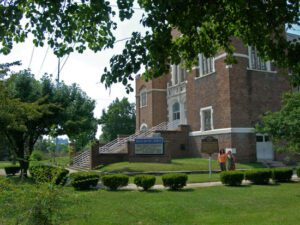
The Shiloh Baptist Church was completed in 1923. Founded in 1869, Shiloh is the third oldest African-American church in Columbus and is a descendent of the Second Baptist Church. The church is located in the Mt. Vernon neighborhood, which is adjacent to the central businesses of Columbus and Interstate 71. The dominant physical presence of Shiloh Baptist Church shows its importance as a religious and social institution for more than one hundred years in the Mt. Vernon area.
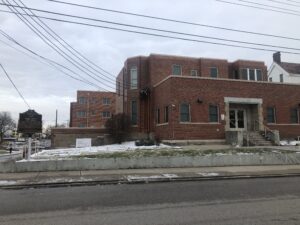
Walnut Hills has been home to a significant middle- and working-class Black community since the 1850s. In 1931, African American entrepreneur Horace Sudduth bought 1004 Chapel Street and then the row of buildings across Monfort, naming them the Manse Hotel and Annex. Throughout the 1940s, hotel dinner parties could move to the Federation of Colored Women’s Clubs house next door for dancing. A large addition to the Manse in 1950 created its own ballroom, 24-hour coffee shop, upgraded Sweetbriar Restaurant, and more guest rooms. It appeared in the Negro Motorist’s Green Book between 1940-1963, providing local, transient, and residential guests both catered meetings and top entertainment during the last decades of segregation. It closed in the late 1960s when the economic need for a first-class segregated hotel disappeared in the age of Black Power.
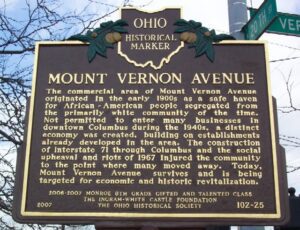
The commercial area of Mount Vernon Avenue originated in the early 1900s as a safe haven for African-American people segregated from the primarily white community of the time. Not permitted to enter many businesses in downtown Columbus during the 1940s, a distinct economy was created, building on establishments already developed in the area. The construction of Interstate 71 through Columbus and the social upheaval and riots of 1967 injured the community to the point where many moved away. Today, Mount Vernon Avenue survives and is being targeted for economic and historic revitalization.
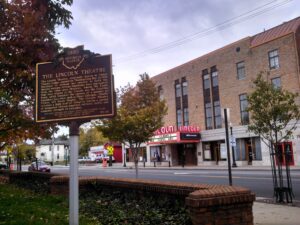
The Lincoln Theatre, originally known as Ogden Theatre Lodge, opened on Thanksgiving Day in 1929. Developer Al Jackson was spurred to build the theatre because African-Americans were segregated from the other area theatres. Among the bands that have played at the Lincoln was the Eckstine Band, which launched the careers of a number of legendary jazz stars such as Dizzy Gillespie, Charlie Parker, and Sarah Vaughn. The Lincoln Theatre retained a high level of integrity during a period of unequaled African-American cultural, social, and economic strength in Columbus.
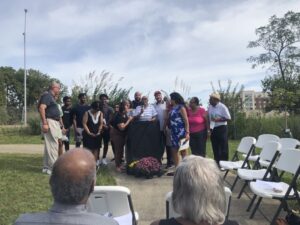
United Colored American Cemetery is among the earliest in situ African American cemeteries in Hamilton County. The 11.6 acres in Madisonville were purchased by the United Colored American Association (UCAA) after the legislated closure of their earlier Avondale cemetery. Many Avondale burials and headstones were moved prior to the new cemetery’s dedication on May 30, 1883. Designed by Adolph Strauch, United Colored American Cemetery features the looping roads and picturesque elements typical of his designs at Spring Grove and Eden Park. After the dissolution of the UCAA, Cincinnati mayor Charles P. Taft asked Union Baptist Church to take ownership and maintenance of the cemetery. Union Baptist assumed ownership in 1968 and burials continued until 2019. United Colored American Cemetery was listed on the National Register of Historic Places in 2022.