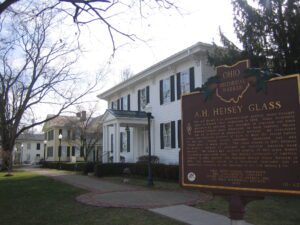
The A.H. Heisey & Co. produced high quality, hand-wrought glass in Newark, Ohio beginning in 1896. Glass originally produced by pressing was intended to simulate cut glass making elegant glass affordable to more families. Heisey was an innovator in production methods. He introduced colors and different patterns of glass to meet the social habits of the era. Highly skilled craftsmen produced, cut, and etched glass in many styles. The plant closed in 1957 because of Heisey’s refusal to produce an inferior machine-made product. The beauty and superior quality of this glass makes it a highly collectable item. The Heisey Collectors of America, founded in 1971, opened The National Heisey Glass Museum in 1974. The Museum stands as a historical reminder and an educational resource to the heritage of the A.H. Heisey & Co.
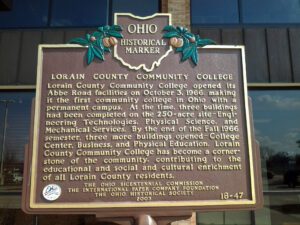
Lorain County Community College opened its Abbe Road facilities on October 3, 1966, making it the first community college in Ohio with a permanent campus. At the time, three buildings had been completed on the 250-acre site-Engineering Technologies, Physical Science, and Mechanical Services. By the end of the Fall 1966 semester, three more buildings opened-College Center, Business, and Physical Education. Lorain County Community College has become a cornerstone of the community, contributing to the educational and social and cultural enrichment of all Lorain County residents.
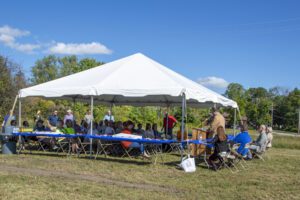
Near this location on May 15, 1823, the first murder trial in Geauga County concluded with the public execution of Benjamin Wright, Jr. On February 1, 1823, Wright stabbed Zophar Warner over a financial dispute, wounding him mortally. The following month, a jury found Wright guilty of murder and ordered that “he be hung by the neck until he be dead.” At the time, executions in Ohio were carried out locally and public hangings were seen by some as social events. The “hanging bee” drew more than 4,000 people, some of whom traveled from upwards of 50 miles to witness the spectacle. One witness wrote, “I felt that he deserved to be hung…but it was an awful site I hope to never the like see again.” Wright’s body was taken to nearby LeRoy for burial and the gallows was dismantled.
Ottawa Park, the largest city park, was developed in the early 1890s on the 280-acre farm of John B. Ketcham. Based on a design by the famous landscape architect, Frederick Law Olmsted, Ottawa Park was intended to be central to a vast park and boulevard system. By 1920 the Toledo Park movement had provided fifteen parks totaling nearly 1400 acres.
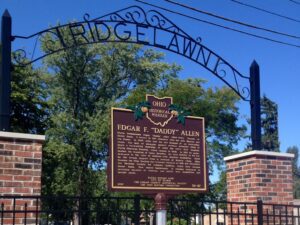
Elyria businessman Edgar “Daddy” Allen (1862 — 1937), founder of Easter Seals, is buried in this cemetery with his wife Blanche and son Homer. In 1907 Allen lost his son because of an interurban crash. The lack of adequate medical services prompted Allen to begin a fundraising campaign to build the city’s first hospital, Elyria Memorial Hospital, which opened in 1908. In 1915 he spearheaded the founding of Gates Hospital, the first facility in the U.S. dedicated to the care of children with physical disabilities. Aided by the strong support from a network of Rotary Clubs, Allen founded the Ohio Society for Crippled Children in 1919 and thereafter the National Society for Crippled Children, which later became Easter Seals. Now named Easterseals, it remains dedicated to providing services to children and adults with disabilities and special needs.
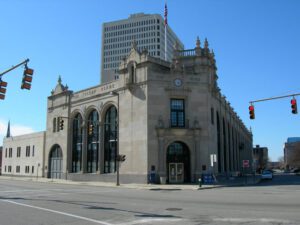
The Toledo Blade is the city’s oldest continuing business. The newspaper was first published on December 19, 1835, during the Ohio-Michigan boundary dispute known as the “Toledo War.” The name is derived from that conflict and the famous swords of Toledo, Spain. A copy of the first edition and two gift swords from that Spanish city are displayed inside the Blade Building.
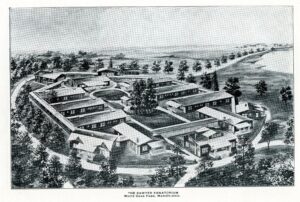
Doctors Charles Elmer Sawyer and his son, Carl Walker Sawyer, opened Sawyer Sanatorium on White Oaks Farm in 1911. Built to provide physical and emotional healing in a unique environment, the complex incorporated six patient bungalows, houses for the two doctors, offices, a large dining and social hall, and treatment buildings. An enclosed quarter-mile-long cloister connected these buildings around a large courtyard. Each bungalow, given botanical names such as “Ivy” and “Rose,” contained individual patient rooms, a communal living room, and bathing facilities. Hydropathic and electropathic treatments buildings were added later. A shady ten-acre knoll on the farm featured a grove of white oak trees that served as a picnic area for patients. Over the years, the facility also hosted local and national social and political events. (Continued on other side)
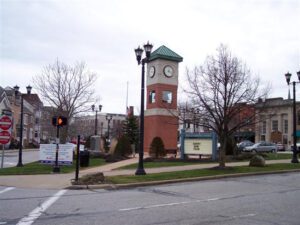
The Triangle, one of the most historic places in Berea, has been the center of the city’s civic life since the mid-19th century. Just beneath lie the solid layers of the famous Berea Sandstone that brought prosperity to Berea during its early years. Quarry owner and Berea Seminary founder John Baldwin obtained much of what is now Berea from Gideon Granger, Postmaster General under President Thomas Jefferson and original owner of Township 6, Range 14 (later Middleburg Township) of the Western Reserve. When the seminary trustees transferred the Triangle tract to the people of Berea in 1847, they designated it by deed as a public promenade. This farsighted stipulation preserved it from commercial development during the 20th century. (continued on other side)