

, OH
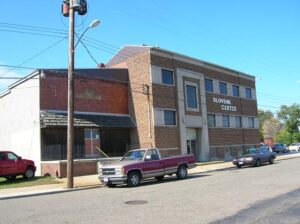
In 1918, early Slovene immigrants organized the Slovenian Independent Society Home and later constructed this hall, which became the center for Barberton Slovene cultural, social, and recreational activities. They formed dramatic and singing clubs, conducting performances in their native language. In the early twentieth century, prior to employers providing insurance or health care for their workers, the society acted to ensure sick and death benefits for its members. It also prepared members for citizenship in their newly chosen country. First generation Slovenes provided the labor that helped spur the growth of local industries while succeeding generations have continued to contribute to the community in various business, industrial, professional, and governmental capacities.
, OH
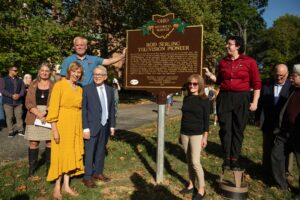
Rodman Edward Serling (1924-1975) enrolled at Antioch College in 1946 following military service in World War II. He began college as a physical education major, but soon discovered writing as a way of working through his war experiences. As a student, he contributed short fiction to The Antiochian literary magazine, managed the student-run Antioch Broadcasting System, and wrote and produced award-winning radio dramas. In July 1948, Serling married classmate Carolyn “Carol” Kramer. Shortly after earning his degree in 1950, he took a copy writer job at Cincinnati’s WLW radio. Serling quickly focused on selling scripts to national television networks. After eight years in Ohio, he and his wife moved to Connecticut. He returned to Antioch after the third season of The Twilight Zone to teach writing, drama, and media during the 1962-1963 academic year.
, OH
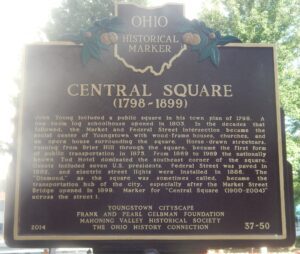
John Young included a public square in his town plan of 1798. A one-room log schoolhouse opened in 1803. In the decades that followed, the Market and Federal Street intersection became the social center of Youngstown with wood-frame houses, churches, and an opera house surrounding the square. Horse-drawn streetcars, running from Brier Hill through the square, became the first form of public transportation in 1875. From 1869 to 1969 the nationally known Tod Hotel dominated the southeast corner of the square. Guests included seven U.S. presidents. Federal Street was paved in 1882, and electric street lights were installed in 1886. The “Diamond,” as the square was sometimes called, became the transportation hub of the city, especially after the Market Street Bridge opened in 1899. Marker for “Central Square (1900-2004)” across the street.
, OH
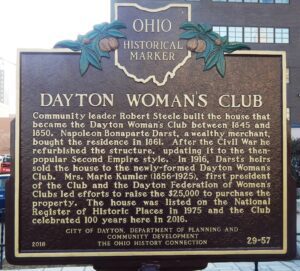
Dayton Woman’s Club. Community leader Robert Steele built the house that became the Dayton Woman’s Club between 1845 and 1850. Napoleon Bonaparte Darst, a wealthy merchant, bought the residence in 1861. After the Civil War he refurbished the structure, updating it to the then-popular Second Empire style. In 1916, Darst’s heirs sold the house to the newly-formed Dayton Woman’s Club. Mrs. Marie Kumler (1856-1925), first president of the Club and the Dayton Federation of Women’s Clubs led efforts to raise the $25,000 to purchase the property. The house was listed on the National Register of Historic Places in 1975 and the Club celebrated 100 years here in 2016.
, OH
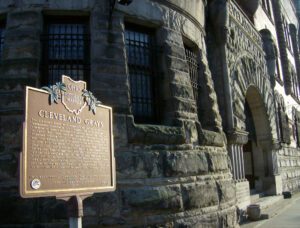
The Cleveland Grays were organized by statute in 1837 as an independent volunteer militia company. The Grays were the first company to leave Cleveland for service during the Civil War. In April 1861, they were designated Company E, 1st Ohio Volunteer Infantry (OVI). They saw action at Vienna Station and First Manassas and also served in the 84th OVI and were on duty with the 150th OVI at Fort Stephens when Confederate General Jubal Early attacked Washington in the summer of 1864. During the Spanish-American War the Grays volunteered for service and were admitted to the National Guard as the 1st Battalion of Engineers, 10th OVI. In 1916, they joined General John J. Pershing’s Punitive Expedition against Mexico. After service on the Mexican border, the Grays became part of the 1st Battalion, 148th Infantry Regiment, 37th “Buckeye” Division. (continued on other side)
, OH
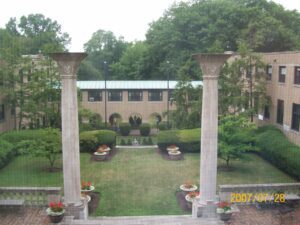
Elm Court, designed by Howard Van Doren Shaw of Illinois, was built in 1912 for Arthur Hudson Marks. The original mansion exemplifies the Italian Renaissance Revival style. Elm Court included the mansion, barn, stables, carriage house, pond, and a variety of trees, especially elms, on 33 acres. Arthur Marks was the inventive genius in chemistry and business who revolutionized the rubber industry in Akron. He was best known for inventing the alkaline-recovery vulcanization process in 1899, the cord tire, the chemical research laboratory system, and placing rubber research on a scientific basis. In World War I he served as director of chemical warfare services. Marks served as vice-president of B.F. Goodrich Company and Curtis Airplane and Engine Company and president of other rubber companies and the Aeolian Skinner Organ Company.
, OH
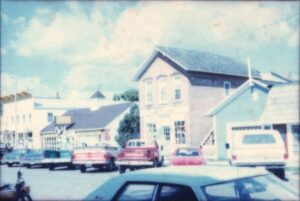
Born in Rhode Island, John Pray (1783-1872) moved to the Maumee River Valley from New York shortly after serving in the War of 1812 and completing a prospecting tour in Ohio. He built a dam across the river to Granger Island and in 1821 constructed a water-powered gristmill, the first on the lower Maumee. In 1831, he laid out the Village of Waterville with the first 50 lots. The Columbian House, a stagecoach inn constructed by Pray in 1828 and expanded in 1837, was for years the commercial and social center of Waterville and accommodated travelers from cities such as Detroit and Cincinnati. From this building, he operated the village’s post office. When Wood County was organized in 1820, Pray became a commissioner until Lucas County was formed from part of Wood in 1835. For nine years he served as Justice of the Peace in Waterville. He and his wife Lucy raised eleven children to adulthood. Circa 1854 he constructed his home, which today overlooks Pray Park.
, OH
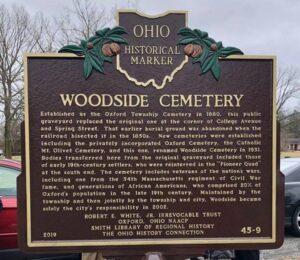
Established as the Oxford Township Cemetery in 1880, this public graveyard replaced the original one at the corner of College Avenue and Spring Street. That earlier burial ground was abandoned when the railroad bisected it in the 1850s. New cemeteries were established including the privately incorporated Oxford Cemetery, the Catholic Mt. Olivet Cemetery, and this one, renamed Woodside Cemetery in 1931. Bodies transferred here from the original graveyard included those of early 19th-century settlers, who were reinterred in the “Pioneer Quad” at the south end. The cemetery includes veterans of the nation’s wars, including one from the 54th Massachusetts regiment of Civil War fame, and generations of African Americans, who comprised 20% of Oxford’s population in the late 19th century. Maintained by the township and then jointly by the township and city, Woodside became solely the city’s responsibility in 2002.