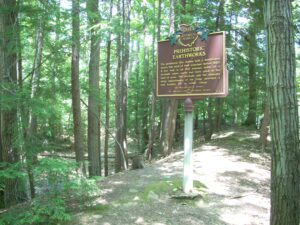
The prehistoric Erie Indians built a fortification across this neck of land sometime before 1650. A low wall is all that remains today of a stockade where earth had been piled at the base of posts. The stockade and the naturally steep embankments of the ridge provided a safe location for an Indian village.
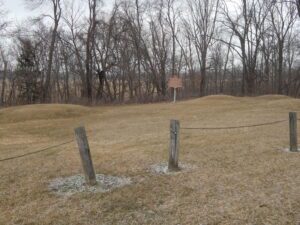
The Nettle Lake Mound Group consists of 4 low mounds overlooking a stream that runs into Nettle Lake. The mounds vary in height from 1 to 3 feet and in diameter from 18 to 30 feet. The mounds are composed primarily of reddish-brown sand (secondary mound) covering a layer of darker sand and loam (primary mound). These mounds have been partially excavated in the past by pot hunters in search of relics. Although the records of these excavations are vague and incomplete, pottery fragments, burials, and flint artifacts found in the mounds indicate that they were constructed by the Hopewell Indians.
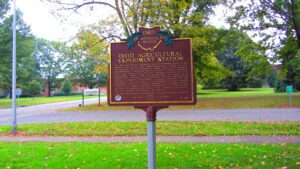
The Ohio General Assembly established the Ohio Agricultural Experiment Station in 1882. From its inception until 1892, the Station occupied 17 acres on the Columbus campus of The Ohio State University before relocating to 470 acres in Wayne County. In 1965, the Station changed its name to the Ohio Agricultural Research and Development Center (OARDC) to more accurately reflect its mission and programs. In 1982, the Center formally merged with The Ohio State University. Today, the Center encompasses nearly 2,100 acres in Wayne County with 10 branches located across the state for a total of approximately 7,100 acres dedicated to agricultural research.
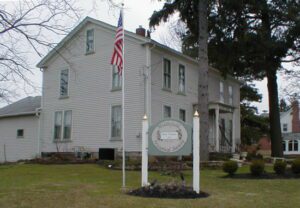
Originally called the James Thompson Inn, named for its builder, the son of Middlefield’s first settler, Isaac Thompson, the Batavia House is Middlefield’s oldest remaining structure. Built in 1818, the two-story wood frame structure was operated continually as an inn by Thompson until his death in 1877. It became the private residence of his daughter, Caroline, until 1907 when again it became an inn, functioning as the Century Inn until 1951. The one-story cement block portion was added circa 1950 to accommodate the weight of the heavy printing presses of the Shetler Printing Company, which occupied the building until 1983.
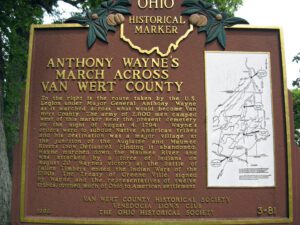
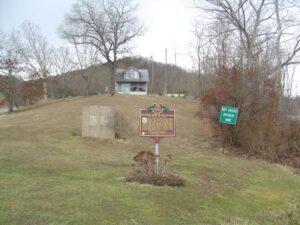
To the right is the route taken by the U.S. Legion under Major General Anthony Wayne as it marched across what would become Van Wert County. The army of 2,800 men camped west of this marker near the present cemetery on the night of August 4, 1794. Wayne’s orders were to subdue Native American tribes and his destination was a major village at the junction of the Auglaize and Maumee Rivers (now Defiance). Finding it abandoned, Wayne marched down the Maumee River and was attacked by a force of Indians on August 20. Wayne’s victory at the Battle of Fallen Timbers ended the Indian Wars of the 1790s. The Treaty of Greene Ville, signed by Wayne and the representatives of twelve tribes, opened much of Ohio to American settlement. Side one includes a map on the right hand side of the marker showing the route of Wayne’s army through the eastern third of Van Wert County.
One of the most influential icons of American popular culture in the mid-20th century, Roy Rogers was born Leonard Franklin Sly on November 5, 1911 in Cincinnati. He moved to this farm at age 8 from Portsmouth and lived here with his family until the Great Depression. He went to California in 1930, working as a truck driver, fruit picker, and country musician before signing a movie contract with Republic Pictures in 1937. Immediately popular, the clean-cut singing cowboy appeared in more than 100 western films, often making six or more movies a year during the 1940s. With his nearly equally-famous horse Trigger and his wife and partner Dale Evans-“the Queen of the West”-he subsequently starred in more than 100 television episodes of the family-oriented Roy Rogers Show from 1951 to 1957. A perennial hero and “good guy,” Rogers personified the mythical American cowboy who always fought fairly and lived by a strong moral code. He died in California on July 6, 1998.
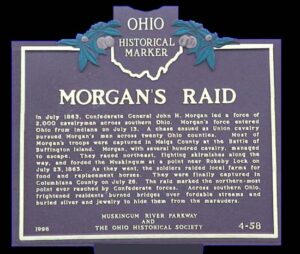
In July 1863, Confederate General John H. Morgan led a force of 2,000 cavalrymen across southern Ohio. Morgan’s force entered Ohio from Indiana on July 13. A chase ensued as Union cavalry pursued Morgan’s men across twenty Ohio counties. Most of Morgan’s troops were captured in Meigs County at the Battle of Buffington Island. Morgan, with several hundred cavalry, managed to escape. They raced northeast, fighting skirmishes along the way, and forded the Muskingum at a point near Rokeby Lock on July 23, 1863. As they went, the soldiers raided local farms for food and replacement horses. They were finally captured in Columbiana County on July 26. The raid marked the northern-most point ever reached by Confederate forces. Across southern Ohio, frightened residents burned bridges over fordable streams and buried silver and jewelry to hide them from the marauders.
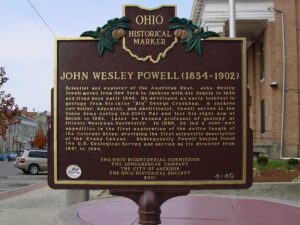
Scientist and explorer of the American West, John Wesley Powell moved from New York to Jackson with his family in 1838 and lived here until 1846. He developed an early interest in geology from his tutor “Big” George Crookham, a Jackson salt boiler, educator, and abolitionist. Powell served in the Union Army during the Civil War and lost his right arm at Shiloh in 1862. Later he became professor of geology at Illinois Wesleyan University. In 1869, he led a nine-man expedition in the first exploration of the entire length of the Colorado River, providing the first scientific description of the Grand Canyon. Subsequently Powell helped found the U.S. Geological Survey and served as its director from 1881 to 1894.