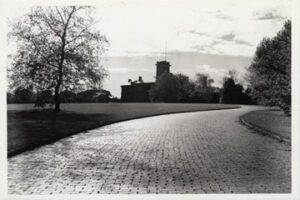
The Ohio General Assembly established the Ohio Agricultural Experiment Station in 1882. From its inception until 1892, the Station occupied 17 acres on the Columbus campus of The Ohio State University before relocating to 470 acres in Wayne County. In 1965, the Station changed its name to the Ohio Agricultural Research and Development Center (OARDC) to more accurately reflect its mission and programs. In 1982, the Center formally merged with The Ohio State University. Today, the Center encompasses nearly 2,100 acres in Wayne County with 10 branches located across the state for a total of approximately 7,100 acres dedicated to agricultural research.
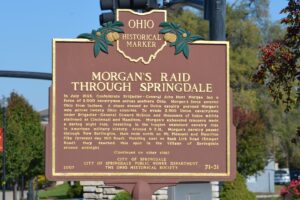
In July 1863, Confederate Brigadier-General John Hunt Morgan led a force of 2,000 cavalrymen across southern Ohio. Morgan’s force entered Ohio from Indiana. A chase ensued as Union cavalry pursued Morgan’s men across twenty Ohio counties. To evade 2,500 Union cavalrymen under Brigadier-General Edward Hobson and thousands of Union militia stationed at Cincinnati and Hamilton, Morgan’s exhausted troopers made a daring night ride, resulting in the longest sustained cavalry ride in American military history. Around 9 P.M., Morgan’s cavalry passed through New Burlington, then rode north on Mt. Pleasant and Hamilton Pike (present day Mill Road). Heading east on Bank Lick Road (Kemper Road), they reached this spot in the Village of Springdale around midnight. (Continued on other side)
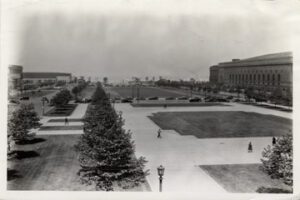
In August 1903, architects Daniel H. Burnham, John M. Carrere, and Arnold W. Brunner presented Mayor Tom L. Johnson and the City of Cleveland a plan that epitomized the City Beautiful Movement in America. The Group Plan envisioned a grand landscaped mall surrounded by public buildings in the Beaux-Arts style. The plan would create a monumental civic center, influence the design of buildings throughout the city, and lay the foundation for a city planning commission. The first of its kind in the nation, the Group Plan, as built, was the most completely realized of Burnham’s city planning efforts. In its green space and architecture, the Mall remains an enduring and vital element of Cleveland’s civic culture. (continued on other side)
George Bellows (1882-1925) is widely recognized as one of America’s premier artists. His vivid portrayals of modern urban life have become indelible icons of American art. Born and reared in Columbus, he retained close ties here throughout his life. Bellows gained fame while a young artist in New York, becoming a key figure among a group of artists nicknamed the “Ashcan School” because of their preference for commonplace subjects painted in dark colors. Bellows also excelled at printmaking, and it was largely through his efforts that lithography came to be accepted as a fine art in America. Bellow’s career was unexpectedly cut short by his death from complications following an appendectomy at the age of forty-two.
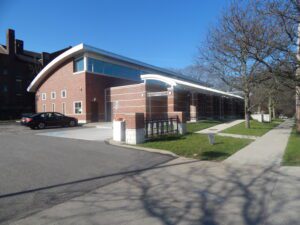
Langston Hughes Branch Library, 10200 Superior Avenue
Cleveland
, OH
One of the most recognized figures of the Harlem Renaissance, Langston Hughes was born in Joplin, Missouri on February 1, 1902 and moved to Cleveland by the time he was in high school. An avid traveler, he credited his years at Central High School for the inspiration to write and dream. The consummate Renaissance man, Hughes incorporated his love of theater, music, poetry, and literature in his writings. As an activist, he wrote about the racial politics and culture of his day. He was awarded the Spingarn Medal by the NAACP. He published over 40 books, for children and adults. Known as the “Poet Laureate of the Negro People,” Hughes most famous poem is “The Negro Speaks of Rivers.” Langston died on May 22, 1967, and his remains were interred beneath the commemoratively designed “I’ve Known Rivers” tile floor in the Schomburg Center for Research in Black Culture in Harlem.
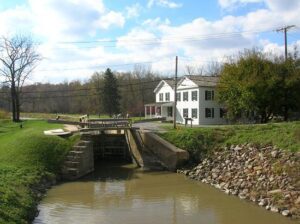
Directly across the Cuyahoga River from this spot is the South Park Village. Here, archeologists uncovered the remains of a four-acre, Native American settlement populated by people of the Whittlesey Tradition. The people of South Park lived in communal structures and grew maize, beans, and squash in the floodplain fields that surround you. Food remains found in the village excavations reveal that they hunted deer, elk, black bear, and other game and gathered clams and fish from the Cuyahoga River. South Park was abandoned and reoccupied several times between A.D. 1000 and 1600. Numerous seasonal campsites have been found on the floodplains and terraces on both sides of the river. The first localized cultural development unique to this area, Whittlesey sites have been identified upriver from here in Summit County and in the Chagrin and Grand River valleys to the east.
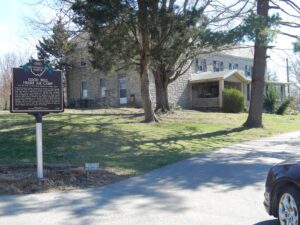
Reverend Richard E. Scully, founder of the Cincinnati Goodwill operated a Fresh Air Camp for women and children in the 1930s and 40s. The camp was part of a 100-acre site with vegetable fields, a swimming pool, tennis courts and horseshoe pits. The farm house on site was used as lodging for visitors. Men who worked at the camp received food and other forms of relief for their families. Vegetables produced on site were distributed at the Goodwill location at Ninth Street and Freeman Avenue in Cicinnati. According to family stories, Ruth Ann Eldridge, the frist child of Edison and Anna Eldridge, was buried on the site of the camp in 1933. Rev. Scully had officiated at Edison and Anna’s wedding and was a friend of the family.
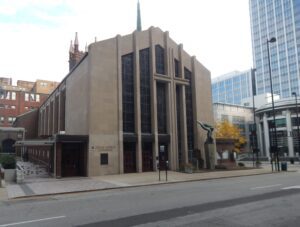
In 1817 twenty-two men, including future President William Henry Harrison, chartered Cincinnati’s first Episcopal parish, Christ Church. In 1835 members erected a Gothic Revival-style church on this site. The neighborhood evolved as the city grew with the influx of immigrants. Parish women raised funds to teach, feed, clothe, and shelter tenement families, and alleviate suffering during floods and disease outbreaks. In 1883 the women helped establish what became Cincinnati Children’s Hospital. In 1909 members opened the Late Gothic-style Parish House, a community center with kitchen, classrooms, library, auditorium, clinic, gymnasium, and bowling alley. By the parish’s centennial in 1917, music had expanded beyond worship to public concerts. In 1940 the annual Boar’s Head Festival of music and pageantry began. Since the 1960s, members have collaborated with local agencies to advocate for social and economic justice, a mission continuing into the 21st century. (Continued on other side)