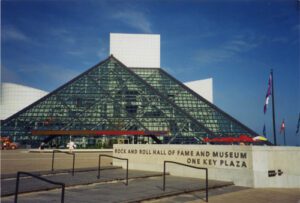
When radio station WJW disc jockey Alan Freed (1921-1965) used the term “rock and roll” to describe the uptempo black rhythm and blues records he played beginning in 1951, he named a new genre of popular music that appealed to audiences on both sides of 1950s American racial boundaries–and dominated American culture for the rest of the 20th century. The popularity of Freed’s nightly “Moon Dog House Rock and Roll Party” radio show encouraged him to organize the Moondog Coronation Ball–the first rock concert. Held at the Cleveland Arena on March 21, 1952, the oversold show was beset by a riot during the first set. Freed, a charter inductee into the Rock and Roll Hall of Fame, moved to WINS in New York City in 1954 and continued to promote rock music through radio, television, movies, and live performances.
Recognized for their biodiversity and high quality aquatic habitat, Big Darby Creek and Little Darby Creek were designated as state and national scenic rivers. These riparian ecosystems provide modern recreational opportunities while allowing a sense of their appearance centuries ago. Nearby Indian mounds indicate that the Darby creeks have been important food and transportation resources for thousands of years. More than 100 species of fish and 40 species of freshwater mollusks have been recorded within these watersheds. Several, including the indigenous Scioto Madtom, are locally and federally endangered.
Jerry Siegel and Joe Shuster, two Glenville High School students imbued with imagination and talent and passion for science fiction and comics, had dream become reality in 1932. They created Superman, the first of the superheroes ever to see print. The 1932 prototype was of a villainous superhero. Superman then became the hero who has been called the Action Ace, the Man of Steel, and the Man of Tomorrow. (continued on other side)
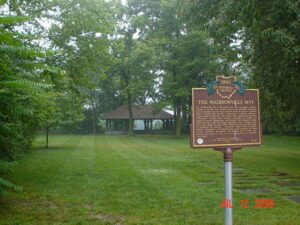
The Madisonville site is the largest and most thoroughly studied village of the late Fort Ancient culture (AD 1450 – 1670). Artifacts were so abundant here that local residents called this site the “pottery field.” Between 1879 and 1911, a generation of Harvard archaeologists trained at this site. Dr. Charles Metz, assisted by Harvard University’s Frederic Ward Putnam, excavated the remains of numerous houses, storage pits, and burials. The presence of glass beads and bits from iron kettles indicates these villagers may have been among the first native Ohioans to learn of the coming of Europeans to America. Mariemont street names Cachepit, Midden, Flintpoint, and Hammerstone, are reminders of these earlier residents. The pavilion was designed by the noted town planner John Nolen in 1921, but not constructed and dedicated until 2001.
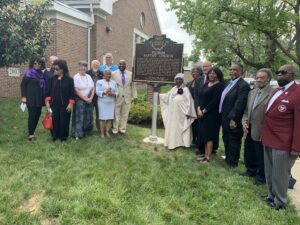
On January 9, 1919, a group of eight men and three women, being led by the Holy Spirit, met at a house on Wallace Street to form a new black Missionary Baptist Church in Hamilton, Ohio. The group quickly raised $150 to make the down payment on a two-story brick building at 333 Chestnut Street being sold for $1,850. The building was occupied on March 25, 1919, and the name Pilgrim Baptist Church was suggested and accepted. On May 11, 1919, a special council requested admittance into the Western Union Baptist Association, a district association now affiliated with the Ohio Baptist General Convention. Requirements for admission were met and Pilgrim Baptist Church was recognized as a Missionary Baptist Church. In 2019, Pilgrim Baptist Church celebrated a centennial of faithfulness in Hamilton.
William E. Telling (1869-1938) was one of ten children born in a farmhouse on this property. As a boy he sold strawberries and milk door-to-door and worked in a local sandstone quarry until at age 23 he purchased a milk route. He and four brothers formed the Telling Brothers Ice Cream Company in 1895 with William as president. A merger in 1915 formed the Telling Belle Vernon Dairy Company that was the first local distributor of pasteurized, glass-bottled milk. Their unique bacteriological laboratory (later Sealtest Laboratories) developed the baby food S.M.A. His recipe for success was “just work and work and work some more; do the work of two and draw the pay of one.”
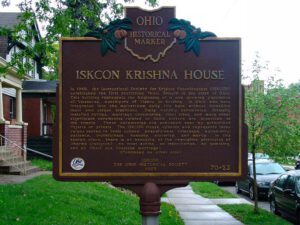
In 1968, the International Society for Krishna Consciousness (ISKCON) established the first practicing Vedic Temple in the state of Ohio. This building represents the beginning of a now growing population of Vaisnavas, worshipers of Vishnu or Krishna, in Ohio who have integrated into the mainstream daily life here without forsaking their own unique traditions. Daily worship ceremonies, formally installed deities, marriage ceremonies, final rites, and many other significant ceremonies related to Vedic culture are practiced at the temple. These ceremonies are prevailed over by authorized Pujaris or priests. The ISKCON House upholds and represents those values sacred to Vedic culture: peacefulness, tolerance, equanimity, patience, truthfulness, honesty, austerity, and mercy. In this sacred place, there is no breaking of the regulative principles of Dharma (religion): no meat eating, no intoxication, no gambling, and no illicit sex (outside marriage).
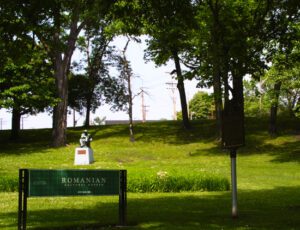
The Union and League of Romanian Societies, Incorporated was formed in 1928 from a unification of two separate fraternal organizations, the Union and the League. The Union, founded on July 4, 1906, was originally organized for the purpose of promoting the general welfare of its members through life insurance policies obtained through individual societies located in the United States and Canada. The societies of the Union and League offer social interaction within their local lodges and through the strength of the larger parent organization. The purpose of the current Union and League is to maintain and encourage Romanian cultural heritage by promoting interest in Romanian ethnic values through cultural activities and to sustain loyalty to the United States and Canada among its respective members.