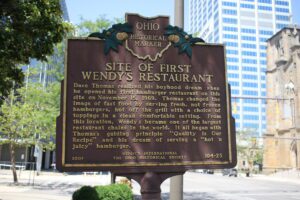
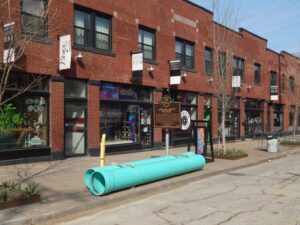
Dave Thomas realized his boyhood dream when he opened his first hamburger restaurant on this site on November 15, 1969. Thomas changed the image of fast food by serving fresh, not frozen hamburgers, hot off the grill with a choice of toppings in a clean comfortable setting. From this location, Wendy’s became one of the largest restaurant chains in the world. It all began with Thomas’s guiding principle “Quality is Our Recipe” and his dream of serving a “hot ‘n juicy” hamburger.
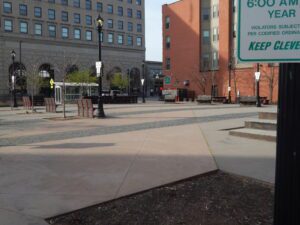
Market Square, home to the Pearl Street Market, was located on the corner of Pearl and Lorain Streets (now West 25th St. and Lorain Ave.) in what was then known as the City of Ohio. The land that Market Square occupies was donated by local businessmen Josiah Barber and Richard Lord in 1840 for the public’s use. Farmers and food vendors gathered to sell their wares after a public market moved here in 1859. In 1868, an enclosed wood-framed Pearl Street Market building was erected.
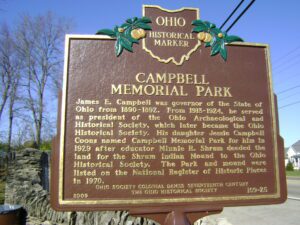
James E. Campbell was governor of the State of Ohio from 1890-1892. From 1913-1924, he served as president of the Ohio Archaeological and Historical Society, which later became the Ohio Historical Society. His daughter Jessie Campbell Coons named Campbell Memorial Park for him in 1929 after educator Minnie R. Shrum deeded the land for the Shrum Indian Mound to the Ohio Historical Society. The park and mound were listed on the National Register of Historic Places in 1970.
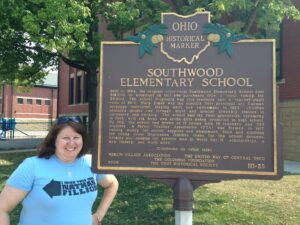
Built in 1894, the original eight-room Southwood Elementary School cost $16,000 to construct on this site purchased from a local family for $3,000. The school originally had five teachers and a teacher-pupil ratio of 50-1. Mary Esper was the school’s first principal and German language instructor, staying until her retirement in 1923. Children attended grades one through eight and special biweekly classes in carpentry and cooking. The school had its first graduation ceremony in 1896, with six boys and seven girls being promoted to high school. By 1912, the school had grown to 17 rooms with 16 teachers and 735 students. A Parent Teacher Association (PTA) was formed in 1917, raising money for school supplies and equipment, food and clothing for needy Great Depression families, trees for the school grounds, cookies and candies for service men in World War II, scholarships, a new library, and much more. [continued on other side]
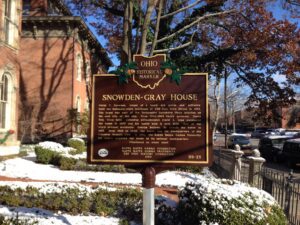
Philip T. Snowden, owner of a fancy dry goods and millinery, built the Italianate-style residence at 530 East Town Street in 1852. The house was part of the fashionable University Place addition on the east side of the city. From 1862-1864 Ohio’s governor, David Tod, lived here. Columbus philanthropist David S. Gray purchased the house in 1870 and his family held it until 1922. One of the city’s premier architects, George Bellows, Sr. rebuilt the house in 1872. From 1923 to 1940, the house was the headquarters of the Columbus Women’s Club. In 1951, the Kappa Kappa Gamma fraternity for women acquired the house as its national headquarters. (Continued on other side)
This block of W. 29th Street was home to Cleveland’s vibrant LGBT community and central to the development of the modern LGBT civil rights movement. In 1988, the Striebinger Building, at 1418 W. 29th, housed Cleveland’s Lesbian-Gay Community Services Center, which addressed the needs of the LGBT community. Cleveland’s first Pride Festival since the mid-1970s was held on the block in 1989, and in 1990 Cleveland’s first Pride Parade culminated here. During the HIV/AIDS crisis, The Living Room and ACT UP were located in the Striebinger Building and gave support to those with HIV/AIDs and provided a platform for political activism. It was on this block where many people could find their voices to “come-out” and advocate for their rights and their humanity. (Continued on other side)
Acquiring the African American Cultural Garden was a struggle for equitable access to public space in Cleveland during the Civil Rights era. Between 1961 and 1977, Black Clevelanders sought space to celebrate Black pride and culture within Cleveland’s Cultural Gardens. Activists lobbied the Cultural Garden Federation, City Council, and engaged the Black community to acquire a garden space. When the African American Cultural Garden was dedicated on October 23, 1977, dignitaries from Ghana, Togo, Kenya, and Tanzania, were joined by national, state, and city officials to celebrate the first garden space assigned to a community of color.