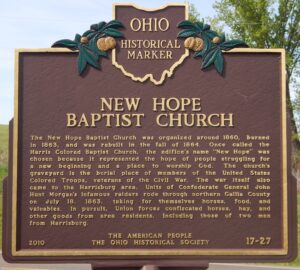
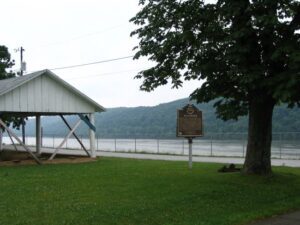
The New Hope Baptist Church was organized around 1860, burned in 1863, and was rebuilt in the fall of 1864. Once called the Harris Colored Baptist Church, the edifice’s name “New Hope” was chosen because it represented the hope of people struggling for a new beginning and a place to worship God. The church’s graveyard is the burial place of members of the United States Colored Troops, veterans of the Civil War. The war itself also came to the Harrisburg area. Units of Confederate general John Hunt Morgan’s infamous raiders rode through northern Gallia County on July 18, 1863, taking for themselves horses, food, and valuables. In pursuit, Union forces confiscated horses, hay, and other goods from area residents, including those of two men from Harrisburg.
Manchester was founded in 1791 by Nathaniel Massie as a base to survey the land warrants of American Revolutionary War soldiers in the Virginia Military District. This bank of the Ohio River provided a secure site for the last civilian stockade built in Ohio. The natural protection of this fortification included marshland to the west and north and the river on the south. The nearby three islands provided a safe place for retreat in dangerous circumstances and also supplied an area to raise food in its rich bottomlands. The invention of the steam powered paddle wheel boat allowed the river to become the city’s main source of shipping and commerce in the nineteenth century. Manchester was an important port of call for provisions; the export of agricultural products; and the manufacture of goods such as pottery, furniture, and leather goods.
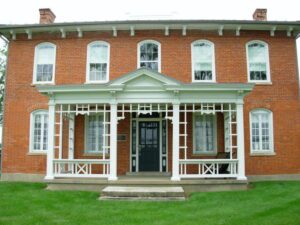
Known as the “Halfway House,” the Gooding House and Tavern was built by George B. Gooding halfway between the towns of Worthington and Delaware in 1827. Its location was influenced by construction of the Columbus and Sandusky Turnpike that was chartered by the State of Ohio the year before. Also known as the “Mud Pike,” the turnpike was slow and difficult for travelers and could take nearly a day to travel 10 miles. The Gooding House was the perfect place for stagecoach drivers to change teams of horses and for travelers to rest and have refreshments. George Gooding also prospered as a farmer with over 1,000 acres of land. This stately brick farmstead remained in the Gooding family for 175 years with each succeeding generation adding its imprint on the property. The Gooding House and Tavern was listed on the National Register of Historic Places in 2005 and restored in 2007.
791 Farmview Rd (located on OH 588 just off US Route 35)
Bidwell
, OH
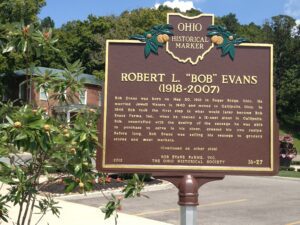
Bob Evans was born on May 30, 1918 in Sugar Ridge, Ohio. He married Jewell Waters in 1940 and moved to Gallipolis, Ohio. In 1946 Bob took the first step in what would later become Bob Evans Farms, Inc., when he opened a 12-seat diner in Gallipolis. Bob, unsatisfied with the quality of the sausage he was able to purchase to serve in his diner, created his own recipe. Before long, Bob Evans was selling his sausage to grocery stores and meat markets.
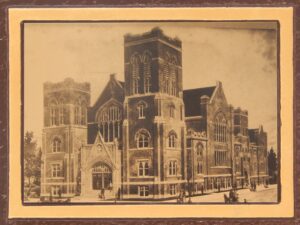
The Euclid Avenue United Brethren Church, later the Mount Enon Missionary Baptist Church, was erected at Third & Euclid Street in Dayton. Milton Wright, a bishop of the church, was present at the laying of the cornerstone on May 28, 1911. Bishop and Mrs. Susan (Koerner) Wright were the parents of Orville and Wilbur Wright and their siblings Reuchlin, Lorin and Katherine. The church’s congregation included Orville and Katherine Wright and other notable Daytonians such as local historian and former pastor Dr. Augustus W. Drury, food distributor and potato chip maker Daniel Mikesell and Prof. Josiah P. Landis of the Bonebrake Theological Seminary. The church playedd a role in offering aid during the disasterous flood of 1913.
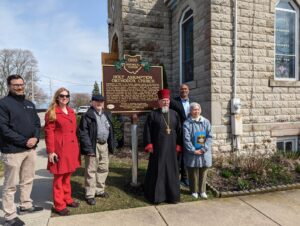
Established in 1898 as the Russian Orthodox Church of the Dormition, Holy Assumption was founded by Carpatho-Russian immigrants from the Austro-Hungarian Empire. Constructed in 1905-1906, it is considered to be the oldest Orthodox church building in Ohio. Archbishop Tikhon, head of the Russian Orthodox Church in North America, consecrated the church and celebrated the first Liturgy. Tsar Nicholas II of Russian personally donated the four icons on the iconostas, or icon screen, as well as liturgical items. Both the Tsar and, by then Patriarch, Tikhon were murdered by the Bolsheviks during the 1917 Russian Revolution and were glorified as Saints of the Orthodox Church. Holy Assumption Orthodox Church continues to be a beacon of the Orthodox Faith on the Marblehead peninsula.
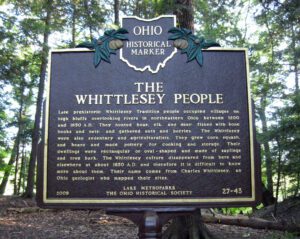
The Indian Point Site contains the remains of a prehistoric Native American earthen enclosure, officially known as the Lyman site, named after a former property owner. The site contains two earthen walls that are bordered by ditches. Steep cliffs provide natural barriers on two sides of the enclosure. Archaeological digs have uncovered many artifacts here, including pottery sherds, tools, pipes, and beads. There is evidence that the walls were built around 140 B.C., and the site was occupied again around 1500 A.D. by the Whittlesey Tradition people. It is uncertain if the site was a village or was used as a ceremonial center. After 1650 A.D., the area became a neutral hunting ground for various historic tribes.
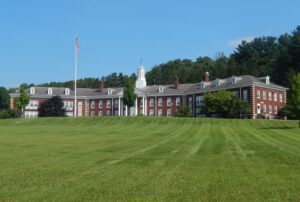
Tuberculosis, or TB, is a contagious disease that was responsible for the deaths of one out of every seven people in the U.S. in the early 20th century. The Licking County Tuberculosis Sanatorium, known as the TB San, was constructed in 1931-1932 at a cost of $250,000. The facility kept TB patients separate from the general population, controlling the spread of disease. The location provided patients with rest, fresh air, food, and exercise, the main treatments for TB in the 19th through mid-20th centuries. (Continued on other side)