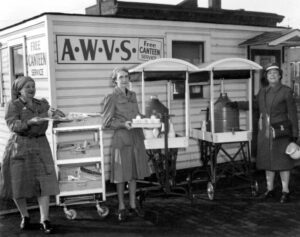
The Lima Chapter of the American Women’s Voluntary Services Organization established a community-based, free canteen during World War II for troops traveling on the Pennsylvania Railroad and adjacent Baltimore & Ohio-Nickel Plate Railroads. Meeting as many as forty trains a day, the ladies served 2.5 million troops between 1942-1945. Food, coffee, and other items were donated to the canteen from a twelve county area. The “AWVS” disbanded in 1945, but succeeding volunteers continued to provide service throughout the Korean Conflict and Viet Nam War. Lima’s “Servicemen’s Free Canteen” was the longest, continuously operated service canteen in the United States. An estimated four million soldiers, sailors, and marines were served between 1942-1970.
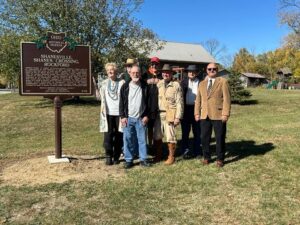
John Chapman (1774 – 1845) leased these three acres to the north and west from William Botts Hedges on April 29, 1828. He paid Hedges by cultivating 1,000 apple trees on the site over the next ten years. Apples provided an important food source. Cut and dried for sauces in the winter, they could be pressed into cider or “apple jack” at a time when water often carried disease. The Hedges Nursery profited the Shanesville area by shipping apples to the major trading posts at Piqua and Ft. Wayne. During his lifetime, Chapman proved an able businessman who established profitable orchards in Ohio, Pennsylvania, and Indiana. In 2009, American Forests, the Johnny Appleseed Foundation, the Museum at Urbana University, and the Village of Rockford planted two “Rambo” apple trees at the Hedges Nursery site.
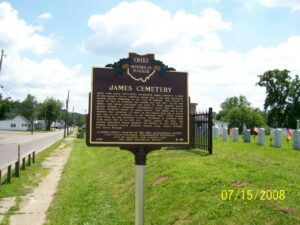
Major John James (1772-1854) established James Cemetery in 1828 on and around a Native American mound that is the only significant ancient mound remaining in the city of Jackson. The mound is about 70 feet in diameter and nearly six feet tall. In the late 1800s, this mound comprised one point of three ancient mound groups forming a triangular configuration along East Broadway Street, formerly known as James Street. One group was a few hundred feet northeast of here on the Watson farm and a second was just to the northwest on the Warnicke farm. These mounds were built by the Hopewell Culture, prominent in southern Ohio from about 100 BC to 400 AD. Major James, his wife, and several immediate family members are buried on the mound including Jackson County pioneers Andrew Long, Daniel Hoffman, and David Mitchell.
The history of New Knoxville provides one of the best examples of chain migration to America. After the Shawnee were removed from what would become Auglaize County, James Knox Lytle, cousin to James Knox Polk, purchased land in Washington Township. Lytle platted a village of 102 lots in 1836, calling it Knoxville to honor his mother’s family. Meanwhile, newly married Wilhelm and Elisabeth Fledderjohann Kuckhermann (later Kuck) immigrated from Ladbergen in northwest Germany. Having missed their boat to St. Louis, the couple lived briefly in Stallostown (Minster) and Bremen (New Bremen). They wrote home, encouraging others to emigrate; in the summer of 1835 the Fledderjohanns (Elisabeth’s family), Meckstroths, and Lutterbecks arrived. The families bought land near the site of Knoxville. (continued on other side)
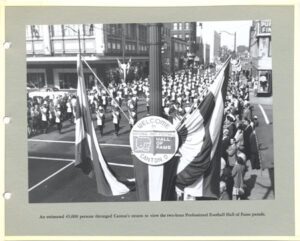
On September 17, 1920, representatives from ten professional football teams met in Canton and formed the American Professional Football Association, which in 1922 became the National Football League (NFL). Pro football evolved from club football in the 1890s, and by the early 1900s had begun to spread across the country, concentrating in the Midwest. Jim Thorpe, the first nationally prominent pro, started with the Canton Bulldogs-an early pro football power-in 1915. In 1959, Canton citizens launched a well-organized and ultimately successful effort to have their city, “the cradle of professional football,” designated as the site of a monument to the sport’s historic stars. The Professional Football Hall of Fame opened on September 7, 1963, inducting seventeen charter members. The Hall of Fame interprets and promotes the study of the role of professional football in American culture.
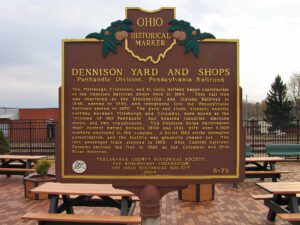
The Pittsburgh, Cincinnati, and St. Louis Railway began construction of the Dennison Railroad Shops here in 1864. This rail line was chartered as the Steubenville and Indiana Railroad in 1849, opened in 1855, and integrated into the Pennsylvania Railroad system in 1870. The yard and shops, situated exactly halfway between Pittsburgh and Columbus, were known as the “Altoona of the Pan Handle” and boasted foundries, machine shops, and two roundhouses. The Dennison Shops experienced their busiest period between 1900 and 1921, with over 3,000 workers employed in the complex. A bitter 1922 strike prompted consolidation, and the facility was gradually phased out. The last passenger train stopped in 1970. Ohio Central Railroad Systems revived the line in 1992 as the Columbus and Ohio River Railroad.
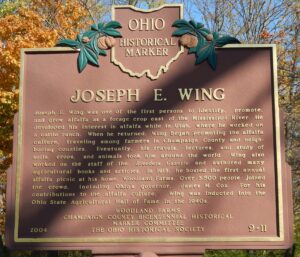
Joseph E. Wing was one of the first persons to identify, promote, and grow alfalfa as a forage crop east of the Mississippi River. He developed his interest in alfalfa while in Utah, where he worked on a cattle ranch. When he returned, Wing began promoting the alfalfa culture, traveling among farmers in Champaign County and neighboring counties. Eventually, his travels, lectures, and study of soils, crops, and animals took him around the world. Wing also worked on the staff of the Breeders Gazette and authored many agricultural books and articles. In 1913, he hosted the first annual alfalfa picnic at his home, Woodland Farms. Over 3,500 people joined the crowd, including Ohio’s governor, James M. Cox. For his contributions to the alfalfa culture, Wing was inducted into the Ohio State Agricultural Hall of Fame in the 1940s.
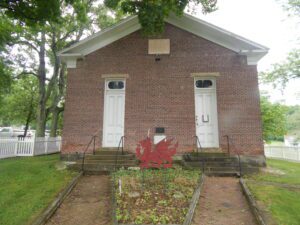
In 1972 a group of Welsh-Americans chartered the Welsh-American Heritage Museum to preserve Welsh history and culture, and to preserve the Welsh Congregational Church. The old brick church was where songs of praises rang, as the Welsh gathered and sang beloved hymns of their homeland in four-part harmony. The church is a link in a long, unbroken chain of memories and still serves the community as a center of Welsh-American activities and a keeper of the community’s heritage. The red dragon and daffodil are symbols of Wales.