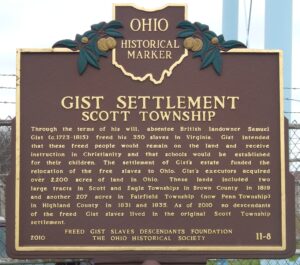
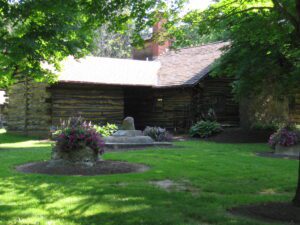
Through the terms of his will, absentee British landowner Samuel Gist (c. 1723-1815) freed his 350 slaves in Virginia. Gist intended that these freed people would remain on the land and receive instruction in Christianity and that schools would be established for their children. The settlement of Gist’s estate funded the relocation of the freed slaves to Ohio. Gist’s executors acquired over 2,200 acres of land in Ohio. These lands included two large tracts in Scott and Eagle Townships in Brown County in 1819 and another 207 acres in Fairfield Township (now Penn Township) in Highland County in 1831 and 1835. As of 2010, no descendants of the freed Gist slaves lived in the original Scott Township settlement.
In recognition of its noteworthy representation of the history, culture, and architecture of the Western Reserve, Burton Village’s Historic District was placed on the National Register of Historic Places in 1974. The Historic District, an area of approximately 20 acres surrounding the Village Green and along streets at the north end of the Green, includes 15 buildings of historical significance built between 1815 and 1891. Preserved within the District are commercial and public buildings and private dwellings that reflect the cultural and architectural development of a village of the Western Reserve of Ohio during the 19th century. Buildings in the predominant architectural styles of the 19th century are all represented in the Historic District, including Western Reserve, Greek Revival, Second Empire, Italianate, and Queen Anne. [Continued on other side]
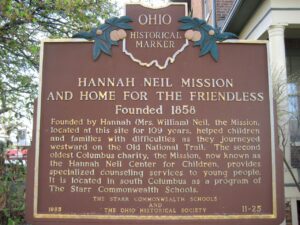
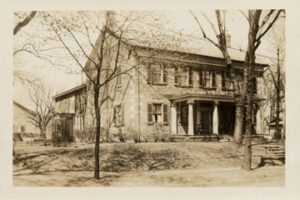
Founded by Hannah (Mrs. William) Neil, the Mission, located at this site for 109 years, helped children and families with difficulties as they journeyed westward on the Old National Trail. The second oldest Columbus charity, the Mission, now known as the Hannah Neil Center for Children, provides specialized counseling services to young people. It is located in south Columbus as a program of The Starr Commonwealth Schools.
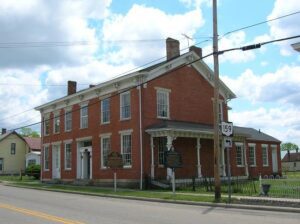
Constructed of sandstone quarried from nearby Putnam Hill, the Stone Academy dates to 1809. The Springfield School House Company erected the building, it is believed, to lure the statehouse from Chillicothe. However, when Zanesville was chosen as the capital the following year, the building was used for public functions and for its “intended” purpose as a school. The Ohio Anti-slavery Society held its state conventions here in 1835 and 1839, with prominent abolitionist leader Theodore Weld, among others, in attendance. The Stone Academy became a private residence after 1839. In the 1870s, it was the childhood home of Elizabeth Robins, the famed late-nineteenth and early-twentieth century actress, playwright, author, and activist. The Stone Academy was donated to the Pioneer and Historical Society of Muskingum County in 1981.
Major General William Sooy Smith was born in Tarlton on July 22, 1830. He attended Ohio University and supported himself throughout his college undergraduate career, graduating in 1849. He then entered the United States Military Academy at West Point to pursue engineering and graduated 6th in the class of 1853. In 1857, Smith established the private engineering firm Parkinson & Smith and made the first surveys for the international bridge across the Niagara River near Niagara Falls. At the outbreak of the Civil War, Smith joined the 13th Ohio Infantry, winning the commission of colonel in June 1861. After early victories in western Virginia, he was promoted to brigadier general in April 1862 for his gallant and meritorious service at the Battle of Shilo. (continued on other side)
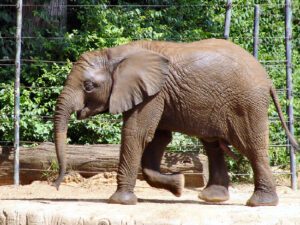
Now ranked among the country’s finest, the zoo began in 1900 with one large woodchuck in a box at Walbridge Park. After the organization of the Toledo Zoological Society, 1905-10, the zoo began its steady growth, particularly after 1923 under the leadership of Percy C. Jones. An ambitious federal construction program during the Great Depression of the 1930s provided several major structures.(See other side)
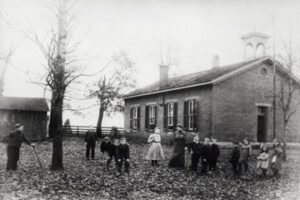
In 1854, Samuel and Rebecca McClellan Collins deeded 1.28 acres to Beavercreek Township, Greene County, for the purpose of building a schoolhouse. The first two schoolhouses were constructed of stone with fireplaces for heat. Collins neighborhood children in first through eighth grade were educated in the present red brick building until 1944, when decreased enrollment forced Xenia Township to close the school. Virgil and Helen Bryson Brantley, great-granddaughter of Samuel and Rebecca Collins, purchased the school property in 1982 and began the restoration of the vandalized and deteriorated schoolhouse. The pony/coal shed and privies were rebuilt on their foundations. (Continued on other side)
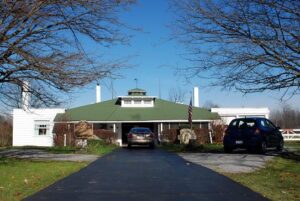
Southern Park Stables, at 126 Washington Boulevard in Boardman, was the private training stable of Attorney David Arrel and was built circa 1912 to house his standardbred horses racing at Southern Park Trotting Track one block south. The Stables is the last remaining structure of a large complex known as Southern Park, which included not only the racetrack and accompanying stables, grandstand, and outbuildings, but a dance hall, picnic pavilions, and baseball diamonds. The park was a favorite destination for Youngstown city residents wishing to relax in the country, and many company picnics were held here. Janie S. Jenkins has lived at Southern Park Stables since 1946 and deeded it and 8.33 acres to the Boardman Township Park District in 1993 with restrictions that it be forever preserved. The wrought iron gates at the driveway entrance were originally the main entrance gates for the racetrack.