

, OH
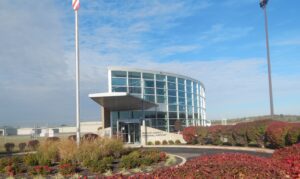
The Hogan Family owned and operated what was known as the Hamilton Airport for over 52 years. Airplane owner and pilot, Carl “Pop” Muhlberger and aviation enthusiast and farmer, Joe Hogan, co-founded the airport in July 1929. Muhlberger taught Joe to fly and in return, Joe managed and maintained the field. During the Great Depression, Muhlberger could not afford to operate the airport, closing in July 1932. With financial backing from Joe’s older brother, Charles, and their father, William, the family purchased and reopened the airport. Running the airport was a family affair. Joe taught his brothers, Bill, Bernie, and Art to fly. They raised money to run the airport by barnstorming, sightseeing flights, and flying lessons. Sisters, Mary Ann, Katie, and Loretta (Sauer), also flew. They, along with their mother Emma, helped run the airport and its restaurant. (Continued on other side)
, OH
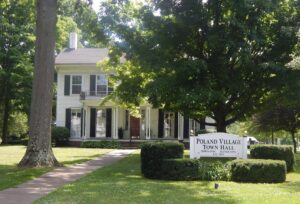
The Village of Poland officially incorporated in August 1866, a year after the end of the Civil War. In April 1867, the citizens elected John Leslie as mayor. As of 1880, Poland’s population exceeded 400. Through its history, the village has consisted of a four-acre village green, churches, schools, hotels, a sawmill, gristmill, post office, tannery, and foundry, as well as carriage, tin, and cabinet shops; drug, dry goods, and hardware stores, and doctors, blacksmiths, and shoemakers. Residents swam in and skated on Yellow Creek. The Poland Municipal Forest was established in 1938 and annexed later as the Village continued to grow. In 1966, the residents held a three day Centennial Celebration, featuring an address by Governor James Rhodes. The centennial year also saw the publication of a history of Poland and the restoration of Centennial Gardens.
, OH
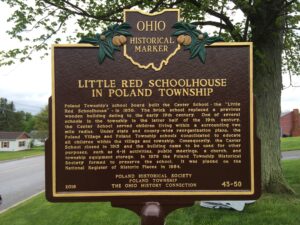
Poland Township’s school board built the Center School- the “Little Red Schoolhouse”- in 1858. The brick school replaced a previous wooden building dating to the early 19th century. One of several schools in the township in the latter half of the 19th century, the Center School served children living within a surrounding two mile radius. Under state and county-wide reorganization plans, the Poland Village and Poland Township schools consolidated to educate all children within the village and township. Consequently, the Center School closed in 1915 and the building came to be used for other purposes, such as 4-H activities, public meetings, a church, and township equipment storage. In 1979 the Poland Township Historical Society formed to preserve the school. It was placed on the National Register of Historic Places in 1984.
, OH
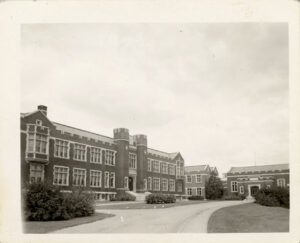
Hebrew Union College (HUC), founded in Cincinnati in 1875, is the oldest institution of higher Jewish learning in the United States. Its founder, Rabbi Isaac Mayer Wise (1819-1900), was a leading proponent of Reform Judaism in America. In 1950, the college merged with the Jewish Institute of Religion (JIR), a liberal Jewish seminary in New York founded by Rabbi Stephen S. Wise (1874-1949) in 1922. A third center opened in Los Angeles in 1954 to serve Jewry on the West Coast and, in 1963, a fourth campus opened in Jerusalem. As of 2003, HUC-JIR educates rabbis, cantors, communal, and educational professionals. It also offers advanced academic training for scholars of all faiths. The holdings of the school’s Klau Library constitute one of the most extensive Jewish libraries in the world.
, OH
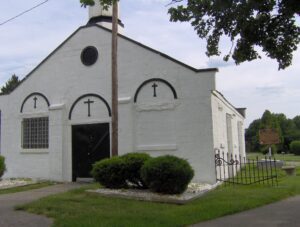
Born in Richmond, Virginia, Powhatan Beaty moved to Cincinnati in 1849, where he spent the majority of his life. Beaty enlisted as a private in the Union Army in June 1863, and two days later was promoted to first sergeant, Company G, 5th United States Colored Troops (USCT). All the officers of Company G were killed or wounded during an attack on Confederate forces at New Market Heights, Virginia, in September 1864. Beaty took command of his company, and for his valor received the Congressional Medal of Honor. Beaty was one of two African-Americans buried in Ohio to receive the Medal of Honor for service in the Civil War. He died on December 6, 1916, leaving two sons, attorney and state representative A. Lee Beaty and John W. Beaty. He is buried in Union Baptist Cemetery along with nearly 150 USCT veterans.
, OH
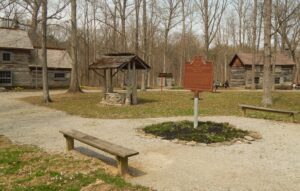
Edward Bebb, father of William Bebb and first Welshman to settle in Paddy’s Run, Morgan Township, Butler County purchased this cabin in 1801. Originally the cabin stood four miles southeast of this site on the Dry Fork of the Whitewater River. It was here that William Bebb was born on December 8, 1802, the first white child born in Butler County west of the Great Miami River. At the age of twenty, after attending district schools, William Bebb became a teacher. In 1826 he became the first teacher at Paddy’s Run School. Two years later Bebb and his wife opened a boarding school on his father’s farm. While teaching school he began the study of law and in 1831 passed the state bar examination. A year later he began to practice law in Hamilton, where he soon became an active politician. In 1840 he stumped the state for Harrison and Tyler and in 1846 he was nominated for Governor by the Whig party. He was elected on the slogan “Wm. Bebb and a Home Currency against David Tod and Pot Metal.” After his term as governor, Bebb served in a number of government positions until his retirement to his farm near Rockford, Illinois. He died on October 23, 1873.
, OH
The Lincoln School building stood at 2402 Central Avenue for almost a century. In 1919, a twenty-year bond levy provided for the construction of five schools, including the “new east school” Lincoln Elementary. Construction began in 1921 on the eight-acre site while students attended classes in temporary structures. Lincoln School opened in 1923 with 500 students enrolled. Lincoln Field, football grounds for McKinley High School’s “Middies,” stood behind Lincoln from 1930 until 1950 when Barnitz Field Stadium was built on South Main Street. Additions to the original Lincoln building included a maintenance annex in 1935 and a gymnasium in 1959. Lincoln School closed in November 1980 during a 1980-1981 Middletown City School District reorganization. Students from Lincoln and Sherman schools moved to the refurbished Roosevelt School at 2701 Central Avenue.
, OH
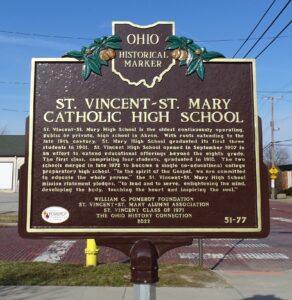
St. Vincent-St. Mary High School is the oldest continuously operating, public or private, high school in Akron. With roots extending to the late 19th century, St. Mary High School graduated its first three students in 1901. St. Vincent High School opened in September 1907 in an effort to extend educational offerings beyond the eighth grade. The first class, comprising four students, graduated in 1910. The two schools merged in late 1972 to become a single co-educational college preparatory high school. “In the spirit of the Gospel, we are committed to educate the whole person,” the St. Vincent-St. Mary High School mission statement pledges, “to lead and to serve, enlightening the mind, developing the body, touching the heart and inspiring the soul.”