

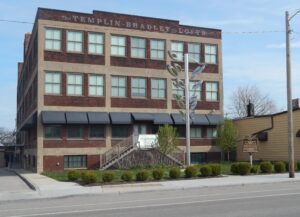
, OH
In 1907, the Templin-Bradley Company’s Children’s Flower Mission was developed in response to the Cleveland Public Schools Horticulture Program, supplying seed packets for 1 cent each–commonly referred to as Penny Packet Seeds. This earned the company a reputation for being the nation’s largest distributor of seeds for school garden programs. Although only nine varieties of plants were offered, interest was so great that nearly 50,000 packages were sold during the first year with no expense to the public-school teachers. With great success realized in the local school gardening program, interest grew exponentially across the nation and programs began in other cities. For fifty years, the Templin-Bradley Company sold flower and vegetable seeds at low costs to student members of garden groups throughout the country, cultivating many generations of gardeners.
, OH
In 1907, the Templin-Bradley Company’s Children’s Flower Mission was developed in response to the Cleveland Public Schools Horticulture Program, supplying seed packets for 1 cent each–commonly referred to as Penny Packet Seeds. This earned the company a reputation for being the nation’s largest distributor of seeds for school garden programs. Although only nine varieties of plants were offered, interest was so great that nearly 50,000 packages were sold during the first year with no expense to the public-school teachers. With great success realized in the local school gardening program, interest grew exponentially across the nation and programs began in other cities. For fifty years, the Templin-Bradley Company sold flower and vegetable seeds at low costs to student members of garden groups throughout the country, cultivating many generations of gardeners.
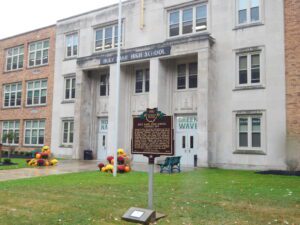
, OH
Founded in 1914, Holy Name High School was one of the first co-educational Roman Catholic high schools in Cleveland. Originally located at Harvard and Broadway Avenues, the school opened under the direction of Holy Name Parish with educational leadership of the Sisters of Charity from Cincinnati. In 1978, Holy Name High School moved to its present location in Parma Heights, the former home of Nazareth Academy. Throughout its history, Holy Name High School has served the community by providing a Catholic, college-preparatory education. The Holy Name spirit lives on through its alumni, who have made a difference around the world.

, OH
“Uncle” George Lathrop Cooley (1861-1939) was known as the “Champion of the Farmer” for his advocacy on behalf of rural interests. He was born on a farm at the northwest corner of Dover and Hilliard Roads in Dover Township (Westlake). He attended area schools and Ohio Northern University and, in 1887, married Clara Hall. Cooley served as Dover Township trustee from 1901-1905 and as president of Dover’s village council in 1916. Cooley’s interest in better roads led him to supervise the hard-surfacing of Dover Center Road, which ran by his house. From about 1900 to 1913, he was involved in road construction and helped to organize state highway departments in Ohio, Louisiana and California. (Continued on other side)
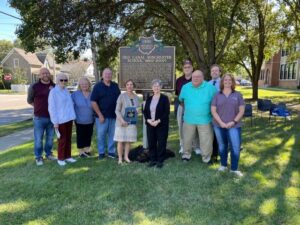
, OH
Over its 145 years, the Old Canal Winchester School building played a significant role in the community. The original four-room building opened in 1862 and its first high school class graduated seven in 1886. Canal Winchester’s growth is reflected in the school’s several additions, the first of which was in 1875. Other expansions include a separate high school building in 1909, a three-story connector in 1929 between the 1862 and the 1909 buildings, and elementary school wings in 1956 and 1967. The school was also the site of continuing education and vocational classes for adults in the 1930s and 1950s, agricultural programs for veterans after World War II, and a cannery from the time of that war to 1952. The school was added to the National Register of Historic Places in 2017 and it remains the district’s administrative center and a community gathering space.
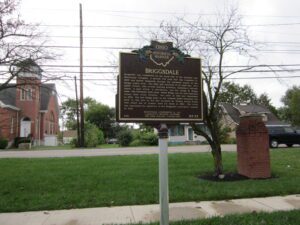
, OH
Briggsdale was established on the north side of the Columbus and Harrisburg Turnpike, a private toll road that was completed in 1849 and passed diagonally through the southeast corner of the Briggs family farm. The 1893 plat consisted of 97 small lots, five public streets, and several existing buildings, including a railroad depot, a post office, a schoolhouse, and the Joseph M. Briggs home. The Italianate style home, where Briggs and his wife Louisiana raised their seven children, was built in 1881 and demolished in 1958. The last Briggs home on the original family farmstead was built on this site in 1911 and occupied by William Irving Briggs (the eldest son of Joseph) until his death in 1964. The house was demolished for expansion of the Briggsdale Apartments complex in 2018.
, OH
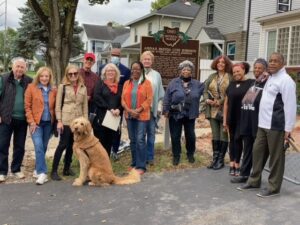
Aminah Brenda Lynn Robinson (1940-2015) and her son Sydney moved into this home in 1974. The artist, a visual historian, lived and worked here in the Shepard community until her passing. Raised in Columbus’s Poindexter Village and educated in the local public schools, Robinson also studied at Columbus College of Art and Design and The Ohio State University. Her art reflected stories handed down from her elders, experienced within her community, and the local history she researched while working at the Columbus Metropolitan Library. She received a 2004 MacArthur Award for her celebration of “family, ancestry, and the grandeur of simple objects in drawings, paintings, and large-scale, mixed-media assemblages.” (Continued on the other side)
, OH
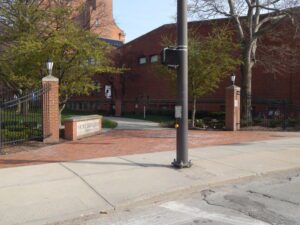
In 1886, Bishop Richard Gilmour (1824-1891) of the Roman Catholic diocese of Cleveland requested that the Jesuit superior of Buffalo establish a high school on Cleveland’s west side. The Jesuits, an order of the Roman Catholic Church founded by St. Ignatius Loyola in 1540, sought to establish schools that instilled a zeal for the Gospel and a love of learning. Under the leadership of Father Henry Behren, S.J. (1815-1895), the twentieth Jesuit secondary school in the United States opened in September 1886. Named Saint Ignatius College, the school grew from 76 students in 1886 to 490 in 1924. In 1924, the College split into two separate institutions: John Carroll University, which moved to University Heights in 1935, and Saint Ignatius High School, which remains on its original site. (Continued on other side)