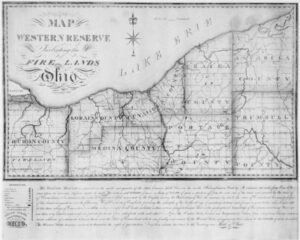
On July 4, 1796, Moses Cleaveland and his survey party landed at the mouth of Conneaut Creek on the southern shore of Lake Erie in what is today Conneaut, Ohio. The Connecticut Land Company, a private land speculation enterprise, had hired General Cleaveland as its agent to survey the Connecticut Western Reserve lands and to found a settlement along the Cuyahoga River, later named Cleveland. Group members pitched tents and erected a crude shelter to protect the provisions and survey equipment before celebrating the independence of the new country with toasts and salutes. The next day they organized into field groups to begin the historic survey of measuring the townships and ranges of the Western Reserve.
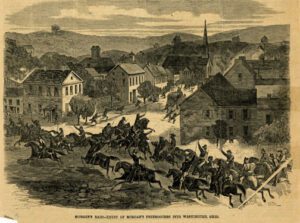
During the summer of 1863, General John Hunt Morgan, a Confederate cavalry leader from Kentucky, invaded southern Ohio with 2,460 mounted men. Throughout the campaign Morgan’s men plundered and looted before being captured by Union forces. On July 17, Morgan led his troops into Wilkesville stealing horses, sacking stores, and robbing private citizens. That night Morgan and some of his troops took lodging and meals with his first cousin Ruth Virginia Althar Cline and her husband Dr. William Cline. Morgan’s troops camped near the house of John and Elzia Levis where Elzia cooked for the men for fear they would harm her family. Additional soldiers of the raiding party stayed on the village square. Legend has it that while Morgan slept at the Cline Mansion, his black servant stole his looted money, and abolitionists Dr. Cline and Abraham Morris, helped him escape to freedom on the Underground Railroad.
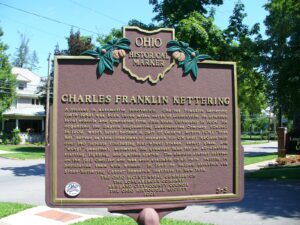
A pioneer in automotive innovation, Charles Franklin Kettering (1876-1958) was born three miles north of Loudonville. He attended local schools and graduated from Ohio State University in 1904. He organized the Dayton Engineering Laboratories Company (Delco) in 1909, which later became a part of General Motors (GM). “Boss Ket” served as vice-president of research for GM until 1920 and held over 140 patents (including four-wheel brakes, safety glass, and “ethyl” gasoline), achieving his greatest fame for an all-electric starting, lighting, and ignition system. The electric starter debuted on the 1912 Cadillac and was soon available on all cars, helping to popularize them with women. In 1945 he helped establish the Sloan-Kettering Cancer Research Institute in New York.
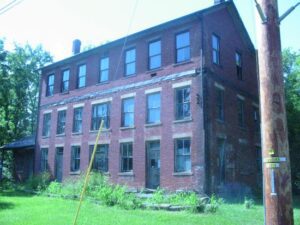
This historic inn began serving travelers on the old Portage-Columbiana stage road (now Tallmadge Road) in 1832. Two major stage lines, one from Cleveland to Wellsville (the closest Ohio River port) and the other from Cleveland to Pittsburgh, passed through Palmyra in the early 1800s. Originally a simple two-story Greek Revival-style building, it had its third story added in 1888 when it became a lodge for the Knights of Pythias fraternal organization. It served as a private residence and store for most of the 20th century. The Palmyra Center Hotel was added to the National Register of Historic Places in 1976.
Henry Simon Winzeler, founder of The Ohio Art Company, was born in 1876 in the Winzeler family home just north of this site in Burlington. As a young man, he opened a dental practice in 1900 in the Murbach Building in Archbold on the corner of North Defiance and East Holland streets. Making a dramatic career change eight years later, Winzeler, inspired by an oval mirror in his aunt’s clothing store, started a company to manufacture picture frames. Calling it The Ohio Art Company, venture capital came from Winzeler’s Hub Grocery that he opened in August 1908 located on North Defiance Street. His picture frame company was opened in the Spoerle and Baer Building, a few doors down on the same street. [Continued on other side]
Here, on September 6, 1918, Bryan’s Air Mail Field began operations as one of Ohio’s first official airfields with the arrival of a survey flight to establish air mail service between New York and Chicago. Scheduled service began on July 1, 1919, and stretched west to San Francisco on September 8, 1920, completing the 2,666 mile U.S transcontinental air mail route. Flying the Curtiss JN-4H “Jenny,” R-4, Standard JR-1B, and later, the De Havilland DH-4, aviators pioneered cross continental flight in open cockpit biplanes without radios or electronic navigational aids and reduced coast to coast mail delivery from 87 hours by rail to 33 hours by air.
Burial Site of Congressional Medal of Honor Recipient Private First Class Joe R. Hastings, U.S. Army, World War II Hastings, the squad leader of a light machinegun section in Company C, 386th Infantry, 97th Infantry Division, displayed conspicuous initiative in battle at Drabenderhohe, Germany, on April 12, 1945, allowing his battered unit to evacuate its wounded and reorganize. Pfc. Hastings, by his intrepidity, outstanding leadership, and unrelenting determination to wipe out the formidable German opposition, cleared the path for his company’s advance. He was killed in action four days later while again supporting his unit. President Truman posthumously awarded Hastings the Congressional Medal of Honor on November 8, 1945.
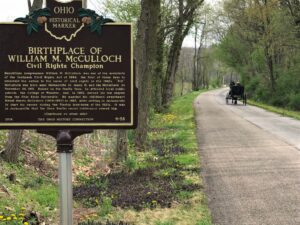
Republican congressman William M. McCulloch was one of the architects of the landmark Civil Rights Act of 1964, the first of three laws to recommit the nation to the cause of civil rights in the 1960s. “Bill” McCulloch was born near Holmesville to James H. and Ida McCulloch on November 24, 1901. Raised on the family farm, he attended local public schools, the College of Wooster, and, in 1925, earned his law degree from the Ohio State University. He married his childhood sweetheart Mabel Harris McCulloch (1904-1990) in 1927, after settling in Jacksonville to start his career during the Florida land-boom of the 1920s. It was in Jacksonville that the Deep South’s racial intolerance seared him. (Continued on other side)