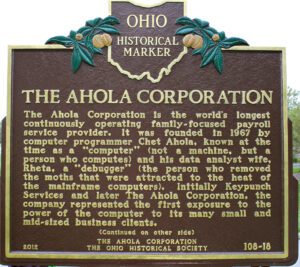
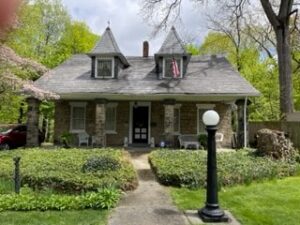
The Ahola Corporation is the world’s longest continuously operating family-focused payroll service provider. It was founded in 1967 by computer programmer Chet Ahola, known at the time as a “computer” (not a machine, but a person who computes) and his data analyst wife, Rheta, a “debugger” (the person who removed the moths that were attracted to the heat of the mainframe computers). Initially Keypunch Services and later the Ahola Corporation, the company represented the first exposure to the power of the computer to its many small and mid-sized business clients.
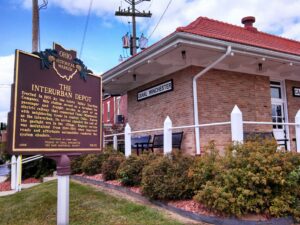
Erected in 1905 by the Scioto Valley Traction Company, this station served as a terminal for passenger and freight service as part of an electric railway that connected Canal Winchester with neighboring towns in central Ohio. Known as the interurban, its arrival signaled the end of the gaslight era in the village. Regular service was maintained from 1904-1930 when improved roads and affordable automobiles rendered the system obsolete. [continued on other side]
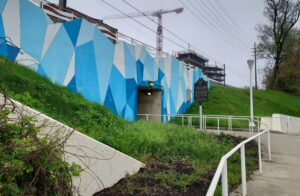
7650 W. Cleveland Memorial Shoreway at W. 76th Street Tunnel
Cleveland
, OH
The W. 76th and W. 65th Street tunnels survive today and symbolize the power of community action. In 1911, Cleveland City Council approved construction of elevated tracks by Lake Shore & Michigan Southern Railway Company. The tracks separated Cleveland’s neighborhoods from Lake Erie. In protest, West Side residents petitioned the council and the mayor to demand that safe access to the lakefront be restored. Council passed Ordinance 23308 to issue $85,000 in bonds to extend W. 76th Street and build a “subway” for vehicles and pedestrians. Obligating the railway company to pay half, the council approved Ordinance 28043 in February 1913 to construct pedestrian subways at E. 79th, W. 65th and W. 76th for $126,000. The E. 79th and W. 65th subways were constructed the same year, and W. 76th completed in 1914.
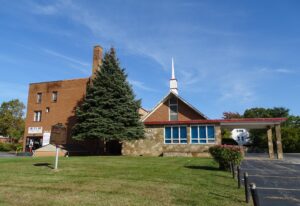
“…on Sunday morning, especially in the African American community, you could go down the street and hear The Wings Over Jordan just coming from everybody’s house….” Glenn Brackens, 2017. Upholding the sanctity of traditional African American spirituals, believing in the power of radio to uplift listeners, and recognizing his choir’s rich talent, Rev. Glenn T. Settle (1894-1967), pastor of Gethsemane Baptist Church, originated the “Negro Hour” on Cleveland’s WGAR in 1937. The Sunday morning radio show featured the choir’s moving renditions of spirituals and was originally directed by James Tate (1918-1986). Williette Firmbanks Thompson (1910-1992) was assistant director and a soloist (Continued on other side)
The Curtis-Preyer Stone House takes its name from two families associated with its early history. Richard and Clarissa Dille Curtis purchased 70 acres in the Connecticut Western Reserve from veteran Elias Lee in 1819. The Euclid Township “Turkey Knob” settlement soon thrived around Dugway Brook, springs sites, and an American Indian crossroads. The Curtis, Dille, Lee, and Stillman families, related by marriage, helped each other succeed by harnessing the creek to power their grist and saw mills and selling quarried stone and felled timber. Sometime between 1819 and 1835 Curtis built his stone house using the Berea sandstone quarried on site. The roof was created of ax-hewn “pegged” tree timbers, and the thick stone walls fashioned of uncoursed, chiseled stones. A central chimney fed seven fireplaces and a bake oven.
William Henry Fouse was born in Westerville to former slaves Squire Fouse and “Sallie” Syler. The first Black student to graduate from Westerville High School (1884), he worked as a bootblack and waiter to earn college tuition. Fouse graduated cum laude from Otterbein (1893), and as the college’s first Black graduate, delivered “A Plea for the Afro-American” at commencement. For forty-five years Fouse worked as a teacher and administrator in Corydon (Indiana), Gallipolis (Ohio), Covington (Kentucky), and Lexington (Kentucky). He served as principal at Lexington’s Paul Lawrence Dunbar High School from its opening in 1923 until his retirement in 1938. During that time, Fouse developed the Bluegrass Oratorical Association, served as president of the Kentucky Negro Education Association, and earned his MA in Education. In 1937, Otterbein conferred a Doctor of Pedagogy upon the distinguished educator.
Carl Stokes was born in Cleveland on June 21, 1927. Recognized for his trailblazing service as a public official, Stokes is one of the few American politicians whose career spanned all three branches of state government. Over 30 years, he served 3 terms as an Ohio legislator (1963-1967), 2 terms as Cleveland’s mayor (1967-1971), and 8 years as a municipal court judge (1983-1994). In 1972, he became the first Black anchorman for a television station in New York City. After a decade working in television, Stokes returned to Cleveland to work as an attorney for the United Auto Workers. In 1994, President Bill Clinton appointed him U.S. Ambassador to the Republic of Seychelles. While serving as Ambassador, he was diagnosed with cancer. Carl Stokes died, in Cleveland, on April 3, 1996.
Invited to speak at three Cleveland high schools, Dr. Martin Luther King Jr. delivered his powerful “Rise Up!” speech to students at Glenville High School on April 26, 1967. It signaled King’s opening drive to elect African Americans to prominent government positions in northern cities. Encouraging students to “develop a sense of somebodiness,” King challenged them to “work passionately and unrelentingly for first-class citizenship.” Recognizing the fear of racial unrest in the city, King underscored the significance of nonviolence. “Our power lies in our ability to say non-violently that we’re not going to take it any longer,” he asserted. Making Carl Stokes’ mayoral bid the focus of his push for Black voters to elect Black leaders, King urged Glenville’s students to join civil rights organizations and community action programs.