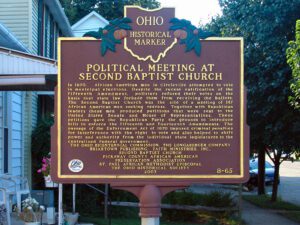
In 1870, African American men in Circleville attempted to vote in municipal elections. Despite the recent ratification of the Fifteenth Amendment, pollsters refused their votes on the basis that state law forbade them from receiving the ballots. The Second Baptist Church was the site of a meeting of 147 African American men seeking redress. Together with Republican leaders these men produced petitions that were sent to the United States Senate and House of Representatives. These petitions gave the Republican Party the grounds to introduce bills to enforce the Fifteenth and Fourteenth Amendments. The passage of the Enforcement Act of 1870 imposed criminal penalties for interference with the right to vote and also helped to shift power and authority from the individual state legislatures to the centralized Federal government.
During the early months of World War II, ordinary citizens as well as soldiers made enormous sacrifices for the war effort. In March 1942 the War Department announced plans to build a 13,000-acre munitions manufacturing complex northeast of Marion. Using the power of eminent domain, the U.S. Government purchased the homes and farms of 126 families in the Likens Chapel community. Given only two months to vacate their property, many displaced farmers found the government-appraised values for their land inadequate for buying similar farms elsewhere and the growing season too advanced to plant new crops. (continued on other side)
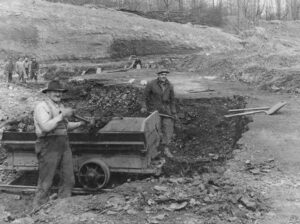
Agriculture dominated the economy of southeastern Ohio’s Morgan County until the 1940s when harvests dwindled, the population declined, and land values dropped. Surface mining the area’s rich underground coal deposits replaced agriculture as the major industry and revitalized the declining local economy. As the nation’s demand for electricity grew over the next half-century, so did the demand for coal as fuel for nearby power generation plants. During mining’s heyday in the 1960s to the late 1980s, American Electric Power’s former Central Ohio Coal Company subsidiary employed nearly 1,000 people. Nearby communities-such as Cumberland, Caldwell and Chandlersville-thrived. As time passed, however, the robust coal industry was hit hard by environmental regulations that reduced the market for the area’s high-sulfur coal. In turn, mine work forces shrank considerably and local businesses closed. (continued on other side)
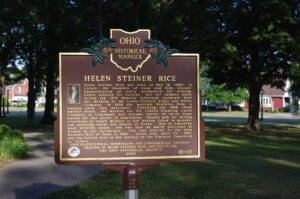
Helen Steiner Rice was born on May 19, 1900, in Lorain, the daughter of Anna and John Steiner. Demonstrating an early propensity for writing, Helen planned for college, but her father’s death during the 1918 Spanish Influenza epidemic kept her working at the Lorain Electric Light and Power Company. In 1929 she married Franklin Rice, a Dayton bank vice president. Following the 1929 stock market crash, she worked for the Gibson Greeting Cards Company in Cincinnati and became editor of verse lines. Known for her words of inspiration, Helen’s gift for writing continues to reach millions in her poetry found in modern-day greeting cards and dozens of books. One of America’s most prolific poets, she was also an early advocate of women in the workplace. She was elected to the Ohio Women’s Hall of Fame in 1992. Helen died April 23, 1981, and was buried next to her parents at the Elmwood Cemetery in Lorain.
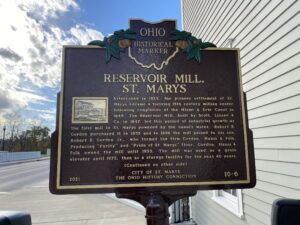
Established in 1823, the pioneer settlement of St. Marys became a thriving 19th century milling center following completion of the Miami & Erie Canal in 1845. The Reservoir Mill, built by Scott, Linzee & Co. in 1847, led this period of industrial growth as the first mill in St. Marys powered by the canal’s water. Robert B. Gordon purchased it in 1855 and in 1896 the mill passed to his son, Robert B. Gordon Jr., who formed the firm Gordon, Hauss & Folk. Producing “Purity” and “Pride of St. Marys” flour, Gordon, Hauss & Folk owned the mill until 1955. The mill was used as a grain elevator until 1972, then as a storage facility for the next 40 years. (Continued on other side)
On November 14, 1935, the rural electrification movement got its start in Piqua with the installation of the first electric pole financed by the Rural Electrification Administration (REA). In partnership with the Miami Rural Electric Cooperative, Inc., the pole was constructed to support a power line of 193 miles, bringing electricity to nearly 700 farms in the county. At the time the REA was established by the federal government, only 10% of the rural population had electricity. Today, electric cooperative lines reach more than 36 million consumers in 47 states.
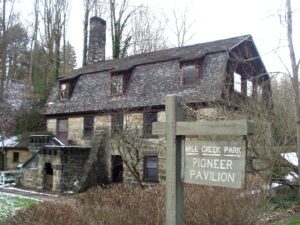
Pioneer Pavilion, one of the oldest structures in Youngstown, is a rare surviving example of early nineteenth-century industry. James Heaton constructed this sandstone building in 1821 as a mill for carding and fulling wool. A millrace from Mill Creek and a waterwheel on the west side supplied the power. In the 1830s and 1840s, the woolen mill was converted to a storage facility for the nearby Mill Creek Furnace and later served as a cattle barn. In 1891, Youngstown attorney Volney Rogers purchased the property for Mill Creek Park, renovating the building in 1893 as a dining and dancing facility, and naming it Pioneer Pavilion. Generations of area residents spanning three centuries have celebrated social events in this historic landmark.
J.W. Denver Williams Jr. Park, 1100 Rombach Avenue
Wilmington
, OH
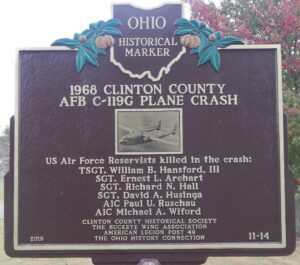
On August 9, 1968, a plane carrying 31 military passengers and crew members left the Clinton County Air Force Base for completion of an annual two-week active duty training held at Otis Air Force Base, Massachusetts. The transport was assigned to the 907th Tactical Airlift Group, 302nd Tactical Airlift Wing. Just after takeoff, the C-119G “Flying Boxcar” lost power, and the pilot attempted to return to the base. The plane crash-landed and caught fire on the Ottie Griffith Farm two miles from the base. Six reservists perished, and many passengers and rescuers were injured.