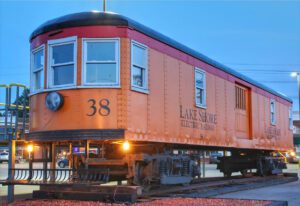
From the 1890s to the 1930s, interurban railways were an important form of travel in the Midwest. Beach Park Station had an interurban carhouse, where repairs were performed and passengers boarded. The Lorain & Cleveland Railway (L&C) built the 65½ by 200 foot brick station in 1897. By 1901, the L&C became part of the Lake Shore Electric Railway (LSE) and Beach Park became stop 65 on a line that ran from Cleveland to Toledo and then to Detroit. Requiring power and water, the LSE built an electric plant and water tower at Avon Lake. This infrastructure spurred the community’s development and growth. (Continued on other side
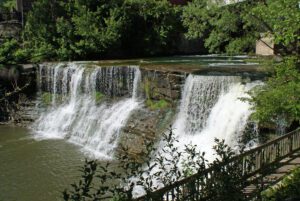
The Chagrin River was named for Francois Seguin, a Frenchman who traded with Native Americans in Northeast Ohio circa 1742. The “High Falls” of the Chagrin River primarily attracted settlers from New England (circa 1833) seeking a location with ample waterpower. By the mid-nineteenth century an axe factory, a foundry, 2 flour mills, 4 woolen mills, 2 sawmills, 3 paper mills, and a woodenware factory had been built along the riverbanks in Chagrin Falls. The “High Falls” provided a power source for a gristmill, built in 1836 at this location. Today, only one factory remains in operation in the Village of Chagrin Falls.
The Piqua Nuclear Power Facility was part of the U.S. Atomic Energy Commission’s Power Demonstration Reactor Program. The program developed experimental nuclear reactors that could supplement steam generation for electricity production. In 1956, the commission accepted Director of Municipal Utilities John P. Gallagher’s proposal to build a reactor in Piqua and the following year Congress set aside $11,465,000 for the project. The Piqua Nuclear Power Facility was the first nuclear power plant of any type to be operated by a municipal utility. It reached criticality in 1963 and, for a few years, Piqua proudly called itself “The Atomic City.” The reactor was shut down due to technical issues and economic considerations in 1966. It was fully decommissioned by February 1969. The facilities were demolished in 2023.
The facilities once here propelled the United States through the Nuclear and Space Ages and were named for the nearby pre-historic Miamisburg Mound. The Manhattan Engineer District of the War Department began construction of Mound Laboratory in 1946. The facility consolidated production of the nuclear-reaction initiators, developed for the United States’ first atomic bombs during World War II. Previously (1943-1946), the work to separate, purify, and process the element polonium used in these initiators occurred at facilities throughout the Dayton area. Mound Laboratory was the nation’s first permanent post-WWII Atomic Energy Commission site. Mound Laboratory had 116 buildings and at its peak employed approximately 2,500 scientists, engineers, and skilled workers. Contractors operating at the site were Monsanto (1947-1988), Edgerton, Germeshausen, and Grier (1988-1997), and Babcock and Wilcox (1997-2002). (Continued on other side)
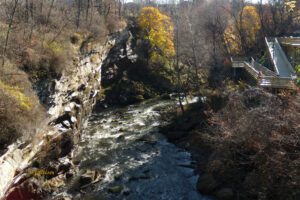
In 1879, local hardware store owners L.W. Loomis and H.E. Parks established a summer resort at Front Street and Prospect Avenue. The High Bridge Glens and Caves park spanned both sides of the Cuyahoga River and featured a dance and dining pavilion, scenic trails and overlooks, cascades and waterfalls, deep caverns, curious geological formations, and a suspension footbridge. The park also offered several manmade attractions, including what is believed to have been one of the earliest roller coasters in the area. At the height of its popularity, the park attracted more than 8,000 visitors a day, including Congressman (later president of the United States) William McKinley. (continued on other side)
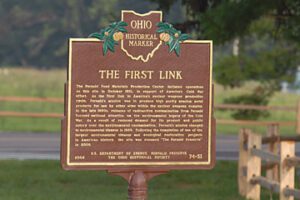
The Fernald Feed Materials Production Center initiated operations on this site in October 1951, in support of America’s Cold War effort. As the first link in America’s nuclear weapons production cycle, Fernald’s mission was to produce high purity uranium metal products for use by other sites within the nuclear weapons complex. In the late 1980s, releases of radioactive contamination from Fernald focused national attention on the environmental legacy of the Cold War. As a result of reduced demand for its product and public outcry over the environmental contamination, Fernald’s mission changed to environmental cleanup in 1989. Following the completion of one of the largest environmental cleanup and ecological restoration projects in American history, the site was renamed “The Fernald Preserve” in 2006.
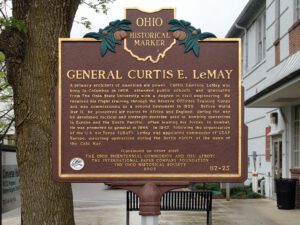
A primary architect of American air power, Curtis Emerson LeMay was born in Columbus in 1906, attended public schools, and graduated from The Ohio State University with a degree in civil engineering. He received his flight training through the Reserve Officers Training Corps and was commissioned as a second lieutenant in 1929. Before World War II, he pioneered air routes to Africa and England; during the war he developed tactical and strategic doctrine used in bombing operations in Europe and the South Pacific, often leading his forces in combat. He was promoted to general in 1944. In 1947, following the organization of the U.S.Air Force (USAF), LeMay was appointed commander of USAF Europe, directing operations during the Berlin Airlift at the dawn of the Cold War. (continued on other side)
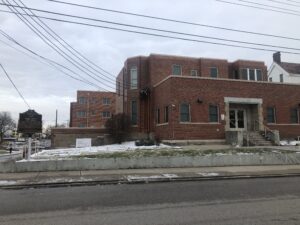
Walnut Hills has been home to a significant middle- and working-class Black community since the 1850s. In 1931, African American entrepreneur Horace Sudduth bought 1004 Chapel Street and then the row of buildings across Monfort, naming them the Manse Hotel and Annex. Throughout the 1940s, hotel dinner parties could move to the Federation of Colored Women’s Clubs house next door for dancing. A large addition to the Manse in 1950 created its own ballroom, 24-hour coffee shop, upgraded Sweetbriar Restaurant, and more guest rooms. It appeared in the Negro Motorist’s Green Book between 1940-1963, providing local, transient, and residential guests both catered meetings and top entertainment during the last decades of segregation. It closed in the late 1960s when the economic need for a first-class segregated hotel disappeared in the age of Black Power.