

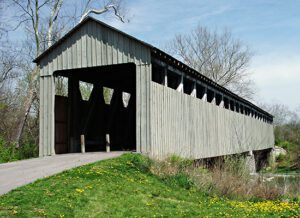
, OH
One of the few remaining covered bridges in southwestern Ohio and the only one in Butler County on its original site, this bridge was built in 1868-1869 to give access to a saw and grist mill owned by James B. Pugh on Four Mile (Tallawanda) Creek. The wooden frame three-story mill had a 16-foot overshot water wheel to power it. Pugh’s Mill ceased operation after two decades. The name of the span gradually changed to Black Bridge, likely because there was a white covered bridge downstream near present State Route 73. The Oxford Museum Association assumed stewardship of the Black Bridge in 1976 as part of the American Bicentennial celebration. Placed on the National Register of Historic Places in 1975, it was restored and rededicated in 2000.
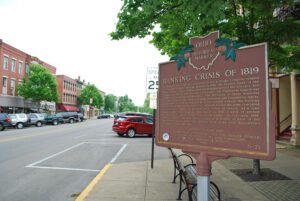
, OH
To provide direction and stability to the economy, Congress created the nation’s largest lending agency in 1816, the Second Bank of the United States. Branch banks were established around the country, two of them in Ohio-Chillicothe and Cincinnati. The Chillicothe branch was located in a building on this site. The presence of these branches adversely affected the ability of state chartered and independent banks, which had long printed and lent their own money without the backing of species. When the Secretary of Treasury forced the state chartered and independent banks to redeem their notes in specie, at a time when a sharp recession hit the nation in 1819, a wave of protest arose from those connected with those banks. In February 1819, Ohio’s General Assembly levied a tax of $50,000 on each of the two branch banks, and bank officers were given until September 1 to comply with the law. (continued on other side)
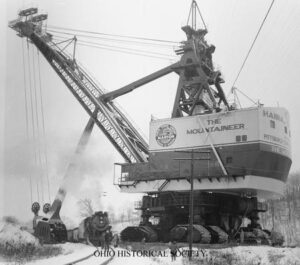
, OH
The Marion Steam Shovel Company built the primary tools for America’s civil engineering for more than 100 years. Founded in 1884 by Henry M. Barnhart, George W. King, and Edward Huber, the company’s patent steam shovels helped revolutionize railway and road construction, and were used in the building of the Panama Canal, Hoover Dam, and the Holland Tunnel. “The Shovel” also built ditchers, log loaders, dredges, and draglines, including some of the largest land vehicles ever built. The first electric machine was built in 1915, but it was not until 1946 that the name was changed to Marion Power Shovel. In the mid-twentieth century, “The Shovel” employed 2,500 workers. In the 1960s, the National Aeronautics and Space Administration selected Marion to build the crawlers that transport spacecraft to their launch pads. Hundred-year rival Bucyrus International acquired and closed the company in 1997.
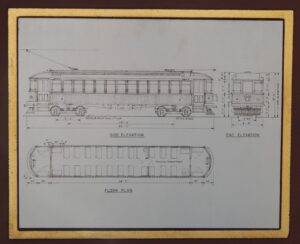
, OH
The Dayton, Springfield, and Urbana Electric Railway (DS&U) was an “Interurban” rail system that ran between the cities of Urbana, Springfield and Dayton. Its beginning can be traced to the franchise given to William H. Hanford to operate a single line of electrical railway between Springfield and the southern boundary of Champaign County in 1895. Hanford then sold his rights to John G. Webb of Springfield and Colonel Frederich Colburn of Kentucky, who along with other syndicate members formed the Dayton, Springfield, and Urbana Electric Railway. In 1897 Boston promoter Arthur E. Appleyard joined the syndicate and brought investment monies, organizational skills, and energy to the venture. He quickly became managing director/treasurer and the real driving force of the DS&U. The railway was organized into two divisions. One operated between Dayton and Springfield and the other between Springfield and Urbana. [continued on other side]
, OH
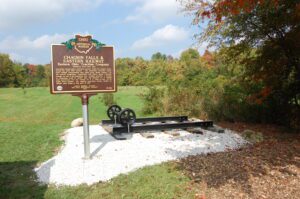
From east to west, the Chagrin Falls and Eastern Interurban Railway crossed the Muggleton Farm (now South Russell Village Park) at this location and connected the Chagrin Valley with Hiram, Garrettsville, and Middlefield. Its sister interurban, the Cleveland and Chagrin Falls Electric Railway served points west. Soon after their formation, the Everett-Moore Syndicate merged the two lines into the extensive interurban rail network, The Eastern Ohio Traction Company. The EOTC and its predecessors operated from 1899-1925, mainly moving mail, farm goods, and passengers. In 1914, the more rural line from Chagrin Falls traveling eastward became the first major interurban in the United States to cease operations. It is believed that declining use, insufficient power for the railway, and a failed line extension to Youngstown were likely factors contributing to the line’s demise.(Continued on other side)
, OH
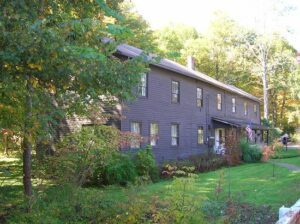
The Ghent Woolen Mill was one of at least thirteen mills built in the Yellow Creek Valley to take advantage of the water power available in the creek’s 400-foot fall across Bath Township. Erected by Messrs. Allen and Bloom in 1832, it was a marginal commercial success and changed hands several times during the 1800s – reportedly because an abundant wolf population in this region made raising sheep a risky venture. In its peak years of operation during the Civil War era the Ghent mill processed as much as 10,000 pounds of wool into finished cloth and yarn annually. It was converted to a machine shop circa 1889 and subsequently into private residences in the late 1890s. The oldest known woolen mill still standing in Ohio, it retains many of its original architectural features.
, OH
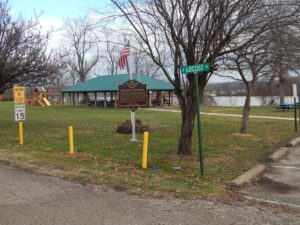
In 1955, at the age of 67, Emma Rowena “Grandma” Gatewood became the first woman to hike the 2,050 mile Appalachian Trail alone and in one season. The Gallia County, Ohio resident hiked the Appalachian Trail again in 1957 and 1964, becoming the first to walk its length three times. In 1959, she hiked the Oregan Trail, from Independence, Missouri to Portland, Oregon. She was a founder of the Buckeye Trail and life member of the Buckeye Trail Association, which named part of the trail after her. Grandma Gatewood was born in 1887 on a farm near Mercerville, one of 15 children, and died in 1973 at the age of 85, the mother of 11 and “grandma” to many more. SHe was inducted into the Appalachian Trail Hall of Fame in 2012.
, OH
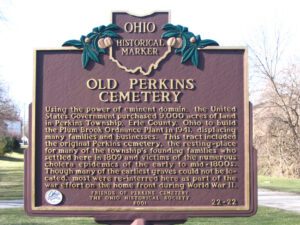
Using the power of eminent domain, the United States Government purchased 9,000 acres of land in Perkins Township, Erie County, Ohio to build the Plum Brook Ordnance Plant in 1941, displacing many families and businesses. This tract included the original Perkins cemetery, the resting-place for many of the township’s founding families who settled here in 1809 and victims of the numerous cholera epidemics of the early to mid-1800s. Though many of the earliest graves could not be located, most were re-interred here as part of the war effort on the home front during World War II.