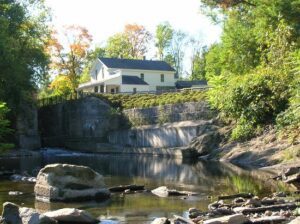
The Mustill house and store are survivors of Akron’s canal era and date to the 1840s. Joseph and Sarah Mustill moved their family from England to Akron in 1833 and owned the store and Greek Revival house at Lock 15 on the Ohio & Erie Canal. Three generations of Mustills lived and worked the grocery business at Lock 15, first Joseph and Sarah, then their son Fred with his wife Emma, and their children Maria, Frederick, Edwin and Franklin. A popular place to buy or barter goods, the store served canallers, farmers, craftsmen, and neighbors for many years.
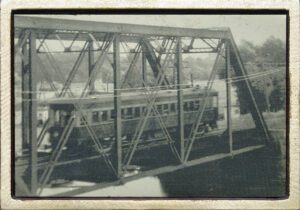
At this site the Lake Shore Electric Railway crossed a bridge that spanned the Vermilion River. The western abutment of the former bridge is plainly visible just below along the river bank. Widely known as the “Greatest Electric Railway in the United States,” the flaming orange trolley cars of the Lake Shore Electric Railway transported people and freight for thirty-seven years (1901-1938) along the southern Lake Erie shores from Cleveland to Toledo often reaching speeds of sixty miles per hour. The interurban line played a primary role in the development of the western Cleveland suburbs and also carried throngs of summer visitors to Lake Erie recreation facilities at Avon Beach Park, Linwood Park, Crystal Beach, Mitiwanga, Ruggles Grove, Rye Beach, and Cedar Point. The power lines still standing along the system’s right-of-way attest to the fact that it also assisted in bringing electric power to the entire region.
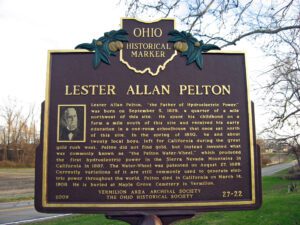
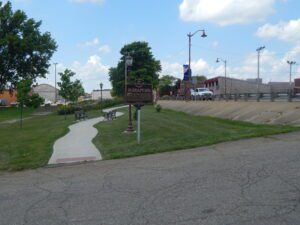
Lester Allan Pelton, “the Father of Hydroelectric Power,” was born on September 5, 1829, a quarter of a mile northwest of this site. He spent his childhood on a farm a mile south of this site and received his early education in a one-room schoolhouse that once sat north of this site. In the spring of 1850, he and about twenty local boys, left for California during the great gold rush west. Pelton did not find gold, but instead invented what was commonly known as “the Pelton Water-Wheel,” which produced the first hydroelectric power in the Sierra Nevada Mountains in California in 1887. The Water-Wheel was patented on August 27, 1889. Currently variations of it are still commonly used to generate electric power throughout the world. Pelton died in California on March 14, 1908. He is buried at Maple Grove Cemetery in Vermilion.
NW corner of N Tuscarawas Avenue and W Front Street
Dover
, OH
Christian Deardorff (1781-1851) with his brother-in-law Jesse Slingluff (1775-1836) platted and founded Dover and built the area’s first gristmill on Sugar Creek. With the coming of the Ohio and Erie Canal to Dover, Deardorff lobbied successfully to make Dover a toll stop for the canal and the be afforded a source of water power for his mill. A dam built on Sugar Creek obstructed for the mill there. Deardorff received access to the canal near Tuscarawas Avenue, and there erected a mill, later named the Cascade Mill by the Hardesty brothers when they purchased it in 1872. The Hardestys, from Carroll County, came to Dover in the 1860s and began operating a large mill on the Calico Ditch, near the foot of 2nd Street. The Dover Milling Company bought the last Hardesty-owned mill in 1951.
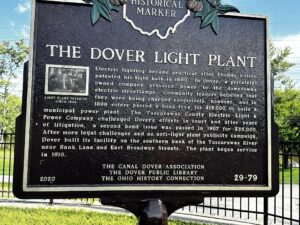
Electric lighting became practical after Thomas Edison patented his light bulb in 1880. In Dover, a privately-owned company provided power to the downtown’s electric streetlamps. Community leaders believed that they were being charged excessively, however, and in 1898 voters passed a bond levy for $15,000 to build a municipal power plant. The Tuscarawas County Electric Light & Power Company challenged Dover’s efforts in court and after years of litigation, a second bond issue was passed in 1907 for $35,000. After more legal challenges and an anti-light plant publicity campaign, Dover built its facility on the southern bank of the Tuscarawas River near Bank Lane and East Broadway Streets. The plant began service in 1910 and, with the Northern Ohio Traction & Light Company, supplied electricity to Dover.
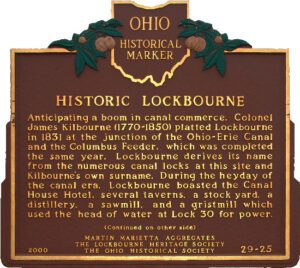
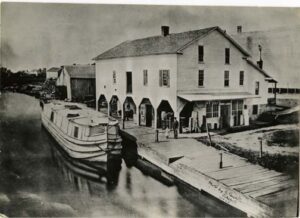
Anticipating a boom in canal commerce, Colonel James Kilbourne (1770-1850) platted Lockbourne in 1831 at the junction of the Ohio-Erie Canal and the Columbus Feeder, which was completed the same year. Lockbourne derives its name from the numerous canal locks at this site and Kilbourne’s own surname. During the heyday of the canal era, Lockbourne boasted the Canal House Hotel, several taverns, a stock yard, a distillery, a sawmill, and a gristmill which used the head of water at Lock 30 for power. (continued on other side)
The Wabash & Erie Canal opened between Toledo and Lafayette, Indiana, May 8, 1843. The Miami Extension Canal was completed to Junction, Ohio, on July 4, 1845, linking the Wabash & Erie Canal with Cincinnati and resulting in changing the canal’s name to the Miami and Erie Canal. Prosperity reigned until the 1850s when railroad competition caused a slow decline in commerce. The canal branch to Indiana was in disuse by 1858 and totally abandoned in 1888. The canal system was revived from 1906-1909 with much reconstruction and improvement only to be badly damaged by severe statewide flooding in 1913. The canal was maintained from here to Maumee for generating hydro-electric power until it was drained in 1929. Twelve miles of canal and the Maumee Side Cut Canal have been leased to the Toledo Area Metroparks since 1932.
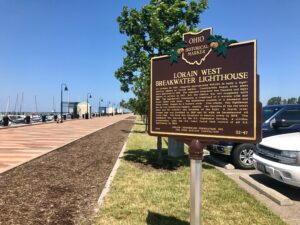
On October 22, 1913, Congress appropriated $35,000 to build a light-and-fog station at Lorain harbor. Construction began after plans were approved in 1916. The concrete structure was finished and light placed in service in 1917, but the station was not completed until 1919. The lighthouse’s foundation is comprised of a wooden crib and boxes filled with stone. The lighthouse consists of a basement and three floors, topped by a lantern room. Like others, this lighthouse had its own identifying signals, namely, the duration of the fog horn’s blast and the rotation and duration of the light. A fourth order Fresnel lens was installed in 1919 and lit with an incandescent oil vapor lamp. The lamp was converted to electric power in 1932. The lighthouse was manned by the U.S. Lighthouse Service, a civilian organization, until the U.S. Coast Guard took control of all U.S. lighthouses in 1939.