

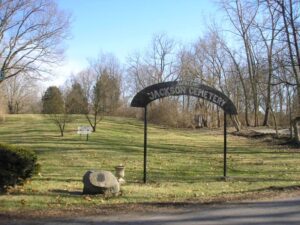
, OH
In 1833, John Randolph from Roanoke, Virginia, died leaving three wills that requested that all of his slaves be set free and that land be purchased for them. Although contested for thirteen years by his family, the slaves were freed and the executor of the wills, Randolph’s cousin Judge William Leigh purchased about 2,000 acres of farm land in Mercer County, Ohio. Traveling by wagon train, the freed slaves, 383 in all, reached their destination in 1846, but were forced to turn back by earlier established white settlers. They turned around and ended up north of Piqua where they purchased land and developed the Village of Rossville. Later some moved on to other places in Miami County and well as Shelby County. In Rossville, they established an African Baptist Church in 1869, cemetery in 1866, and public black school in 1872.
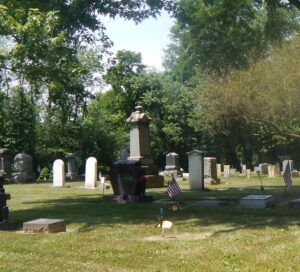
, OH
In 1827, noted evangelist Walter Scott came to Canfield and visited with a number of area Baptist families living on Palmyra Road and in the vicinity of Dean Hill. A follower of Alexander Campbell, Scott delivered powerful sermons that persuaded some to establish a new church congregation in the Disciple faith. After meeting in congregation members’ homes, a framed meeting house was erected circa 1830 on land purchased from William and Orsemus Dean. This church stood across from William Dean’s brick residence. A burial ground was provided at the site with existing grave markers dating to 1837. Veterans from all the wars of this nation are buried here, including Benjamin Dean of the 105th Ohio Infantry Regiment who died from wounds suffered in the 1863 Battle of Murfreesboro in Tennessee. (continued on other side)
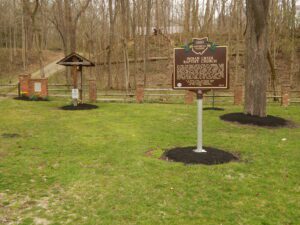
, OH
The Indian Creek Regular Baptist Church was established in 1810 as an arm of the Little Cedar Creek Church of Brookville, Indiana. The congregation purchased three acres of land for a burial ground and church and built a log structure here in 1811. Members voted in 1812 that they would receive no person who believed in the principles of slavery. By 1829, membership had reached 150 and the present brick meeting house was built. In the 1840s, membership declined due to conflict over mission activity The congregation dissolved in 1879 and the land was deeded to the Indian Creek Cemetery Association in 1880. The county park system received the property in 1960 through and with the cooperation of the Butler County Historical Society and the Cemetery Association.
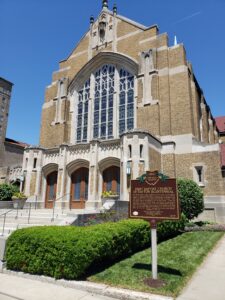
, OH
First Baptist Church of Dayton organized on May 29, 1824. A council met on the porch of William Huffman’s home at Third and Jefferson and approved 9 members as a congregation. The next day Lydia Huffman was baptized in the Great Miami River, the first recorded Baptist immersion in the city. Their first church building was erected in 1827 on Main Street. In 1829 the congregation suffered a Campbellite schism. Those resolved to remain Baptist incorporated on February 25, 1837, as The First Regular Baptist Church of Dayton, Ohio. The foundations for the Monument Avenue building were begun prior to the 1913 Dayton flood and the cornerstone was laid May 31, 1914. The building was completed, furnished, and ready for worship on June 26, 1915. (Continued on other side)
, OH
Fout Hall was one of three original buildings on the Bonebrake Theological Seminary campus. Constructed 1920-1923, it was named for Dr. J. E. Fout, who managed campus construction. Bonebrake Seminary was founded in 1871 by Dayton’s United Brethren in Christ Church and became co-educational in 1873. Generous cash and land gifts (1909-1911) enabled the construction of a new campus. Fout Hall, the administration building, and a powerhouse were designed by Dayton architect Frederick J. Hughes in the Jacobethan Revival style. The three-story buff-brick dormitory was the largest of the buildings and cost $250,000. As well as dining hall, laundry, and storage facilities, it featured 12 single rooms, 54 two-room suites, and 6 three-room suites. Fout Hall was an integral part of the National Register listing of the Dayton View Triangle Historic District in 2022.
, OH
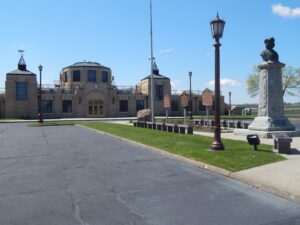
In 1951, several pioneer drag racers opened on of the Midwest’s first drag strips known by local racing enthusiasts as the “Fulton Airport Champioins Raceway.” For the next eight years half-brothers Art and Walt Arfons, Otis “Otie” Smith and “Akron Arlen” Vanke raced here. Both Arfons, who were long-time bitter rivals, at one point held the world land speed record. Otie, the first president of the Cam Jammers car club in Akron, won the National Hot Rod Association’s 1959 championship. Vanke won many national champtionships as a Stock, Super Stock and Pro Stock racer.
, OH
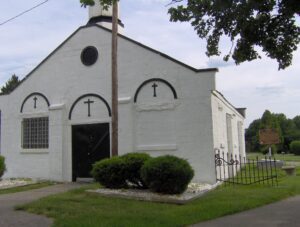
Born in Richmond, Virginia, Powhatan Beaty moved to Cincinnati in 1849, where he spent the majority of his life. Beaty enlisted as a private in the Union Army in June 1863, and two days later was promoted to first sergeant, Company G, 5th United States Colored Troops (USCT). All the officers of Company G were killed or wounded during an attack on Confederate forces at New Market Heights, Virginia, in September 1864. Beaty took command of his company, and for his valor received the Congressional Medal of Honor. Beaty was one of two African-Americans buried in Ohio to receive the Medal of Honor for service in the Civil War. He died on December 6, 1916, leaving two sons, attorney and state representative A. Lee Beaty and John W. Beaty. He is buried in Union Baptist Cemetery along with nearly 150 USCT veterans.
, OH
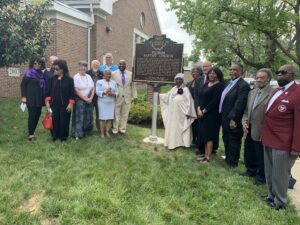
On January 9, 1919, a group of eight men and three women, being led by the Holy Spirit, met at a house on Wallace Street to form a new black Missionary Baptist Church in Hamilton, Ohio. The group quickly raised $150 to make the down payment on a two-story brick building at 333 Chestnut Street being sold for $1,850. The building was occupied on March 25, 1919, and the name Pilgrim Baptist Church was suggested and accepted. On May 11, 1919, a special council requested admittance into the Western Union Baptist Association, a district association now affiliated with the Ohio Baptist General Convention. Requirements for admission were met and Pilgrim Baptist Church was recognized as a Missionary Baptist Church. In 2019, Pilgrim Baptist Church celebrated a centennial of faithfulness in Hamilton.