

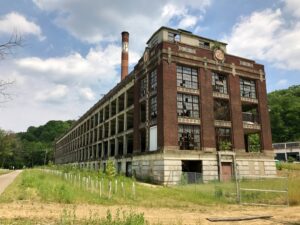
, OH
The Peters Cartridge Company was once a major employer in the region, providing munitions for Allied forces during World Wars I and II. Organized in 1887, it was the first ammunition company to produce machine-loaded shotgun shells. After an explosion in 1890 that killed 12, the factory was rebuilt at this site. By 1916, brick and reinforced concrete buildings had replaced wood structures and a taller shot tower had been erected. Sister company to the King Powder Company across the Little Miami River, 3,000 men and women at Peters produced 1,500,000 cartridges per day in 1917 to supply munitions during WWI. In 1934, Remington Arms bought the company, enlarged it, and then sold it in 1944. The shot tower and smoke stack stand as a reminder that Peters was once the leader in ammunition production.
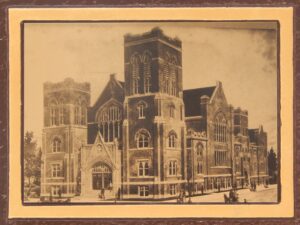
, OH
The Euclid Avenue United Brethren Church, later the Mount Enon Missionary Baptist Church, was erected at Third & Euclid Street in Dayton. Milton Wright, a bishop of the church, was present at the laying of the cornerstone on May 28, 1911. Bishop and Mrs. Susan (Koerner) Wright were the parents of Orville and Wilbur Wright and their siblings Reuchlin, Lorin and Katherine. The church’s congregation included Orville and Katherine Wright and other notable Daytonians such as local historian and former pastor Dr. Augustus W. Drury, food distributor and potato chip maker Daniel Mikesell and Prof. Josiah P. Landis of the Bonebrake Theological Seminary. The church playedd a role in offering aid during the disasterous flood of 1913.
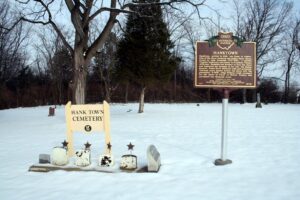
, OH
Hanktown, settled in 1846, was home to eighty-nine of the three hundred and eighty-three slaves, owned by John Randolph (1773-1833), a wealthy Virginian landowner and cousin to President Thomas Jefferson. Randolph had decided to free the slaves and indicated the decision in his will. His family, however, found three different wills and protested. Thirteen years passed before the slaves left the plantation. In 1846, Judge William Leigh arranged for the slaves to travel to Mercer County and purchased two thousand acres. (Continued on other side)
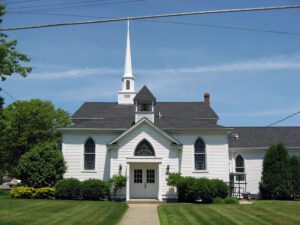
, OH
The Canfield Christian Church began as a Baptist congregation in 1822 and church met for worship in William Dean’s home. The Mahoning Baptist Association Meeting of 1826 was held in David Hayes barn. In 1827, Walter Scott was asked by the Association to be the first paid traveling evangelist in the Mahoning Valley area of Ohio. Scott accepted the offer and moved his family to a house next to the Canfield Church. By June of 1829, the Canfield Church voted to lay aside the Baptist name for the name Disciples of Christ. They believed all creeds were unnecessary and took the Bible alone as their sole rule of faith and practice. In 1847, a new church was built. Charter members of the church include James and Sarah Caldwell, Ann Winfield, Mr. and Mrs. Benjamin Caldwell and daughter, Mr. and Mrs. Andrew Flick, Mr. and Mrs. Walter Clark, Mr. and Mrs. John Flick, and Mr. and Mrs. Simmon Sackett and daughter. (Continued on other side)
, OH
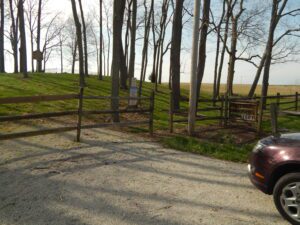
In the early years of the nineteenth century, a religious unrest known as the Second Great Awakening spread across much of the American frontier. Among the most influential of the evolving religious organizations were the Campbellites, or Disciples of Christ, founded in the 1820s by Thomas and Alexander Campbell. The Campbellite movement sought to “restore” New Testament Christianity by calling for a return to the primitive church revealed in the gospels. Campbellites denied creeds and oath-taking and rejected sectarianism. They believed in baptism by immersion and communion on Sundays. Followers also dealt with problems and transgressions of members within the church and did not use civil courts. They held a millennial view that professed human happiness and the belief that Christ would reign on earth for a thousand years. Believers spread this word to the pioneers of the Doty Settlement and elsewhere. By 1850, there were ninety Campbellite Churches in Ohio.
, OH
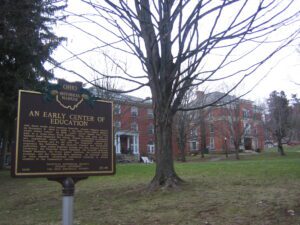
Just three weeks after reaching Granville, pioneer villagers decided on December 9, 1805 to build a log cabin where eighty children would attend school. By 1820, public school classes were being held in a three-story brick building. When rail lines and the National Road bypassed the village, dreams of becoming an industrial and commercial center were dashed. Educational institutions, however, thrived and by the Civil War Granville’s citizens had organized the following: the Granville Literary and Theological Institution, later called Granville College and then renamed Denison University; the Granville Female Seminary, the Granville Episcopal Female Seminary, the Young Ladies’ Institute, the Granville Female Academy, and the Granville Male Academy. As Granville enters its third century, educational excellence continues to attract students to the community’s schools.
, OH
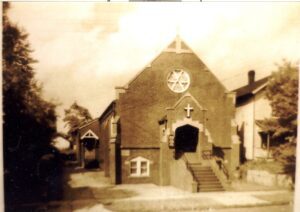
St. Augustine Episcopal Chapel was founded by Lenora Evans Berry, an African American woman, in 1907. A lifelong Baptist, her mission was the development of the Episcopal Church for African Americans in Youngstown. Mrs. Berry’s husband, bricklayer Thomas D. Berry, the son of master builder P. Ross Berry, became the church’s first senior warden and treasurer. The congregation met in St. John’s Parish until they were able to obtain property on Parmalee Avenue. In 1912, Reverend John Ogburn was officially called to vicar. In 1920, work began on plans for a new church. The structure was designed by Charles F. Owsley and construction began after more than six hundred individuals from the community attended the laying of the church’s corner stone on September 11, 1921. St. Augustine Chapel is the oldest African American church and congregation in Youngstown still in its original location and structure.
, OH
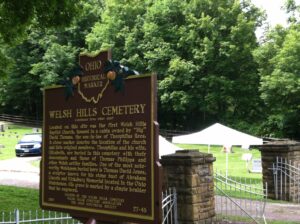
Welsh Hills Cemetery was once part of the United States Military Tract given to veterans of the Revolutionary War. The land was owned by a Philadelphia Welshman named Samson Davis. On September 4, 1801, a portion of his land was purchased by the co-founders of the Welsh Hills community, Theophilus Rees and Thomas Philipps, who came from Carmarthenshire, Wales. On February 6, 1808, Theophilus Rees donated a portion of his land for the establishment of this cemetery. On that same day, Rees Thomas, the 8-year-old grandson of Theophilus Rees, became the first person interred. (Continued on other side)