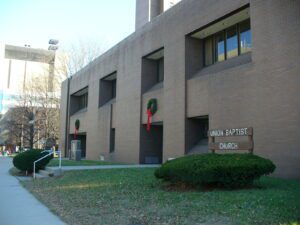
George Washington Williams was born in 1849 in Bedford, Pennsylvania. At age 14, he enlisted in the Union Army to fight in the Civil War and received a medical discharge in 1868. In 1874, he became the first African American to graduate from the Newton Theological Institution in Cambridge, Massachusetts, and shortly after married Sarah. A. Sterrett. He became pastor of the Twelfth Baptist Church in Boston before moving to Washington, D.C. to serve as editor of a newspaper called The Commoner. He then moved to Cincinnati to become pastor of the Union Baptist Church and while there served as the first black member of the Ohio Legislature from 1879-1881. Williams went to the Belgian Congo in 1890 where he criticized King Leopold II in an Open Letter for his inhumane policies in the Congo. He died in 1891 in England.
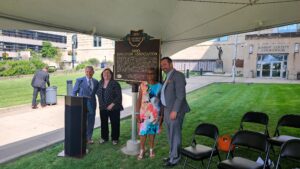
On December 30, 1847, six educators met at the Summit County Courthouse to organize the first convention of the Ohio State Teachers’ Association, now known as the Ohio Education Association (OEA). The organizers Josiah Hurty (Richland County), Thomas W. Harvey (Geauga County), M.D. Leggett (Summit County), Lorin Andrews (Ashland County), William Bowen (Stark County), and Marcellus F. Cowdery (Lake County) hoped “to elevate the profession of teaching” and “to promote the interests of schools in Ohio.” In 1853, the General Assembly enacted the new association’s entire slate of proposals into law, thus ensuring free, universal, public education in Ohio. For 176 years, the Ohio Education Association has advocated for fair terms and conditions of employment for Ohio educators and for the betterment and improvement of public education for all students.
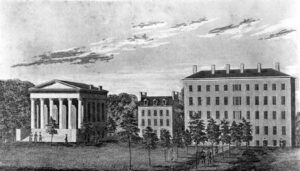
The Lanes, Baptist merchants from New Orleans, and the Kempers, a Presbyterian family from Cincinnati, gave money and land respectively for Cincinnati’s first manual labor theological seminary and high school, which opened in suburban Walnut Hills in 1829. The Reverend Lyman Beecher came from Boston as its first president. The president’s house, now known as the Stowe House after Beecher’s daughter Harriet Beecher Stowe, author of Uncle Tom’s Cabin, still remains at Gilbert and Foraker. Lane Theological Seminary, bound by present day Gilbert, Chapel, Park, and Yale streets, continued to educate Presbyterian ministers until 1932, when it was merged with McCormick Theological Seminary in Chicago.
John Malvin (1795-1880) was an operative on the Underground Railroad and an ardent member of anti-slavery and abolitionist causes. Born in Dumfries, Virginia of a free mother and enslaved father, Malvin was apprenticed at an early age to learn carpentry and taught himself to read and write. In 1827, he moved to Cincinnati where he became an ordained preacher and an activist in the cause of freedom. In 1831, with his wife Harriet, he moved to Cleveland where he became a charter member of the First Baptist Church, a sawmill operator, and captain and owner of the canal boat Auburn. (continued on other side)
In 1962, Asian Indian students of Case Western Reserve University started India Association of Cleveland (IAC). In 1967, IAC started a newspaper “LOTUS,” regarded as the first such Asian Indian community newspapers in the United States. In 1978, IAC started a community center to be owned and managed by a new organization: India Community Center (ICC), the first such facility established by Asian Indians in Ohio. In 1980, IAC and ICC merged and formed the Federation of India Community Associations (FICA). Other associations representing the various states and interests in India became Federation members.
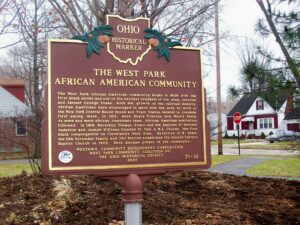
The West Park African American community began in 1809 with the first black settler and one of the earliest residents of the area, inventor and farmer George Peake. With the growth of the railroad industry, African Americans were encouraged to move into the area to work at the New York Central Round House and Train Station located in Linndale. First among these, in 1912, were Beary Frierson and Henry Sharp. As more and more African Americans came, African American institutions followed. In 1919, Reverend Thomas Evans and the families of Herndon Anderson and Joseph Williams founded St. Paul A.M.E. Church, the first black congregation on Cleveland’s West Side. Reverend D.R. Shaw, the Ebb Strowder family and Iler Burrow established the Second Calvary Baptist Church in 1923. Both became pillars of the community.
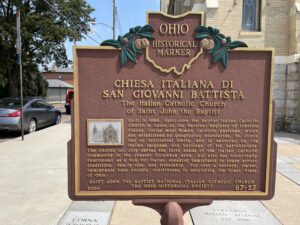
The National Italian Catholic parish of Saint John the Baptist was founded in October 1896 by the Reverend Father Alexander Cestelli, D.D. Father Cestelli was born in Fiesole, Italy and came to America in 1888 to serve as a professor at St. Paul’s Seminary in Minnesota. In January 1896, founding Rector Monsignor John Joseph Jessing invited Father Cestelli to serve at the Pontifical College Josephinum in Columbus, Ohio as a professor of moral theology. In October 1896, the Right Reverend John Ambrose Watterson, D.D., Bishop of Columbus, appointed Father Cestelli as pastor of the Italian Catholic community. Sunday Mass was celebrated in the baptistery of Saint Joseph Cathedral until September 18, 1898, when the Most Reverend Sebastiano Martinelli, Apostolic Delegate to the United States, dedicated this historic church.
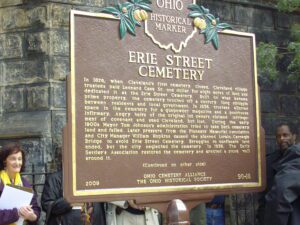
In 1826, when Cleveland’s first cemetery closed, Cleveland village trustees paid Leonard Case Sr. one dollar for eight acres of land and dedicated it as the Erie Street Cemetery. Built on what became prime property, the cemetery touched off a century long struggle between residents and local government. In 1836, trustees allotted space in the cemetery for a gunpowder magazine and a poorhouse infirmary. Angry heirs of the original lot owners claimed infringement of covenant and sued Cleveland, but lost. During the early 1900s Mayor Tom Johnson’s administration tried to take back cemetery land and failed. Later pressure from the Pioneers’ Memorial Association and City Manager William Hopkins caused the planned Lorain Carnegie Bridge to avoid Erie Street Cemetery. Struggles to confiscate land ended, but the city neglected the cemetery. In 1939, The Early Settler’s Association restored the cemetery and erected a stone wall around it. (continued on other side)