

, OH
In 1834, ministers gathered at Providence Church in Berlin Crossroads and organized the Providence Anti-Slavery Baptist Association; believed to be both the first African American Baptist Association in Ohio and among the earliest in the country. The Association’s name boldly reflected its stance: opposition to slavery and a commitment to freedom. Several affiliated churches and their members were known Underground Railroad safe houses and conductors. Providence Association grew to include member churches across Ohio—including Athens, Bidwell, Beaver, Blackfork, Burlington, Gallipolis, Glouster, Ironton, Middleport, Nelsonville, Rutland—as well as congregations in West Virginia, Kentucky, and Michigan.
, OH
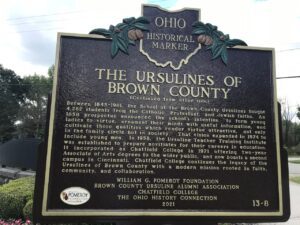
On July 21, 1845, eleven Ursuline sisters from Boulogne-sur-Mer and Beaulieu, France, arrived in St. Martin, Brown County, Ohio. A Catholic order of sisters known for providing quality education to young women, the Ursulines were invited by Cincinnati Archbishop John Baptist Purcell (1800-1883) to establish a school in the diocese and granted approximately 400 acres in St. Martin for that purpose. Led by Mother Julia Chatfield (1808-1878), the sisters quickly established their convent, a day school, and, within the year, admitted their first boarders. Originally known as The Saint Ursula Literary Institute, the school operated for the next 136 years. The Ursulines educated local students from their adopted Brown County as well as many who came from across the U.S. and farther abroad to board on campus. (Continued on other side)
, OH
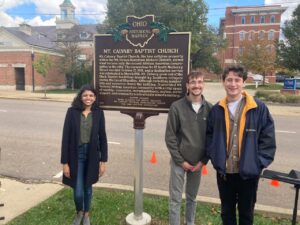
Mt. Calvary Baptist Church, the lone religious property within the Mt. Vernon Downtown Historic District, served what became only the second African American congregation in the city. The cornerstone for 13 South Mulberry Street was laid October 17, 1915, and a dedication service was celebrated in March 1916. Mt. Calvary grew out of the Black Baptist traditions brought by Southern refugees during the Great Migration. Although dwindling membership and resources closed the building, it provided Mt. Vernon’s African American community with a vital space of worship, communion, mutual assistance, asylum, social support, and community celebration for almost a century.
, OH
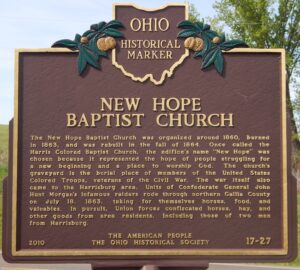
The New Hope Baptist Church was organized around 1860, burned in 1863, and was rebuilt in the fall of 1864. Once called the Harris Colored Baptist Church, the edifice’s name “New Hope” was chosen because it represented the hope of people struggling for a new beginning and a place to worship God. The church’s graveyard is the burial place of members of the United States Colored Troops, veterans of the Civil War. The war itself also came to the Harrisburg area. Units of Confederate general John Hunt Morgan’s infamous raiders rode through northern Gallia County on July 18, 1863, taking for themselves horses, food, and valuables. In pursuit, Union forces confiscated horses, hay, and other goods from area residents, including those of two men from Harrisburg.
, OH
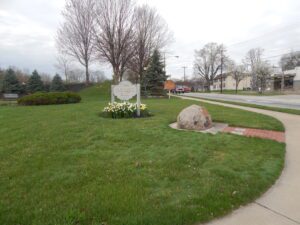
Trenton’s founder, Michael Pearce, came to the area in 1801. The original village of 33 lots was named Bloomfield. When the post office was established in 1820, it was named Trenton to honor the founder’s home state of New Jersey. Pearce’s son-in-law, Squier Littell, was the first resident doctor in Butler County. Originally settled by the English, Trenton saw a migration of Germans by 1840. By 1851, the farming community became a grain center with the introduction of the Cincinnati, Hamilton, and Dayton Railroad. Further development occurred when a franchise was granted to operate interurban electric traction cars through the village in 1896. Early commercial endeavors were Dietz, Good & Company grain elevator, Trenton Foundry, and Magnode Corporation. By 1991, the largest industries were Miller Brewing Company and Cinergy/Cincinnati Gas & Electric.
, OH
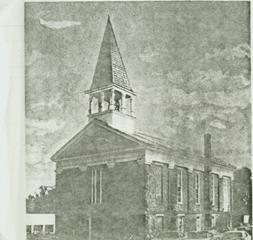
This site has long served the religious, education, and public interests of the residents of Mechanicsburg. A local Methodist congregation built its first church here in 1820, and the townspeople also used the structure as its village school. The Methodists replaced their original structure in 1837, using brick as the main building material. As the Methodist congregation grew, however, it was determined that a larger, more permanent structure was needed. As a result, the Mechanicsburg First Methodist Church was built here in 1858, and it served the congregation until 1894 when an African American based Second Baptist congregation purchased the building at a cost of $2,850. Besides religion and education, the site was also used as Mechanicsburg’s first cemetery. That cemetery lasted until the Maple Grove Cemetery was established and burials at this site were relocated there. [continued on other side]
, OH
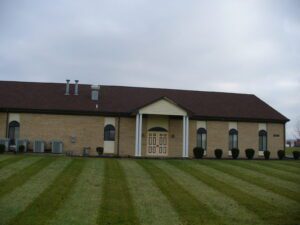
The Jain Center of Cincinnati and Dayton was established on April 22, 1979 as a non-profit tax-exempt organization under the laws of the United States and the State of Ohio. The foundation stone of the Jain temple, the first of its kind in Ohio, was laid down on August 21-22, 1994. The temple was dedicated on September 2 – 4, 1995 when more than one thousand people from all over Ohio and many other states participated in holy rituals to install three idols of Jinas (Gods). The Jain Center is a place for the teaching of non-violence, reverence for life, and compassion for all beings. The center was the home of the twelfth biennial convention for the Federation of Jain Associations in North America, which was held on July 3 – 6, 2003. (Continued on the other side)
, OH
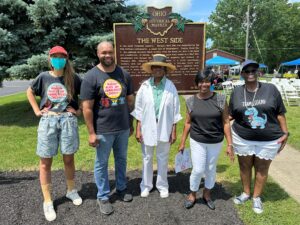
In the early twentieth century, Marion’s West Side was dominated by the Erie Railroad switchyards, a major hub of employment. During World War I, the railroad recruited Black workers from the South for jobs in its yards and roundhouses. In Marion, these workers made their homes in a West Side encampment that became the target of white suspicion and violence. In February 1919, following the unsolved murder of a white roundhouse worker’s wife and a separate alleged assault, a 300-man lynch mob smashed windows and occupied the West Side. All Black residents were ordered to leave the city by 6:00 pm the next day. Despite pleas to Governor Cox, at least 200 Black residents were forced to flee Marion. Marion’s anti-Black violence foreshadowed the nationwide “Red Summer” of 1919.