

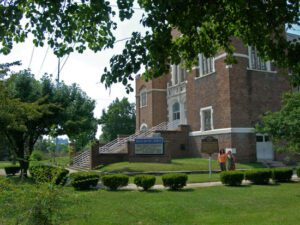
, OH
The Shiloh Baptist Church was completed in 1923. Founded in 1869, Shiloh is the third oldest African-American church in Columbus and is a descendent of the Second Baptist Church. The church is located in the Mt. Vernon neighborhood, which is adjacent to the central businesses of Columbus and Interstate 71. The dominant physical presence of Shiloh Baptist Church shows its importance as a religious and social institution for more than one hundred years in the Mt. Vernon area.
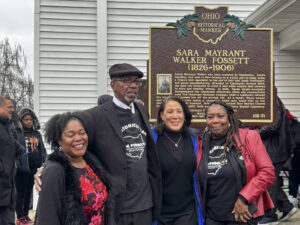
, OH
Sarah Mayrant Walker was born enslaved in Charleston, South Carolina, and sent to New Orleans as a young girl to study under a French hair specialist in the art of hair and scalp treatment, and goods manufacturing. Brought to Cincinnati around 1840, she used her networks to build a hair salon empire that catered to elite and wealthy women. In 1859, Sarah single-handedly desegregated the Cincinnati streetcars when she successfully sued The Passenger Railroad Company after a conductor refused her passage and pushed her off the moving car. As a result, Black women and children could ride inside a streetcar while men could ride on the platform. She and her husband, Peter Fossett, founded First Baptist Church of Cumminsville circa 1870. Both are buried in the Union Baptist Cemetery.
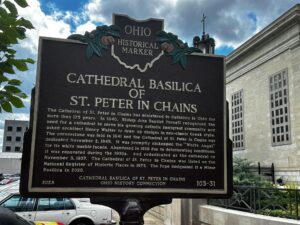
, OH
The Cathedral of St. Peter In Chains has ministered to Catholics in Ohio for more than 175 years. In 1840, Bishop John Baptist Purcell recognized the need for a cathedral to serve his growing catholic immigrant community and asked architect Henry Walter to draw up designs in neo-classic Greek style. The cornerstone was laid in 1841 and the Cathedral of St. Peter in Chains was dedicated November 2, 1845. It was promptly nicknamed the “White Angel” for its white marble façade. Abandoned in 1938 due to deteriorating conditions, it was renovated during the 1950s, and rededicated as the cathedral on November 3, 1957. The Cathedral of St. Peter in Chains was listed on the National Register of Historic Places in 1973. The Pope designated it a Minor Basilica in 2020.
, OH
United Colored American Cemetery is among the earliest in situ African American cemeteries in Hamilton County. The 11.6 acres in Madisonville were purchased by the United Colored American Association (UCAA) after the legislated closure of their earlier Avondale cemetery. Many Avondale burials and headstones were moved prior to the new cemetery’s dedication on May 30, 1883. Designed by Adolph Strauch, United Colored American Cemetery features the looping roads and picturesque elements typical of his designs at Spring Grove and Eden Park. After the dissolution of the UCAA, Cincinnati mayor Charles P. Taft asked Union Baptist Church to take ownership and maintenance of the cemetery. Union Baptist assumed ownership in 1968 and burials continued until 2019. United Colored American Cemetery was listed on the National Register of Historic Places in 2022.
, OH
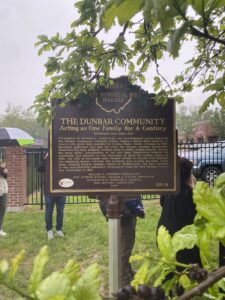
Dunbar, or Corsica Hollow, was an African American neighborhood on the western edge of Madisonville. Its streets and lots were laid out in 1886 after Mahlon and Anna Leonard subdivided their 10-acre tract near Duck Creek and sold lots to African Americans. Many early Dunbar residents were from the South; some born there prior to emancipation. Prominent early citizens included Harriet Deatherage, Elihu Parks, Gandison Embry, Thomas Duett, and James Murphy. Dunbar was home to the New Mission Missionary Baptist Church, founded in 1907. Originally meeting in a one-room building, the extant congregation relocated to Ravenna Street in 1963. By the late 1920s, Dunbar had about forty houses, a grocery run by Henry Lowman, and a hair salon run by Flora Hector. (Continued on other side)
, OH
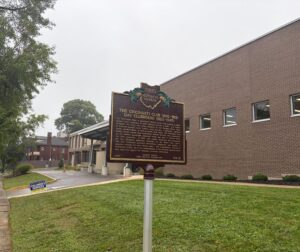
The Cincinnati Club, a prominent Jewish social club founded in 1889, opened their clubhouse at 2840 Melrose Avenue in 1894. A.E. Elzner designed the brick and stone building in the Norman-Gothic style. It featured massive round towers, wide porches, a ballroom, billiard rooms, bowling alley, as well as ornate club rooms. The Cincinnati Club hosted lavish events that celebrated Jewish identity and community. As the Jewish population migrated north and east of Walnut Hills, the club dissolved. In 1922, the vacant clubhouse was purchased by the Disabled American Veterans of the World War (DAV). The DAV Clubhouse provided recreation, resources, and shelter to disabled veterans for over twenty years. The organization, founded in Cincinnati in 1920, led to the establishment of the Veterans Administration and improved support for wounded veterans nationwide.
, OH
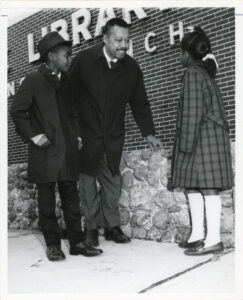
On November 19, 1968, the Columbus Metropolitan Library dedicated the first public library in the nation named after Dr. Martin Luther King Jr. After King’s assassination on April 4, 1968, the East Side Community Council requested that the new library being planned for the King-Lincoln Bronzeville community bear his name. The King family had both family and civic ties to Columbus and were honored by the tribute. More than 1,000 people gathered outside 1600 E. Long Street to hear Martin Luther King Sr. deliver the November dedication speech. Continuing the King family tradition, Martin Luther King III cut the ribbon to open a new branch building at 1487 E. Long Street on October 18, 2018. The Martin Luther King Branch was the first Columbus public library to bear an individual’s name.
, OH
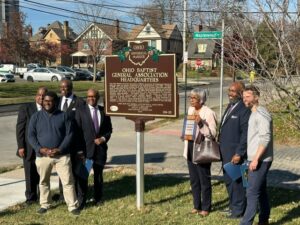
The Ohio Baptist General Association (OBGA) acquired 48 Parkwood Avenue in 1954 and used the former residence as its headquarters until 1996. Formed in 1896, the Association includes more than forty African American churches, many formed prior to the Civil War. Baptist general associations nationwide became an important voice during the 1960s Civil Rights Movement as they addressed the wrongs of racial violence and discrimination in business, housing, and education. The OGBA fought for the ideals of justice and freedom with its strongly-held Baptist beliefs. “America with her wealth as a great nation,“ OGBA President Wilber A. Page declared in 1957, “is well able to face integration and give a democracy to all her citizens.” The former Association Headquarters was listed in the National Register of Historic Places on December 3, 2020.